 June 16 2026
TMT Bar Grades Explained: Fe 500, Fe 550 and Fe 500D - Which Should You Choose?
Every RCC structure needs the right steel grade.
The grade decides strength. It also affects bendability. It can influence safety in seismic areas. This is why TMT bar grades India should be understood before material purchase.
Many buyers hear terms such as Fe 500, Fe 550 and Fe 500D. But they may not know what these names mean. The answer is simple.
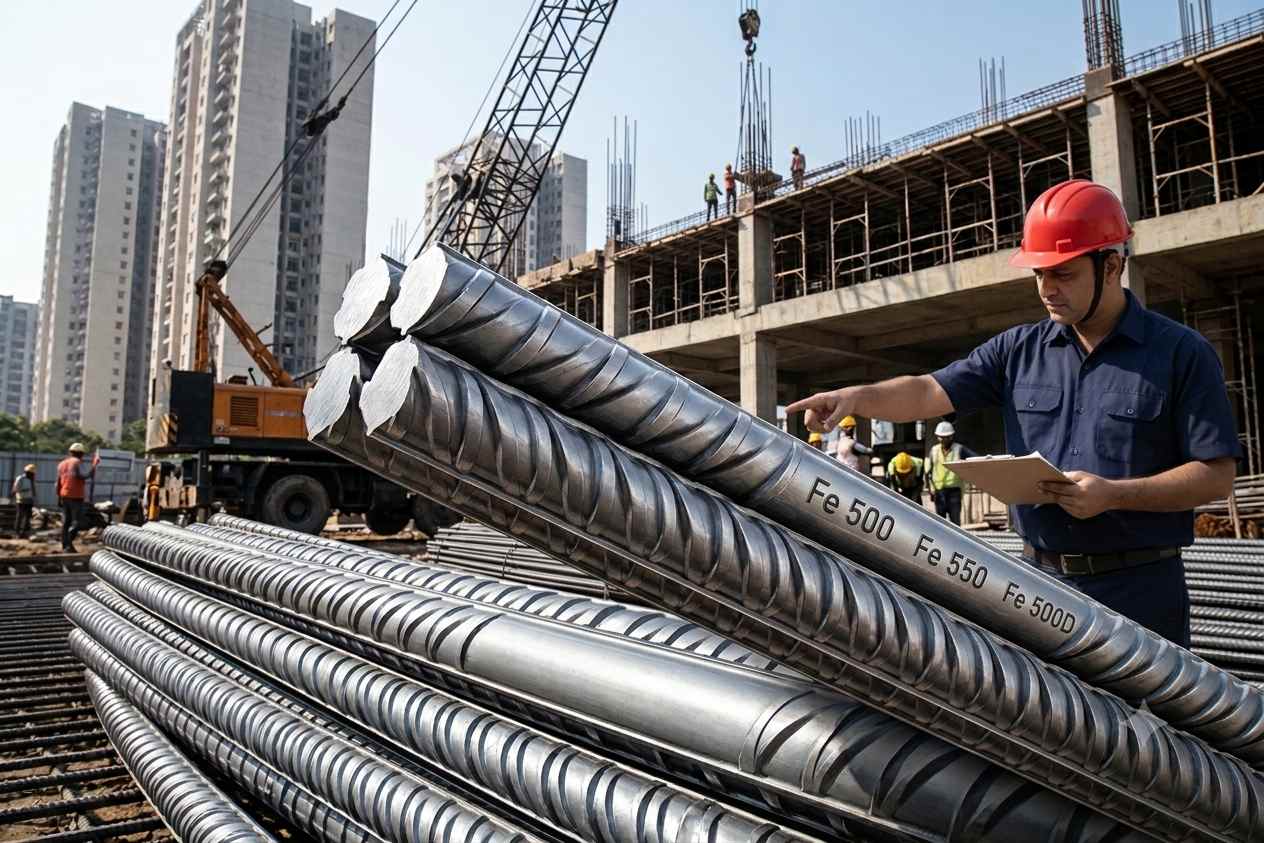
Fe means iron. The number shows minimum yield strength in MPa. The letter D means higher ductility.
This blog compares Fe 500 vs Fe 550 and explains where Fe 500D fits in. It also gives a practical TMT bar selection guide for homes and structural projects.
Why Grades Matter
TMT bars work inside concrete. They carry tensile stress and help the structure resist bending.
If the bar grade is wrong, the structure may not perform as designed. A higher grade is not always automatically better. A more ductile grade is not always needed in every member. The correct choice depends on structural design.
In India, high strength deformed steel bars for concrete reinforcement are governed by IS 1786:2008. BIS certification practice checks mechanical properties, chemical composition and tolerances.
That is why BIS certified TMT bars should be preferred for structural work.
What Is Fe 500?
Fe 500 is one of the most common grades used in Indian construction.
It offers a practical balance of strength and ductility. It is suitable for many residential and commercial buildings. It can be used in slabs, beams, columns and footings when specified by the engineer.
For many home projects, Fe 500 is a dependable choice. It is also widely available.
Use Fe 500 when:
- The structure has regular residential loads
- The engineer specifies Fe 500 in drawings
- Workability and bending are important
- The project does not demand a higher-strength grade
Fe 500 should still be checked for certification, bar marking and test documents.
What Is Fe 550?
Fe 550 has a higher minimum yield strength than Fe 500.
This means it can carry higher stress before yielding. It is useful in heavier construction where design calls for higher strength.
Fe 550 can help optimise steel use in some structures. But it should not be used casually. Higher strength must match structural design. It should also be handled correctly during cutting and bending.
Use Fe 550 when:
- The structure has heavier design loads
- The engineer specifies higher yield strength
- The project involves larger spans or special members
- Steel optimisation is part of the design intent
The decision should come from drawings, not from site convenience.
What Is Fe 500D?
Fe 500D has the same yield strength class as Fe 500. But it has higher ductility requirements.
Ductility means the ability of steel to stretch without sudden breaking. This is important in seismic zones. During an earthquake, a structure may need to absorb energy. Ductile steel helps the RCC frame behave better under such stress.
Kamdhenu has explained in its own grade guidance that Fe 500D adds extra ductility and is useful for quake-prone regions.
Use Fe 500D when:
- The building is in a seismic zone
- The structure needs higher safety margin
- The engineer specifies ductile reinforcement
- The project involves critical RCC members
For many homes, Fe 500D is a sensible upgrade when safety and ductility are priorities.
Quick Comparison Table
| Grade | Strength Level | Ductility | Best Use |
|---|---|---|---|
| Fe 500 | Standard modern strength | Good | Regular homes and buildings |
| Fe 550 | Higher strength | Moderate to good | Heavier loads and larger structures |
| Fe 500D | Fe 500 strength with higher ductility | High | Seismic zones and safer RCC design |
| Fe 550D | High strength with higher ductility | High | High-rise and demanding structures |
This comparison is only a guide. The structural engineer should make the final decision.
Kamdhenu Nxt Grade Options
Kamdhenu Nxt TMT bars are available in Fe 500, Fe 550, Fe 500D and Fe 550D. Kamdhenu states that the bars are supplied against IS 1786:2008 for chemical composition, mechanical properties and dimensional tolerances.
The product range covers common diameters from 8 mm to 25 mm. Larger 32 mm bars are available on bulk demand.
Kamdhenu Nxt also uses a double-rib design. This helps improve interlocking with concrete. Good bond is important because steel and concrete must act together.
How to Choose the Right Grade
A practical TMT bar selection guide should start with the drawing.
Do not choose only by price. Do not choose only by brand name. Match the grade with design need.
Check these points:
- Building type
- Number of floors
- Span length
- Soil and foundation design
- Seismic zone
- Load requirements
- Corrosion exposure
- Engineer's specification
- BIS certification
- Supplier traceability
For a normal home, Fe 500 may be enough if specified. For better ductility, Fe 500D may be preferred. For heavier structures, Fe 550 or Fe 550D may be selected by design.
Common Buying Mistakes
Avoid these mistakes during purchase:
- Buying unmarked bars
- Mixing grades without approval
- Accepting bars without test certificates
- Choosing higher grade without design need
- Ignoring ductility in seismic areas
- Comparing only by rate per kilogram
- Allowing poor storage at site
Steel purchase needs discipline. A small saving on poor steel can create a larger risk later.
Final Takeaway
The choice between Fe 500 vs Fe 550 and Fe 500D is a design decision.
Fe 500 suits many regular structures. Fe 550 suits higher load requirements. Fe 500D gives higher ductility and is valuable in seismic design.
Always follow the structural drawing. Always choose BIS certified TMT bars. Always buy from a trusted source.
For buyers comparing TMT bar grades India, Kamdhenu Nxt offers a practical range across Fe 500, Fe 550, Fe 500D and Fe 550D. It supports strength, ductility, bonding and traceability in one product family.
Grade Selection for Homeowners
Homeowners do not need to become structural designers. But they should know what to ask.
Ask the engineer why a grade has been selected. Ask the contractor to purchase the same grade. Ask the supplier for a test certificate. Keep a copy with the project file.
Do not allow a site team to say that one grade is almost the same as another. Grades have defined properties. A change in grade can affect design assumptions.
This simple discipline keeps the project safer and more transparent.
Quick FAQs
Is Fe 550 always better than Fe 500?
No. Fe 550 is stronger, but it should be used only when the design calls for it.
What does D mean in TMT grades?
D means higher ductility. It is useful where better deformation capacity is required, especially in seismic design.