 March 28 2026
MS Round Pipe in Fabrication and Structures
The MS pipe market is busy.
So are construction schedules.
India’s finished steel consumption in 2023–24 was 136.29 million tonnes, as per Joint Plant Committee data shared in a PIB release.
Industrial and warehouse builds are also growing.
Warehousing transaction volumes in eight primary markets reached 56.4 million sq ft in 2024, up 12% year on year, as reported from a Knight Frank India study.
This demand pushes projects to move faster.
And when speed rises, mistakes rise too.
One mistake shows up again and again.
It is ovality.
A buyer orders an MS Circular pipe.
A yard receives something “close enough.”
Then the fabricator fights fit-up.
Clamps do not sit right.
Weld gaps vary.
Railing lines look wavy.
Mezzanine frames drift out of plumb.
Ovality is not cosmetic.
It becomes rework.
It also becomes delayed.
This blog explains how to buy MS Round Pipe the way commercial teams buy.
With checks.
With standards.
With traceability.
First, be clear about what you are buying
Many disputes start with definitions.
An MS pipe can be specified by:
- Nominal bore (NB)
- Outside diameter (OD)
- Wall thickness
- Classes like Light, Medium, Heavy
For structural applications, “tube” standards are common.
For utility lines, “tube” and “pipe” standards differ by use case.
A practical approach is simple.
Start from the application.
Then choose the standard.
Use case mapping
- Structural members like columns, struts, frames: consider IS 1161.
- General service lines like water, air, and gas: consider IS 1239 Part 1.
This one step reduces most confusion.
Why does weld seam quality matter in MS Circular pipe
Most MS round pipes used in fabrication are welded.
Common processes include ERW or HFIW.
A welded tube is only as consistent as:
- The strip quality
- The forming and sizing
- The weld seam control
- The final dimensional checks
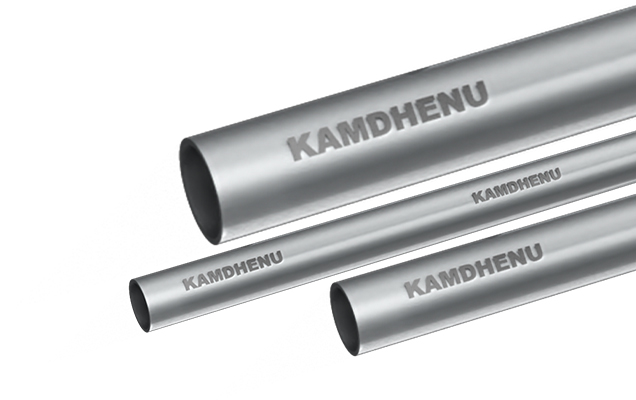
Kamdhenu Pipes are positioned as ERW pipes for mechanical, general engineering, decorative, and structural purposes, with routine dimensional checks.
This is the right language to look for from any supplier.
It shows process discipline.
If you are buying for heavy fabrication, ask one direct question.
How is the weld seam verified batch-wise?
Then ask what test records are kept.
The two dimensions that decide site speed
On paper, the pipe size looks simple.
On-site, two things decide your productivity.
1) Outside diameter consistency
OD variation affects clamps, couplers, and fit-up at joints.
It also affects look and alignment in exposed structures.
2) Wall thickness consistency
Thickness variation affects strength.
It also affects welding heat input and root penetration.
Kamdhenu Pipes highlights “dimensional accuracy” as a key feature and positions pipes as “precisely engineered for uniformity and ease of installation.”
That is exactly what commercial projects should demand.
A real-world checklist for MS Round Pipe RFQs
Use this in your RFQ.
Keep it clear.
Keep it measurable.
Technical details to specify
- Application category: structural, mechanical, utility
- Standard required: IS 1161 or IS 1239 Part 1 (as relevant)
- Size definition: NB and OD clarity
- Thickness and class: Light, Medium, Heavy if using those classes
- Length: standard length or cut-to-length
Quality documents to request
- Test certificate format per dispatch
- Batch identification and marking method
- Dimensional inspection plan
- Replacement policy for transit damage
Logistics to lock
- Bundling and packing method
- Tagging that survives rain and handling
- Delivery schedule by phase
Kamdhenu’s manufacturing process section for pipes describes cutting to specified lengths, branding, and batch testing for tensile strength and dimensional accuracy, followed by bundling for transit protection and dispatch with documentation.
These are the operational controls you should expect from a serious supplier.
What size range is practical for most fabrication jobs
Most commercial fabrication needs a predictable band of sizes.
You do not want exotic sizes that break supply continuity.
On the Kamdhenu Pipes page, Circular Hollow Sections are described with a size range from 15 mm to 100 mm, across Light, Medium, and Heavy wall thickness classes.
The pipes and tubes brochure also states circular sections can be manufactured up to 100 mm NB, and thickness can vary from 2 mm to 5.4 mm, and references IS 1161 for circular hollow sections.
This range covers the most common uses:
- Railings and supports
- Light frames
- Mezzanine members
- Truss bracing
- Signage structures
- Equipment supports
Facts that help buyers compare apples to apples
- Finished steel consumption in India in 2023–24 was 136.29 MnT.
- Warehousing transactions in 2024 reached 56.4 million sq ft across eight markets, up 12% year on year.
- IS 1161 covers ERW or HFIW steel tubes for structural purposes.
These facts help explain why supply discipline matters.
Busy markets increase substitution risk.
So buyers need checks.
Receiving an inspection that catches most problems in 15 minutes
Do this before the unloading sign-off.
Every truck.
No exceptions.
Physical checks
- Check roundness by rolling a sample on a flat floor
- Sight along the length for bend and sweep
- Measure OD in two directions to detect ovality
- Measure wall thickness if you have a thickness gauge
- Inspect the weld seam area for visible inconsistency
Documentation checks
- Match PO size and grade to invoice
- Match batch references to the certificate
- Photograph bundle tags for records
Kamdhenu Pipes states that each pipe has a stamp for traceability and authenticity verification.
This kind of traceability makes receiving faster.
It also makes disputes easier to resolve.
Corrosion and coating are commercial decisions
Corrosion is not only a coastal issue.
It is also a storage and handling issue.
Ask what surface condition you are buying:
- Black
- Coated
- Galvanized, if required by application
The IS 1239 product manual explicitly mentions surface condition options like black and galvanized, along with end conditions as plain, bevel ended, and screwed and socketed, depending on the scope.
Kamdhenu Pipes also mentions coating options “as per customer requirement.”
If you want a longer life, do two things:
- Store bundles on sleepers
- Keep bundles sloped so water drains
Where MS Circular pipe fits best in commercial builds
A good MS round pipe is useful when you want:
- Clean load paths
- Better torsional behaviour than many open sections
- Neat appearance for exposed members
- Faster fabrication with repeatable sizes
The Kamdhenu Pipes page lists suitability for providing support in building frameworks and use in bridges, flyovers, and industrial structures.
That aligns with how these sections are actually used.
Commercial next steps
If your project needs a consistent MS Round Pipe supply, do not buy only on rate.
Buy on fit-up and documentation.
Start by reviewing the Kamdhenu Pipes product page.
Check the CHS range and intended applications.
Then use the “Request a Quote” option shown on the page for bulk requirements.
A good pipe should feel boring on site.
No grinding.
No forced fit-up.
No repeated rework.
That is the real definition of a reliable MS Circular pipe.