 August 19 2026
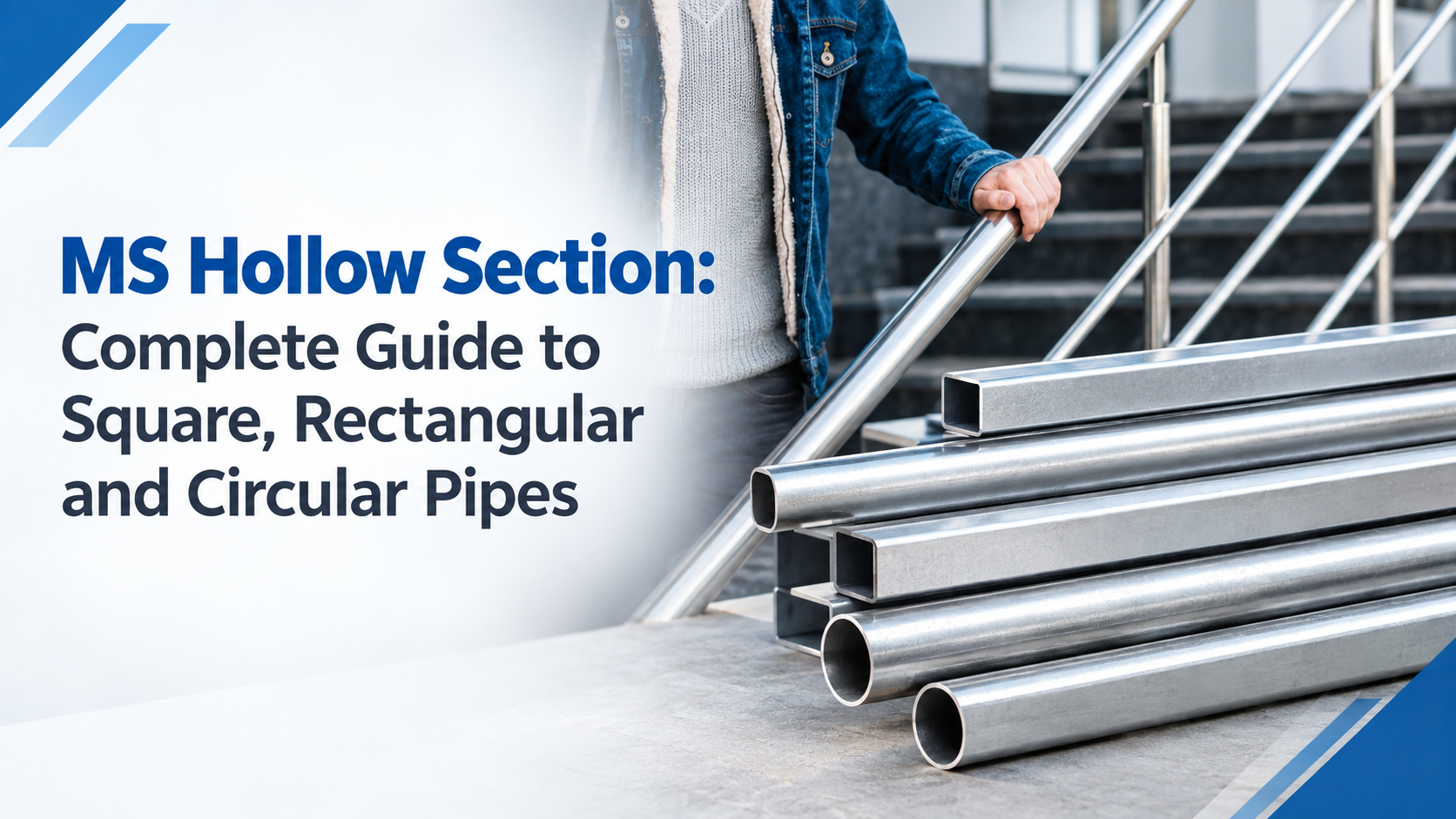
MS Hollow Section: Complete Guide to Square, Rectangular and Circular Pipes
Understanding the Product Before Comparing Prices
An MS Hollow Section is a closed mild steel profile with an empty centre. It may be round, square or rectangular. This simple change in shape gives steel a high level of structural efficiency for frames, supports and fabricated systems.
The market for mild steel hollow section India is large because these products work in both engineering and architectural applications. They can form the hidden skeleton of an industrial frame or remain visible in a clean staircase railing.
For buyers, the key is to understand MS SHS RHS and circular sections as distinct products rather than treating all of them as "MS pipe".
Why Mild Steel Works Well in an MS Hollow Section
An MS Hollow Section uses mild steel because it combines strength with good formability and weldability. It can be rolled into strip, formed into a closed profile and welded along the seam. The result is hollow structural steel with a predictable outer shape and relatively low mass.
A closed profile also resists torsion well. This helps in frames that may see twisting. Because material is placed away from the centre, the section can deliver useful stiffness without becoming a solid, heavy bar.
The efficiency still depends on wall thickness. An MS Hollow Section with insufficient thickness may dent or locally buckle. Structural selection must therefore use section properties, not visual size alone.
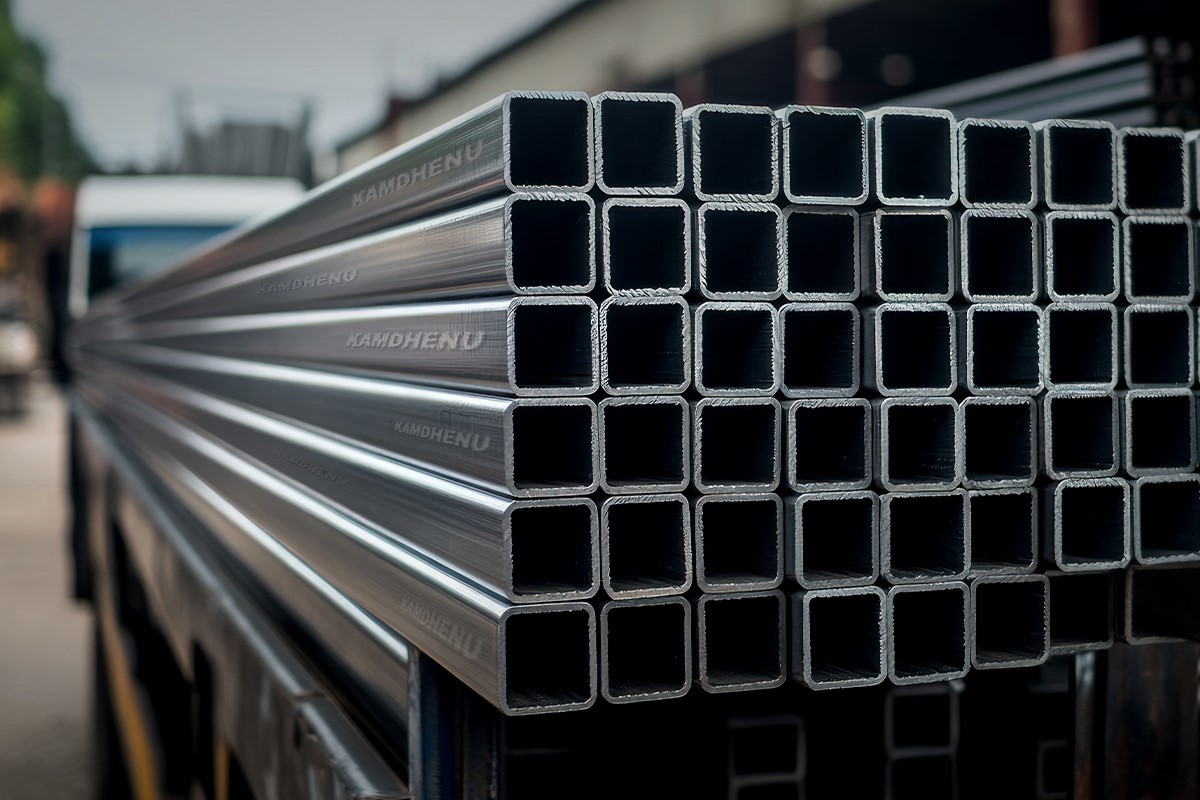
Square MS Hollow Section
A square MS Hollow Section has equal outer dimensions. That gives similar bending behaviour about the two principal axes and makes the section convenient for modular frames.
MS SHS RHS fabricators often prefer SHS when:
- The frame turns in several directions
- Equal visual proportions are wanted
- Plates need to sit on flat faces
- Mitred corners are part of the design
- Cladding or panels must be fixed easily
Common uses include gates, grills, railings, furniture frames, canopies, equipment guards and light structural columns.
Rectangular MS Hollow Section
A rectangular MS Hollow Section has a deeper and a shallower dimension. This gives the designer control over directional stiffness.
When the deeper side is oriented with the main bending direction, RHS can act efficiently as a beam or purlin. It is also useful in racks, façade sub-frames, mezzanine members and equipment supports.
The orientation should be shown clearly on drawings. A rectangular MS Hollow Section rotated by 90 degrees may have very different bending performance.
Circular Hollow Sections
A circular MS Hollow Section distributes geometry evenly around the centre. It is commonly used for columns, struts, braces, handrails, trusses and architectural supports.
The round shape has no preferred visual face and behaves the same in bending about any axis through the centre. Connections can be more involved because there is no flat surface.
For mild steel hollow section India, CHS is often chosen where structural efficiency and a smooth visible form matter together.
Quick Shape Comparison
| Shape | Fabrication Strength | Structural Advantage | Typical Use |
|---|---|---|---|
| SHS | Flat faces, easy jigs | Balanced square geometry | Frames, railings, gates |
| RHS | Flat faces, easy plates | Directional bending stiffness | Beams, racks, purlins |
| CHS | Needs curved fit-up | Uniform round geometry | Columns, braces, rails |
This is the basic logic behind MS SHS RHS and circular selection.
Indian Standards and Published Sizes
IS 4923 covers square and rectangular hollow sections for structural use. IS 1161 covers steel tubes for structural purposes and is relevant to circular tubes.
Kamdhenu's published tube information references these standards. It lists square sections up to 91.5 x 91.5 mm, rectangular sections up to 122 x 61 mm and circular sections up to 100 mm NB. Published thickness across the range is from 2 mm to 5.4 mm.
These figures give buyers a branded reference for hollow structural steel. They do not replace project drawings or structural calculations.
Wall Thickness Is a Major Buying Parameter
Two MS Hollow Section products can share the same outer size but have very different weights. The reason is wall thickness.
Thickness affects:
- Cross-sectional area
- Mass per metre
- Local buckling resistance
- Weld capacity
- Screw or bolt behaviour
- Overall cost
Never approve an MS Hollow Section from outer dimensions alone. Measure thickness on random pieces and compare it with the purchase specification.
Weld Seam and Fabrication Quality
Most MS Hollow Section products are formed and welded. The weld seam should be consistent. It should not show obvious cracks, severe undercut or surface defects that interfere with fabrication.
Straightness is equally important. A bowed mild steel hollow section India product forces fabricators to pull frames into line. That creates residual stress and increases labour.
Corrosion Protection
Hollow structural steel is still steel. It needs protection when exposed to rain, humidity or aggressive environments.
Painted systems require good surface preparation. Galvanised systems need suitable venting and drainage in closed sections. Cut edges and weld repairs should be treated with compatible materials.
Common Applications in Construction
The flexibility of MS SHS RHS and circular tubes explains their wide use.
- Industrial sheds and secondary frames
- Staircases and handrails
- Gates and fencing frames
- Canopies and pergolas
- Racks and mezzanine structures
- Façade supports
- Machine guards and equipment bases
- Sign structures
- Lightweight columns and bracing
- Architectural furniture and display systems
Each application needs a different balance of size, thickness and finish. A decorative rail is not designed the same way as a structural column.
How to Compare Suppliers
A reliable mild steel hollow section India supplier should answer technical questions clearly.
Ask for:
- Section shape and exact dimensions
- Wall thickness and tolerance
- Grade and standard
- Length tolerance
- Mass per metre
- Surface finish
- Coating option
- Material test certificate
- Packing method
- Replacement policy for damaged pieces
Site Receiving Checklist
Before the first cut, inspect each MS Hollow Section bundle.
- Match bundle tags with the order.
- Measure outer size and thickness.
- Check straightness and twist.
- Inspect corners on SHS and RHS.
- Look for dents near tube ends.
- Check the weld seam.
- Confirm coating condition.
- Store bundles clear of standing water.
These steps are simple, but they protect the fabrication schedule.
Where Kamdhenu Fits
Kamdhenu Pipes are offered as circular, square and rectangular hollow sections. The brand emphasises dimensional accuracy, easy fabrication, strength and durable performance.
For a buyer, this means the MS Hollow Section enquiry can stay within one consistent product family while the designer chooses the shape required for each member.
The published product range is especially useful when planning MS SHS RHS fabrication because available sizes can be checked before a detailed cutting list is frozen.
Final Takeaway
A good MS Hollow Section selection starts with shape and ends with quality control.
Use SHS for balanced frames and easy alignment. Use RHS where directional stiffness is useful. Use CHS for columns, braces and smooth exposed work.
For hollow structural steel, specify the standard, grade, outer dimensions and wall thickness. For mild steel hollow section India, compare supplier consistency and documentation as well as price.
A correctly selected MS Hollow Section can make a structure lighter, cleaner and easier to fabricate without compromising the engineer's design intent.

.png)