 August 13 2026
Hollow Section Pipe: Types, Sizes and Applications in Construction
One product family, three very different shapes
Hollow Section Pipe products are common in fabrication because they combine useful stiffness with relatively low weight. But the term Hollow Section Pipe is broad. A circular tube, a square tube and a rectangular tube do not behave or fabricate in exactly the same way.
For contractors and engineers, the best choice begins with shape. SHS pipe India is popular for frames and railings. RHS pipe works well where bending is stronger in one direction. Circular tubes suit columns, braces and smooth architectural work.
All three belong to the wider family of structural hollow section steel.
The three main types
Hollow Section Pipe in circular form
CHS is round. Its properties are symmetrical around the centre. It suits compression members, bracing and structures exposed to load from different directions.
Hollow Section Pipe in square form
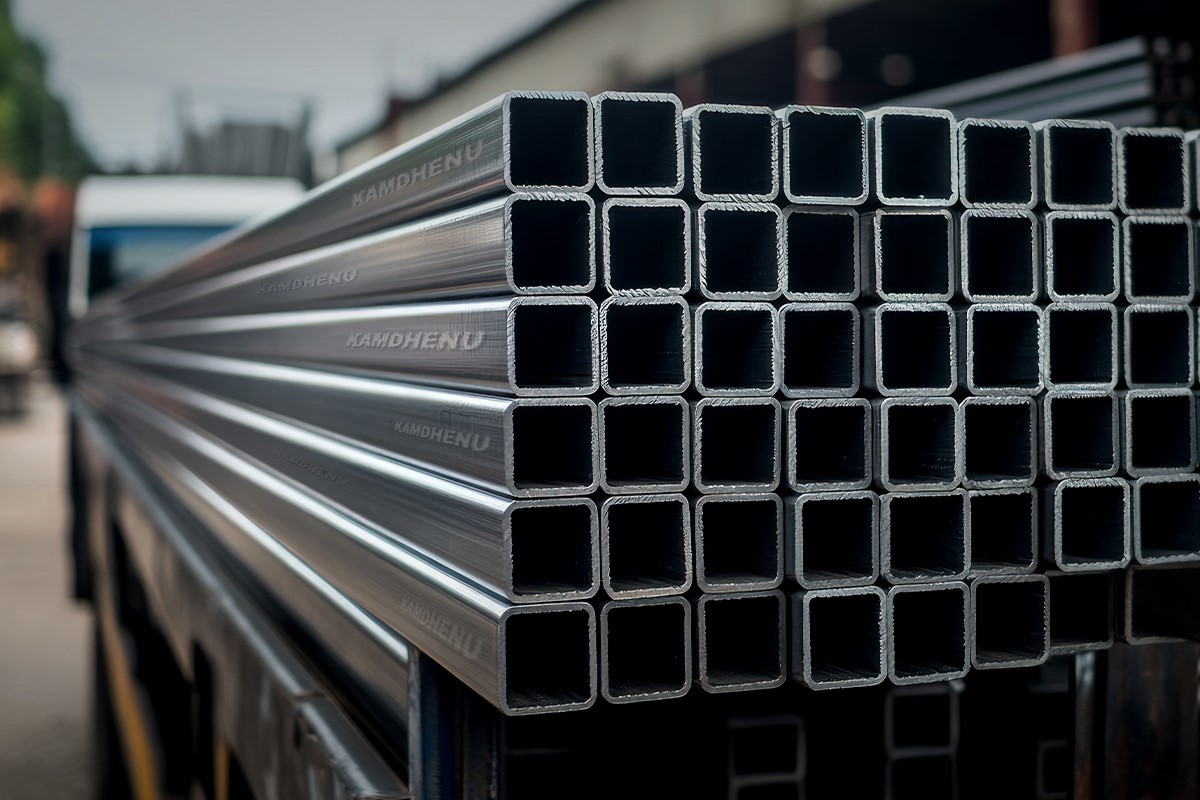
SHS has four equal sides. Its flat faces make measuring, clamping, welding and fixing straightforward. SHS pipe India is widely used for gates, railings, canopies, display frames and light structural work.
Hollow Section Pipe in rectangular form
RHS has two long and two short sides. The designer can orient the deeper dimension where greater bending stiffness is needed. An RHS pipe is therefore useful for beams, purlins, racks and long rectangular frames.
Why Hollow Section Pipe are efficient
A Hollow Section Pipe places steel around the perimeter instead of filling the centre. For many bending and compression applications, this gives a useful strength-to-weight relationship.
Closed sections also resist torsion better than many open sections. This helps frames that may twist under eccentric loads. The smooth external shape is another advantage because there are fewer projecting flanges and corners than in traditional open sections.
That does not mean thinner is always better. structural hollow section steel can fail through local buckling if the wall is too thin for the load and section dimensions. Design should therefore consider both overall size and wall thickness.
Typical sizes and standards
For Hollow Section Pipe purchasing in India, IS 4923 is relevant to square and rectangular Hollow Section Pipe. IS 1161 covers structural steel tubes, including circular sections.
Kamdhenu's published tube range states maximum sizes of 91.5 x 91.5 mm for square sections, 122 x 61 mm for rectangular sections and 100 mm NB for circular sections. Published thickness across the range is 2 mm to 5.4 mm.
These are product-specific published limits, not universal market limits. A designer should never assume that every Hollow Section Pipe supplier offers the same size series.
SHS, RHS and CHS compared
| Type | Main geometry advantage | Common construction use |
|---|---|---|
| CHS | Same bending properties in all directions | Columns, braces, rails |
| SHS | Balanced axes and flat faces | Frames, gates, railings |
| RHS | More depth in one selected direction | Beams, racks, purlins |
For SHS pipe India, equal faces simplify modular fabrication. For an RHS pipe, orientation is part of the design. Turning an RHS by 90 degrees can materially change its bending stiffness.
Applications in building work
The range of structural hollow section steel applications is wide.
- Roof trusses and canopies.
- Industrial shed secondary frames.
- Stair and balcony railings.
- Gates, grills and boundary frames.
- Equipment supports and machine guards.
- Racks and storage systems.
- Mezzanine members.
- Façade frames and signage supports.
- Columns in light and medium structures.
The Hollow Section Pipe member should be designed for its actual load. A railing tube selected for appearance should not be reused as a structural column without calculation.
Fabrication advantages of SHS
A SHS pipe India product is easy to set on a flat table. Jigs can locate it accurately. Plates and brackets sit naturally on the face. Mitre cuts create clean corners.
This makes SHS popular for repetitive fabrication. It is also easy to clad because the outer surface is flat.
But corner radii and wall thickness still matter. If two suppliers use noticeably different corner geometry, a tight architectural detail may not line up. This is why dimensional tolerance should be part of the enquiry.
Where RHS performs well
An RHS pipe gives designers a useful way to increase depth without increasing width equally.
For a beam-like member, the deeper side is generally oriented vertically to improve major-axis stiffness. In a wall frame or rack, the narrower dimension can help save space.
CHS for columns and braces
Circular Hollow Section Pipe has no flat face, but its geometry is efficient for columns and braces. It also looks clean when exposed.
The fabrication challenge is connection fit-up. A CHS-to-CHS joint may require notching or a saddle profile. Plate connections may simplify bolting but need correct weld design.
For visible work, coordinate structural connection plates with the architectural intent before fabrication starts. Hiding a large plate after the frame is welded is difficult.
Corrosion protection
structural hollow section steel needs protection when exposed to moisture. The choice may include paint systems, galvanising or other coatings depending on the service environment.
Hollow Section Pipe also need internal moisture management. Open ends can admit rain. Fully sealed ends can trap condensation if the fabrication is not dry. Hot-dip galvanising requires vent and drain holes.
For Hollow Section Pipe, design the corrosion detail before fabrication.
How to specify a hollow section correctly
A purchase order for Hollow Section Pipe should state:
- CHS, SHS or RHS.
- Outside dimension or nominal bore.
- Wall thickness.
- Grade and relevant standard.
- Length and quantity.
- Surface condition.
- Coating, if required.
- Tolerance expectations.
- Test certificate requirement.
- Delivery and packing needs.
For SHS pipe India, write both outer dimensions even though they are equal. For an RHS pipe, state the larger dimension first in a consistent format and confirm orientation on drawings.
Site inspection checklist
Before cutting Hollow Section Pipe, check random pieces.
- Measure wall thickness.
- Check outer dimensions.
- Sight for bow and twist.
- Inspect the weld seam on welded tubes.
- Look for dents and transport damage.
- Confirm coating condition.
- Match bundle tags with the purchase order.
A dent near a connection can reduce local capacity. A twisted SHS can make an entire frame difficult to square.
Why quality consistency saves fabrication time
The real cost of structural hollow section steel includes labour. If every tube needs correction, grinding or forced alignment, a low purchase price quickly loses its advantage.
Kamdhenu positions its pipes around dimensional accuracy, ease of fabrication, high tensile strength and reliable performance. For fabricators, consistency is a practical productivity benefit.
A repeat order of SHS pipe India should fit the same jig. An RHS pipe should arrive straight enough for the designed frame. A CHS should have predictable wall thickness for welding.
Final takeaway
A Hollow Section Pipe is not a generic commodity once it becomes part of a structure.
Choose CHS for balanced round geometry. Choose SHS for easy alignment and balanced square framing. Choose RHS pipe when directional stiffness is useful.
For structural hollow section steel, match size and wall thickness to engineering design. For SHS pipe India, compare standards, tolerances and supplier consistency along with price.
The right hollow section can reduce dead weight, simplify fabrication and create a cleaner finished structure. The wrong section can create exactly the opposite.
.png)
.png)