 August 05 2026
Barbed Wire Fencing: Complete Guide to Types, Uses and Installation in India
Why barbed fencing is still widely used
A boundary has three jobs. It shows ownership. It controls movement. It discourages casual entry. For large plots, farms, industrial land and construction sites, the boundary must also be economical enough to cover long distances.
That is why Barbed Wire remains relevant in India. It is simple and easy to transport. It can be fixed on concrete, steel or treated timber posts. It gives a clear visual warning without creating a solid wall.
Buyers often begin with barbed wire price in India, but price alone is a weak specification. Wire diameter, galvanising, barb formation, reel weight and spacing between posts all affect the finished fence.
What exactly is barbed wire?
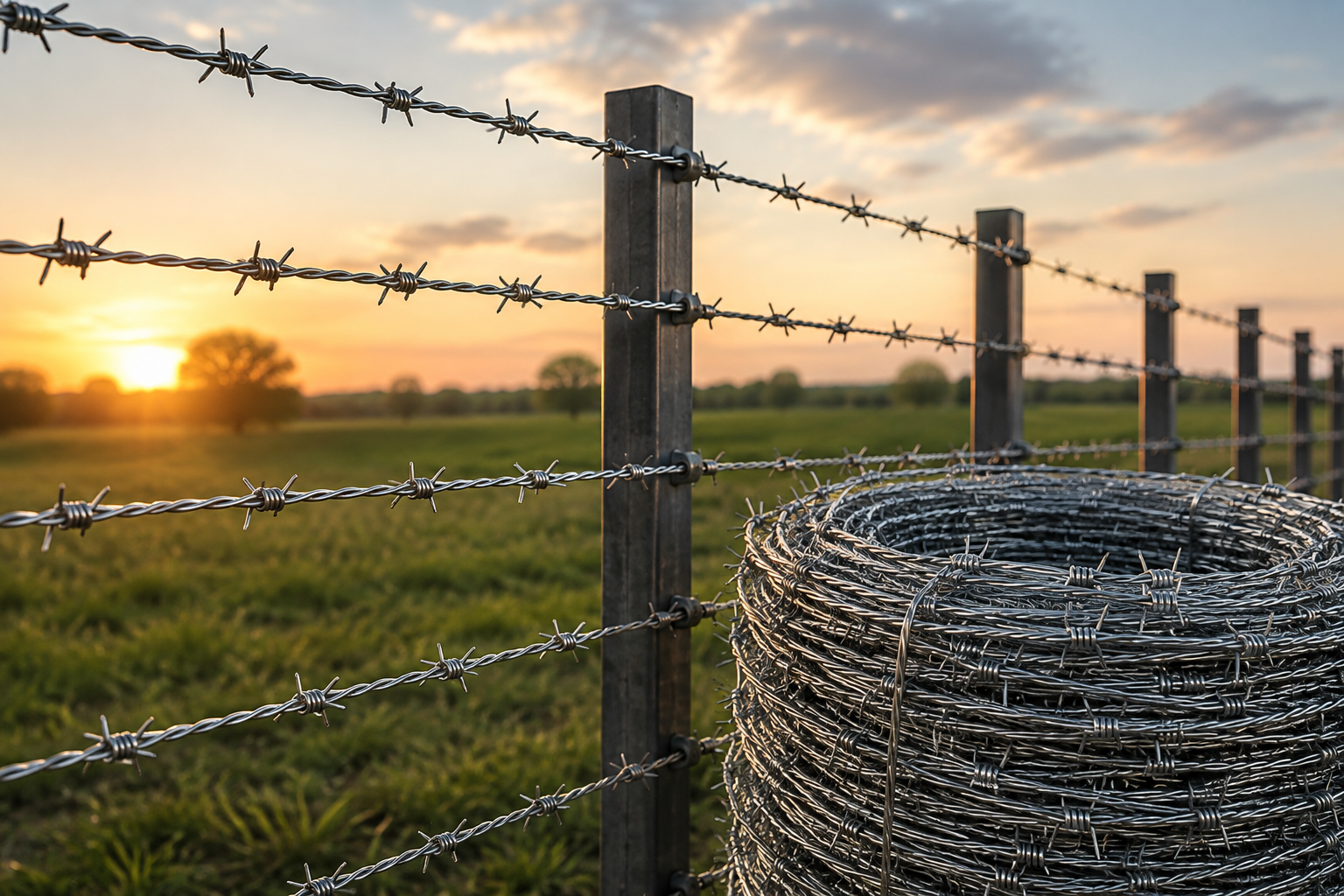
Barbed Wire is made from line wires twisted together with pointed barbs fixed at regular intervals. The line wires provide the continuous tensile element. The barbs provide deterrence.
For a fence to work properly, Barbed Wire must have consistent diameter and the barbs must be tightly formed. Uneven wire can stretch differently from reel to reel. Loose barbs can shift. Poor galvanising can shorten service life outdoors.
Kamdhenu's published barbed wire specification identifies a Type A, LOWA-type annealed and soft-drawn product made to IS 278:2009. The range is listed in SWG 12 and SWG 14, with standard reel packing around 25/26 kg. Published mechanical data also show line-wire tensile strength in the 390-590 N/mm² range for specified diameters.
Those numbers matter because proper security fencing wire should be selected as a technical product, not as an anonymous roll sold only by weight.
Common types used in India
Not every fencing requirement needs the same construction.
Galvanised barbed wire
A zinc coating helps protect steel from rust. This is the usual starting point for open-air boundaries. Coating quality is important in monsoon and humid locations.
Heavier gauge barbed wire
A larger wire diameter usually improves robustness, but it also increases weight and cost. It is used where animals, vegetation or accidental impact may put more stress on the fence.
Multi-strand boundary layouts
The product may be the same, but the fence changes with the number of horizontal lines. Four, five or more runs are common depending on the security need and fence height.
Barbed top extensions
Some industrial boundaries use masonry or welded-mesh fencing below and Barbed Wire on angled extensions above. This improves deterrence without replacing the main fence.
Farm, industrial and temporary applications
The same coil can serve very different sites, but the layout should change with the use.
- farm boundary fencing around crop fields, orchards and grazing land.
- Perimeter marking for vacant plots.
- Temporary control around construction sites.
- Boundary protection for warehouses and utility areas.
- Additional deterrence above walls or mesh fencing.
- Segregation of livestock areas where barbed systems are appropriate and safely positioned.
For farms, post spacing and ground condition often matter more than adding extra strands. A long run over soft soil can lose tension if posts move. Good farm boundary fencing therefore starts below ground, with stable corner posts and properly anchored intermediate posts.
Installation sequence that works
A neat fence is easier to maintain and performs better. The following sequence is practical for most straight boundaries.
- Survey and mark the legal boundary.
- Fix corner, end and gate posts first.
- Establish line and level between fixed points.
- Install intermediate posts at the designed spacing.
- Fix the lowest strand first and tension it gradually.
- Add the remaining strands at even vertical spacing.
- Use suitable clips, staples or ties for the post material.
- Recheck tension after the entire run is connected.
- Treat any damaged protective coating at cut or fixing points.
- Mark the fence clearly where people may approach it unexpectedly.
Do not over-tension security fencing wire. Excessive tension can pull posts out of line or create high local stress at corners.
What controls barbed wire price in India?
There is no single national rate because barbed wire price in India changes with steel prices, coating, wire diameter, reel weight, brand, freight and order size.
| Cost factor | Why it changes price |
|---|---|
| Wire diameter | More steel per metre increases weight |
| Zinc coating | Higher coating adds processing and material |
| Reel weight | Heavier reels carry more material |
| Barb spacing | Product design changes wire consumption |
| Brand and compliance | Testing and traceability add value |
| Freight | Steel fencing is bulky and heavy in volume |
Always compare like with like. A cheaper reel may simply have less steel, a lighter coating or a shorter effective length. Asking only for a per-reel number makes barbed wire price India comparisons unreliable.
How to inspect material on delivery
A five-minute inspection can catch obvious problems before the fence crew opens every reel.
Check that the line wire is circular and reasonably uniform. Look for surface scales, cuts or deep rust. Barbs should be properly wrapped and should not slide easily. The zinc finish should look continuous. Labels should identify the manufacturer and basic product details.
For branded Barbed Wire, ask for the applicable standard and invoice description. Kamdhenu's published information states compliance with IS 278:2009 and identifies type, gauge and packing. That level of detail helps a buyer write a better purchase order.
Designing farm boundary fencing
A farm boundary is exposed to more than people. Animals lean on fences. Grass and creepers add weight. Seasonal soil movement can loosen posts. Tractors can clip corners.
For dependable farm boundary fencing, strengthen the corners first. Use braces where long runs change direction. Keep the lowest strand at a height suited to the animals and crop protection goal. Avoid sharp exposed wire near gates, paths or places where workers handle equipment.
Vegetation should be cleared periodically. Wet plant matter holds moisture against the galvanised surface and can make inspection difficult. In coastal or very humid regions, specify the protective coating more carefully instead of assuming every galvanised reel provides the same life.
Security fencing wire for industrial sites
Industrial perimeter design should consider visibility, access control and emergency movement. security fencing wire is useful as a deterrent, but it should not create unmanaged hazards around public access routes.
At warehouses and factories, gate design is often the weak point. The main fence may be strong while the gate posts are light or the bottom gap is excessive. Treat the gate, corners and drainage crossings as part of the same security system.
Lighting and surveillance also matter. Barbed Wire is a physical layer. It does not replace access control, guards or cameras where a higher security level is required.
Final takeaway
Good fencing is a system. The wire, posts, tension, corners and gates all matter.
Choose Barbed Wire by specification first and price second. For farm boundary fencing, pay special attention to corner bracing and ground conditions. For industrial security fencing wire, combine the physical fence with sensible access control.
When comparing barbed wire price India, compare the same gauge, coating, reel weight and standard. That is the only way to know whether the cheaper quotation is actually better value.
Installed correctly, Barbed Wire remains one of the most practical long-distance fencing choices for Indian sites.
.png)
.png)