.png) August 07 2026
August 07 2026
Mild Steel Products in India: Pipes, Bars and Structural Sections Guide
Mild steel is everywhere because it is practical
Walk through a fabrication shop, warehouse project or construction site and one material appears repeatedly. It may be a beam. It may be a round bar. It may be a square pipe. It may be a bracket cut from a flat.
The common material is Mild Steel. It offers a useful balance of strength, ductility, weldability, availability and cost. That combination explains why MS products India cover such a wide range of industrial and building applications.
The important point is that mild steel is not one product. Buyers have to choose the right shape, grade, thickness and standard for the job. Good mild steel construction begins with matching the section to the load and fabrication method.
What mild steel means in practical terms
Mild Steel is low-carbon steel. The lower carbon content makes it easier to form and weld than many higher-carbon steels. It can be rolled into plates, bars, structural sections and tubes. It can also be cut, drilled, machined and joined using common fabrication processes.
This workability is why fabricators like it. Engineers like the predictable mechanical properties available under recognised standards. Procurement teams like the wide supply base.
Kamdhenu Structural Steel is marketed in sections such as angles, channels, beams and flats, and is stated to conform to IS 2062. Published product data for its E250-range structural steel include minimum yield stress of 250 N/mm², tensile strength of 420 N/mm² and elongation of 24%. Kamdhenu also offers mild steel tubes in circular, square and rectangular hollow forms.
These figures help turn a generic request for MS structural steel into a measurable specification.
Main MS products used in India
Angles
Angle sections have an L-shaped cross-section. Equal and unequal angles are common in trusses, frames, towers, platforms, brackets and general fabrication.
Channels
Channels have a web with two flanges. They are used in equipment frames, secondary beams, floor supports, vehicle bodies and industrial fabrication.
Beams
I- and H-type sections place much of their steel away from the neutral axis. That makes them efficient for bending. They are used as primary load-carrying members in buildings, sheds and industrial structures.
Flats and round bars
Flats are useful for plates, straps, brackets and connection details. Round bars are used in shafts, pins, grills, fabricated components and selected construction applications.
Hollow sections
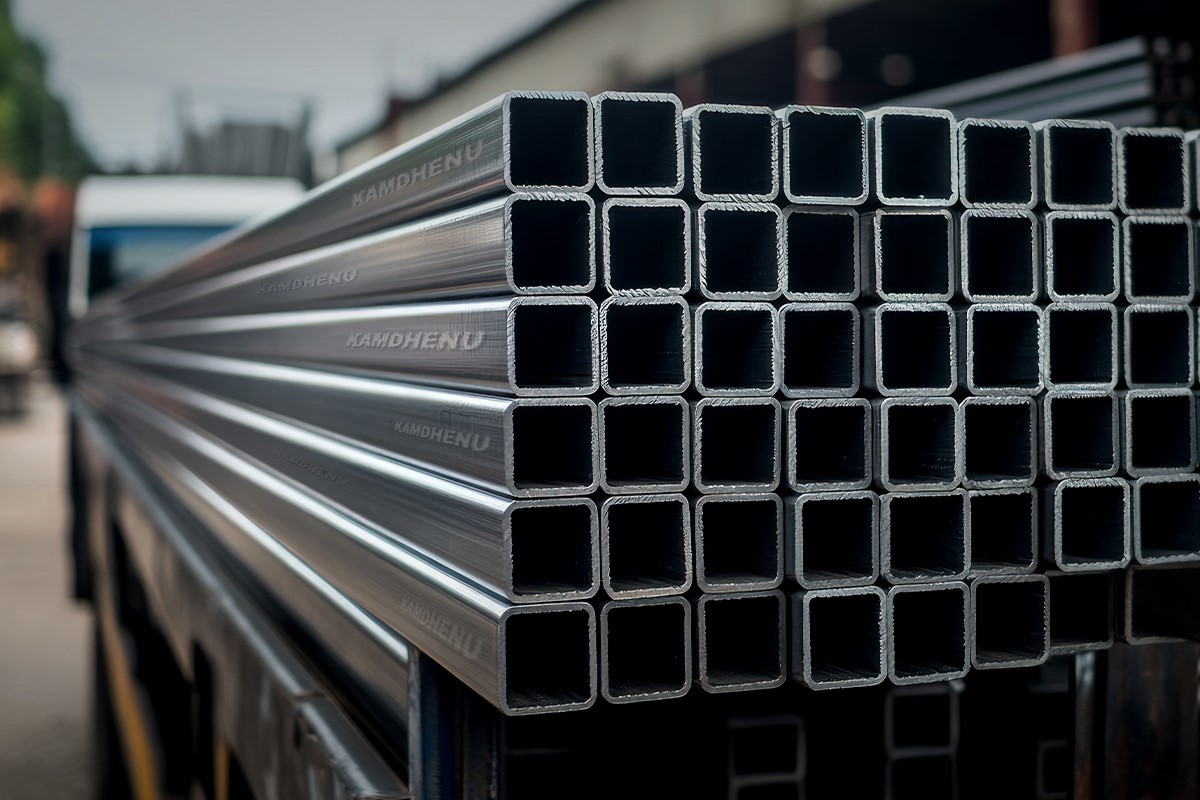
Circular, square and rectangular tubes give a closed section. They are common in frames, railings, trusses, racks, canopies and architectural work.
This variety is why MS products in India should be purchased by full description rather than by a local nickname alone.
Structural sections versus hollow sections
Both can carry structural load, but they behave differently.
| Section family | Typical advantage | Common uses |
|---|---|---|
| Angles | Simple connections and bracing | Trusses, towers, frames |
| Channels | Easy flange connections | Secondary framing, equipment supports |
| Beams | Efficient major-axis bending | Primary beams, sheds, industrial buildings |
| Hollow sections | Good torsional behaviour and clean appearance | Frames, columns, railings, canopies |
| Flats and bars | Simple fabrication and machining | Brackets, ties, pins, grills |
There is no universally best section. The structural engineer chooses based on span, load, buckling, torsion, connection and architectural constraints.
For mild steel construction, changing a section only because another one is cheaper can create more fabrication work or reduce structural efficiency.
Standards buyers should recognise
Standards help buyers compare material on the same basis. IS 2062 is widely used for hot-rolled structural steel. IS 4923 covers square and rectangular hollow steel sections for structural use. IS 1161 covers steel tubes for structural purposes.
The standard number alone is not enough. The purchase order should also state grade, dimensions, thickness, length and testing requirements.
For MS structural steel, check yield strength, tensile strength, elongation and chemical limits relevant to the specified grade. For hollow sections, check outside dimensions, wall thickness, straightness and weld quality.
India consumed around 164 million tonnes of finished steel in FY 2025-26. That scale means the market has both organised and unorganised supply. Traceability therefore matters as much as availability.
Fabrication factors that affect project cost
The cheapest steel at the gate may not be the cheapest steel after fabrication.
- Straight sections reduce forced fit-up and rework.
- Consistent thickness improves welding procedure control.
- Accurate holes and cuts improve erection speed.
- Good surface condition reduces preparation before painting.
- Predictable chemistry supports weldability.
- Standard sizes reduce replacement and repeat-order risk.
This is one reason branded MS products India can create value even when a local quotation looks cheaper per kilogram.
Corrosion protection for mild steel
Unprotected Mild Steel can rust when exposed to moisture and oxygen. Protection should be planned according to the environment.
Indoor dry fabrication may only need a paint system. Outdoor structures may need a more robust primer and top coat. Some components may be hot-dip galvanised. Coastal or chemical environments need more careful coating selection.
Surface preparation is crucial. Paint applied over mill scale, oil or active rust does not deliver the same service life as a properly prepared surface.
For MS structural steel, designers should also avoid details that trap water. Drain holes, sealed ends and accessible maintenance zones can improve durability without changing the base material.
Mild steel construction applications
mild steel construction appears across small and large projects.
- Residential gates, railings and stair frames.
- Industrial sheds and mezzanines.
- Warehouses and equipment platforms.
- Transmission and utility structures.
- Bridges, flyovers and infrastructure support work.
- Racks, machine bases and fabricated skids.
- Canopies, sign structures and architectural frames.
Kamdhenu's published structural steel applications include bridges, flyovers, residential and commercial buildings, industrial structures and other high-stress uses. The company also highlights dimensional accuracy, high strength, ductility and weldability.
How to buy MS products professionally
A good enquiry should remove ambiguity. For each item, state:
- Product shape and section designation.
- Applicable standard and grade.
- Nominal dimensions and thickness.
- Length and cutting requirement.
- Surface condition or coating.
- Quantity in pieces, metres and tonnes where relevant.
- Test certificate requirement.
- Packing and delivery location.
For hollow MS products India, specify CHS, SHS or RHS rather than saying only "pipe". For bars, specify diameter. For beams and channels, use the full section designation.
Kamdhenu product fit
Kamdhenu's portfolio brings together MS structural steel and mild steel tubes for varied projects. Structural products are offered in angles, channels, beams and flats, while the pipe range covers circular, square and rectangular hollow sections.
Published tube information references IS 4923 for square and rectangular hollow sections and IS 1161 for circular sections. Published maximum sizes include 91.5 x 91.5 mm for square sections, 122 x 61 mm for rectangular sections and 100 mm NB for circular sections, with thicknesses from 2 mm to 5.4 mm.
These ranges give fabricators several options within one Mild Steel ecosystem.
Final takeaway
Mild steel succeeds because it is adaptable. But adaptability should not become casual selection.
Choose Mild Steel by grade, section, thickness and application. Use MS structural steel where the design calls for load-bearing rolled sections. Use hollow sections where closed geometry, torsional stiffness or clean appearance offers an advantage.
For dependable mild steel construction, insist on dimensional accuracy, traceability, correct standards and proper corrosion protection.
A clear specification makes MS products India easier to compare, easier to fabricate and more reliable in service.
.png)