 August 14 2026
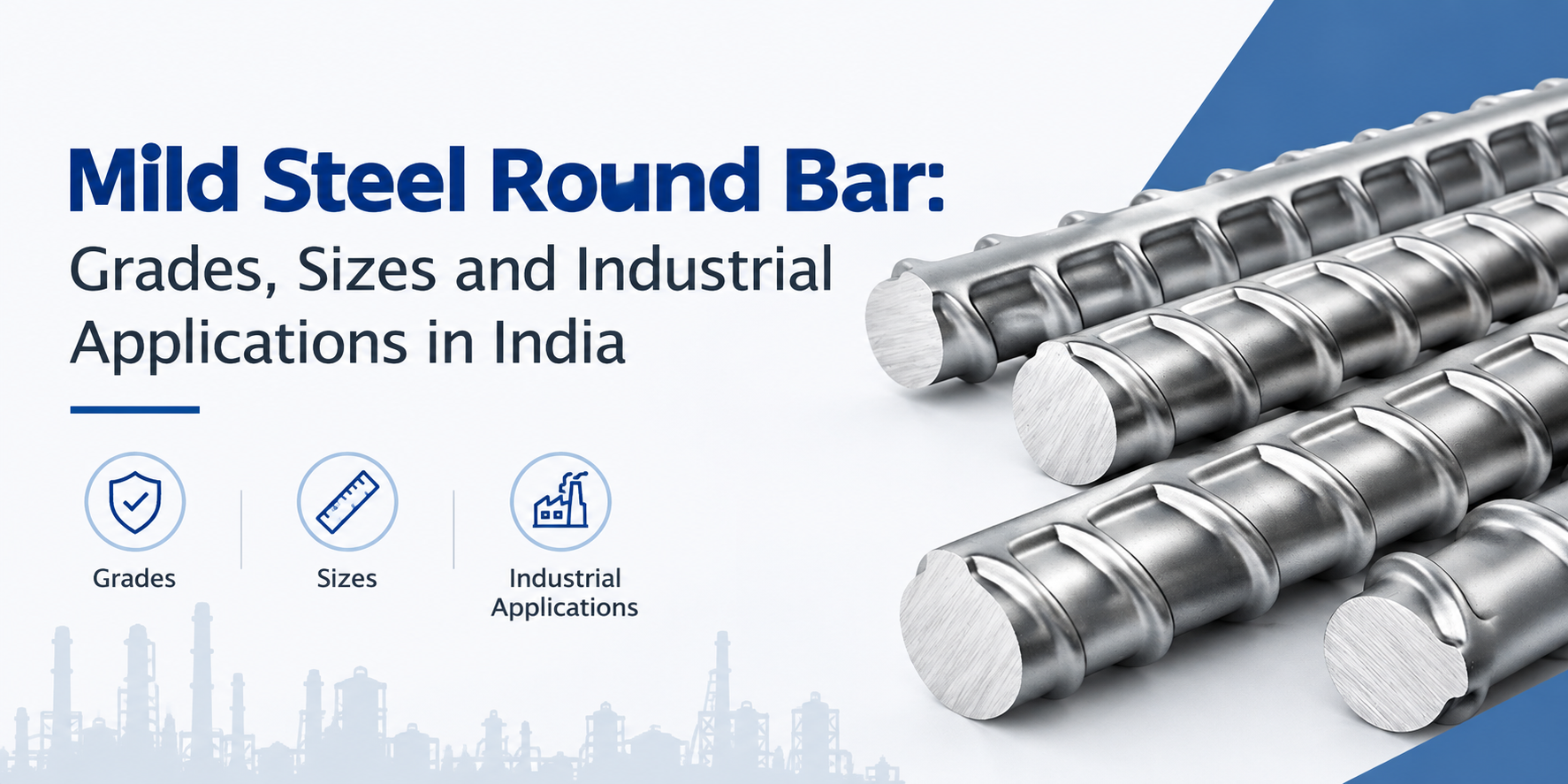
Mild Steel Round Bar: Grades, Sizes and Industrial Applications in India
Why Mild Steel Round Bars Remain an Industrial Basic
A Mild Steel Round Bar is one of the simplest steel products. That simplicity is useful. It can be cut, drilled, threaded, turned, bent and welded into thousands of components.
A Mild Steel Round Bar is commonly used in fabrication, machinery, grills, pins, tie elements, general engineering and selected construction work. Demand for MS round bar India comes from both organised factories and small workshops because the product is easy to process with standard equipment.
The challenge is buying the correct grade and diameter. A round bar selected for a machined pin does not have the same requirement as a decorative grill or a construction round bar.
What Mild Steel Round Bar Is
Mild Steel Round Bar is a solid circular section made from low-carbon steel. Unlike a circular hollow section, there is no internal void. The full cross-section can therefore be machined, threaded or used to carry concentrated bearing loads.
Low-carbon steel is popular because it offers a practical combination of strength, ductility and weldability. Depending on the intended use, material may be supplied to an applicable structural or plain-bar standard.
BIS provisions for mild and medium tensile steel bars include nominal round-bar sizes such as 5, 6, 8, 10, 12, 16, 20, 22, 25, 28, 32, 36, 40, 45 and 50 mm in the relevant specification context. Actual commercial availability should always be checked with mild steel bar suppliers.
Round Bar Is Different from TMT Rebar
For Mild Steel Round Bar, this distinction is important.
TMT bars have ribs designed to improve bond with concrete. A Mild Steel Round Bar has a smooth surface unless it has been further processed. It should not be substituted for high-strength deformed reinforcement where structural drawings specify TMT bars to IS 1786.
A construction round bar may still be used in approved applications such as dowels, holdfasts, fabricated anchors, grills or older/special reinforcement details where the engineer has specified a plain bar. The drawing decides the role.
Common Grades and Specification Logic
The Mild Steel Round Bar grade should match the job. For general structural fabrication, IS 2062 steel designations are widely used. Plain mild steel reinforcement has its own applicable standard requirements.
Instead of asking only for "MS round", state the material grade or standard in the purchase order. This helps MS round bar India buyers compare mechanical properties and chemistry on the same basis.
Key properties may include:
- Yield or proof strength
- Tensile strength
- Elongation
- Bendability
- Chemical composition
- Dimensional tolerance
For machining, straightness and surface condition may be just as important as strength.
Typical Diameter Selection
There is no universal best Mild Steel Round Bar size. The diameter follows load, geometry and fabrication need.
| Diameter Range | Typical Starting Applications |
|---|---|
| Small diameters | Grills, light ties, small pins, brackets |
| Medium diameters | Shafts, fabricated pins, anchors, general engineering |
| Larger diameters | Heavy pins, machined components, structural and industrial parts |
The table is only indicative. A Mild Steel Round Bar used as a structural component must be sized by design, not by this general grouping.
Industrial Applications
A Mild Steel Round Bar can appear in many sectors.
- Machine pins and pivot points
- Threaded rods after machining
- Shafts for light and medium-duty equipment
- Grills, gates and architectural metalwork
- Fabricated clevises and link components
- Jigs and fixtures
- Agricultural equipment parts
- General engineering spares
- Anchors and holdfasts where specified
- Tie and bracing components
This variety is why mild steel bar suppliers should understand whether the buyer needs fabrication-grade stock, machining stock or a standard-compliant structural product.
What Matters for Construction Round Bar
When a construction round bar is used in a building or infrastructure detail, traceability matters.
The engineer should define grade, diameter and role. Site teams should not replace a designed TMT bar with a smooth bar because both happen to be the same diameter. Bond behaviour is different.
Where a round bar is used for anchors or dowels, check embedment, threading, welding and corrosion protection. A small component can become a critical connection if it carries a concentrated load.
Straightness and Tolerance Affect Fabrication
A long Mild Steel Round Bar that is visibly bent creates problems on a lathe and in automated cutting machines. Diameter variation can affect threads, bushes and drilled holes.
For MS round bar India, inspect random bars using a calibrated calliper or micrometre. Check both diameter and ovality where the application is sensitive.
Also compare actual mass with theoretical mass. A consistent relationship between diameter and weight gives the buyer another check on supplied material.
Surface Condition
A light oxide film may be normal on hot-rolled steel, but deep rust, pits, seams and laminations are not desirable.
For a machined Mild Steel Round Bar, deeper defects can remain visible after turning or reduce the usable diameter. For painted fabrication, oil and loose scale increase surface preparation work.
Store bars off the ground. Keep bundles away from standing water. Separate different diameters and grades clearly to prevent mix-ups.
Cutting, Bending and Welding
The workability of mild steel is one of its main advantages.
A Mild Steel Round Bar can be saw-cut, flame-cut in larger sizes, drilled, threaded and welded using suitable procedures. Tight bends should be checked against the material grade and diameter.
For welded structural work, chemistry matters because carbon equivalent influences weldability. This is one reason certificates from reliable mild steel bar suppliers are useful on important projects.
How to Compare Suppliers
A serious enquiry for MS round bar India should include:
- Grade or standard
- Nominal diameter
- Length
- Quantity
- Straightness expectation
- Surface condition
- Test certificate requirement
- Cutting or machining requirement
- Delivery location
Do not compare only price per kilogram. One supplier may include cutting, documented grade and better straightness while another supplies basic mill lengths with limited traceability.
Price Factors
The price of Mild Steel Round Bar changes with steel input cost, diameter, grade, quantity, length, processing and freight.
Large standard diameters may have better availability than uncommon sizes. Cut lengths can reduce site wastage but may add processing cost. Machined or bright-finished bars are a different product category and should not be compared directly with ordinary hot-rolled stock.
For a construction round bar, lifecycle cost also includes coating or galvanising where the component is exposed outdoors.
Kamdhenu and Round Structural Products
Kamdhenu's historical structural steel portfolio has included round and square products along with angles, channels, beams, flats and MS pipes. Current structural steel information emphasises IS 2062-based rolled products, strength, ductility, dimensional accuracy and weldability.
For buyers already using Kamdhenu structural products, the same purchasing discipline applies to a Mild Steel Round Bar: verify grade, dimensions, tolerance and documentation before fabrication.
Final Takeaway
A Mild Steel Round Bar is simple in shape but broad in application.
For MS round bar India, choose grade and diameter according to the actual job. Keep plain bars distinct from TMT reinforcement. For a construction round bar, follow the structural drawing and connection requirement.
The best buying result comes from clear specifications, dimensional checks and reliable mild steel bar suppliers. That discipline reduces machining waste, site substitutions and avoidable fabrication problems.
.png)