 July 13 2026
High Strength TMT Bars: When Should You Upgrade Your Construction Steel
A higher steel grade may sound like an obvious improvement, but structural engineering is not that simple. Reinforcement must suit the building's load path, concrete strength, detailing, service conditions and expected structural behaviour. A structural steel upgrade should therefore solve a defined engineering problem rather than follow a product label or sales claim.
High strength TMT bars generally include reinforcement grades such as Fe 550, Fe 550D and specialised high-performance products. They provide a higher yield-strength level than commonly used Fe 500 bars. Some products may also offer enhanced ductility, bond performance or features intended for specialised concrete systems.
However, procurement teams should never replace the specified reinforcement simply because another grade appears stronger. The structural engineer must evaluate whether the proposed structural steel upgrade improves the actual design.
This guide explains when high strength TMT bars may add value, when ductility matters more than strength, which projects may benefit and what buyers should verify before upgrading.
What Are High Strength TMT Bars?
High strength TMT bars are thermo-mechanically treated reinforcement bars with a higher specified yield or proof-stress level than standard reinforcement grades commonly used in general RCC construction.
They may include:
- Fe 550
- Fe 550D
- Specialised micro-alloyed reinforcement
- Products designed for high-strength concrete systems
- Reinforcement with enhanced ductility or bond characteristics
The thermo-mechanical treatment process develops a strong outer region and a comparatively ductile core. This balance allows the bar to carry structural forces while retaining the deformation capacity required for fabrication and structural performance.
The suitability of high-strength TMT bars depends on more than the grade number. The engineer must also consider:
- Concrete strength
- Member dimensions
- Reinforcement congestion
- Crack-width control
- Deflection
- Development length
- Anchorage
- Lap requirements
- Seismic detailing
- Fabrication capability
- Product availability
A higher numerical grade does not automatically make a bar the best choice for every project.
How the TMT Process Supports High-Strength Performance
TMT bars are manufactured through rolling, rapid cooling, self-tempering and atmospheric cooling.
Hot Rolling
Steel is heated and passed through rolling stands to produce the required bar diameter and surface rib pattern.
The bars leave the final rolling stand at a high temperature.
Rapid Surface Cooling
The hot bars pass through a controlled water-cooling system. The outer surface cools rapidly and becomes harder, while the core remains comparatively hot.
Water pressure, cooling duration and bar temperature must be carefully monitored.
Self-Tempering
Heat from the inner core moves towards the cooled surface and tempers the hardened outer region.
This process supports a balance between strength and ductility.
Atmospheric Cooling
The bar then cools naturally. The inner core retains greater ductility, while the outer layer provides the required strength.
The final performance of high strength TMT bars depends on plant control, steel chemistry, rolling consistency and testing. A high-grade label is meaningful only when it is supported by certification and batch-linked test results.
Types of Higher-Performance TMT Bars
Fe 550 TMT Bars
Fe 550 bars have a specified minimum yield or proof stress of 550 N/mm² under IS 1786.
They may be considered for higher-load structures and designs where reinforcement optimisation is useful.
Fe 550D TMT Bars
Fe 550D provides the same strength class as Fe 550 but with enhanced ductility requirements.
This high ductility steel may be relevant where the design requires greater elongation and deformation before fracture.
Fe 500D TMT Bars
Fe 500D combines the Fe 500 strength level with enhanced ductility.
In some structures, Fe 500D may provide a better balance than moving directly to a higher-strength Fe 550 grade.
Specialised High-Performance Reinforcement
Specialised products may be developed for high-strength concrete, demanding infrastructure or other engineered systems.
Kamdhenu PAS 10000 is positioned by the company as power-alloy steel for highly durable 10,000 PSI concrete structures. Kamdhenu states that the product uses micro-alloying elements and complies with BIS and international quality standards.
Such products should be reviewed through their current technical datasheets, applicable standards, independent test data and written consultant approval.
When High Strength TMT Bars May Add Value
High-Rise and Heavily Loaded Buildings
Tall buildings place significant forces on columns, structural walls, transfer elements and foundations.
High strength TMT bars may help manage the reinforcement area in these heavily loaded members. In suitable designs, they can support more efficient member sizing or reduce reinforcement congestion.
However, the expected benefit must be demonstrated through structural calculations.
Long Spans and Transfer Structures
Long-span beams, transfer girders, podium structures and large floor plates can require substantial reinforcement.
A higher grade may be considered where flexural strength governs the design. Serviceability checks for deflection and cracking must still be satisfied.
Industrial and Infrastructure Projects
Heavy machinery foundations, bridges, metro structures, power plants and large civil works may carry demanding loads.
Premium TMT bars India options may be evaluated where the project specification requires:
- High strength
- Controlled chemical composition
- Strict batch traceability
- Enhanced testing
- Consistent rib formation
- Reliable supply across multiple diameters
The grade must still follow the approved engineering design.
Congested Reinforcement Zones
Closely spaced bars can make concrete placement and compaction difficult.
Where structural calculations permit, high strength TMT bars may reduce the required steel area and create more space between bars. This can improve concrete flow and reduce the risk of voids.
However, minimum reinforcement, bar spacing and ductile detailing requirements still apply.
Special High-Strength Concrete Systems
High-strength concrete may be paired with suitable high-performance reinforcement in specialised engineered systems.
The compatibility between the concrete and reinforcement must be evaluated. A structural steel upgrade should consider bond, strain compatibility, member behaviour and the applicable design provisions.
Benefits of High Strength TMT Bars
Higher Yield Strength
The main advantage of high strength TMT bars is their higher specified yield or proof-stress level.
This allows the steel to carry greater stress before permanent yielding begins.
Potential Reduction in Steel Area
In certain strength-controlled members, the higher grade may allow a reduction in the required reinforcement area.
The actual saving depends on:
- Code provisions
- Minimum steel requirements
- Crack-width limits
- Deflection
- Member geometry
- Bar-spacing rules
- Seismic detailing
A quantity reduction should never be assumed without redesign.
Reduced Reinforcement Congestion
Where the designed steel area decreases, bars may be arranged with improved spacing.
Reduced congestion can support:
- Easier bar fixing
- Better concrete placement
- Improved compaction
- Lower risk of honeycombing
- Clearer inspection before casting
Better Strength-to-Weight Potential
A correctly engineered system using high strength TMT bars may achieve the required structural strength with a more efficient quantity of reinforcement.
This benefit must be calculated for the individual structure.
Suitability for Demanding Loads
Higher-strength bars may be useful in columns, transfer members, foundations and infrastructure components exposed to significant structural forces.
Wider Design Options
The availability of standard and D-grade bars allows the engineer to evaluate different combinations of strength and ductility.
Potential Life-Cycle Value
A higher initial material rate may be justified if the selected reinforcement reduces congestion, improves concrete placement or supports efficient structural design.
However, the premium is wasted when the structural design remains unchanged.
When Ductility Matters More Than Strength
Yield strength is only one reinforcement property. Ductility describes the ability of steel to deform before fracture.
During earthquakes and other dynamic events, structural members may experience repeated load reversals and large deformations. The reinforcement must be capable of yielding and absorbing energy without sudden brittle failure.
High ductility steel, including Fe 500D and Fe 550D, provides enhanced elongation compared with the corresponding standard grade under IS 1786.
In seismic structures, enhanced ductility may be more valuable than merely selecting a higher strength number.
However, a building does not become earthquake-resistant simply because it contains high ductility steel. Safe seismic performance depends on:
- Regular structural configuration
- Ductile member detailing
- Confinement reinforcement
- Adequate anchorage
- Correct lap locations
- Concrete strength
- Proper compaction
- Construction workmanship
- Code compliance
The reinforcement supports the structural system but cannot compensate for poor design.
Strength, Ductility and Bond Must Work Together
A reinforcement bar must develop force without premature slip, brittle fracture or bond failure.
Strength
Strength determines the stress level the bar can carry before yielding.
Ductility
Ductility determines how much deformation the bar can undergo before fracture.
Bond
Surface ribs create mechanical interlock with concrete and help transfer forces between the two materials.
Bond performance also depends on:
- Rib geometry
- Concrete grade
- Concrete compaction
- Bar diameter
- Concrete cover
- Anchorage
- Development length
- Surface condition
Chemical Composition
Steel chemistry influences strength, ductility and weldability. Carbon equivalent becomes particularly important where welding is permitted.
Kamdhenu Nxt uses a published double-rib design intended to improve concrete bonding. Its grade range includes Fe 500, Fe 550, Fe 500D and Fe 550D, allowing engineers to evaluate different strength and ductility combinations.
Practical Grade Comparison
| Project requirement | Possible starting discussion |
|---|---|
| Standard low-rise RCC | Fe 500 or Fe 500D, as designed |
| Seismic and ductile detailing | D-grade reinforcement |
| High load with congestion | Fe 550 or Fe 550D, subject to design |
| High-strength concrete system | Specialised reinforcement and compatibility review |
| Aggressive environment | Durability strategy, verified steel and correct concrete cover |
This is not a substitution chart. It identifies situations where an engineering review may be worthwhile.
The final grade must always match the structural drawings and written specifications.
High Strength TMT Bars vs Standard TMT Bars
| Performance factor | Standard Fe 500 | High strength TMT bars |
|---|---|---|
| Yield-strength level | 500 N/mm² | Commonly 550 N/mm² or specialised higher performance |
| Typical use | General RCC construction | Higher-load or optimised structures |
| Potential steel reduction | Standard design basis | Possible in certain strength-controlled members |
| Congestion management | Depends on required area | May support reduced steel area |
| D-grade option | Fe 500D | Fe 550D or specialised ductile options |
| Design requirement | Engineer's specification | Engineer's recalculation and approval |
| Procurement complexity | Commonly available | May require stronger grade control |
| Testing requirement | Standard project QA | Often greater verification for specialised products |
A structural steel upgrade should not be based on the grade number alone. The engineer must determine whether the design benefits from the change.
When a Structural Steel Upgrade May Not Help
Higher-strength reinforcement does not solve every structural problem.
When Minimum Reinforcement Controls
Codes require minimum steel even when strength calculations indicate a smaller area.
Where minimum reinforcement governs, high strength TMT bars may not reduce the number or size of bars.
When Crack Control Governs
Crack-width requirements may require a certain distribution and quantity of reinforcement.
A higher grade may not reduce steel where serviceability controls the design.
When Deflection Governs
A higher-strength bar does not automatically increase member stiffness. Deflection may still govern the beam or slab design.
When the Structural Layout Is Inefficient
A structural steel upgrade cannot correct poor column positioning, excessively long spans or an inefficient load path.
When Concrete Quality Is Inadequate
Higher-strength steel cannot compensate for low concrete strength, excessive water-cement ratio, inadequate compaction or poor curing.
When Soil Conditions Govern
Weak soil, settlement or foundation-design problems require geotechnical and structural solutions. A higher steel grade alone cannot resolve them.
When Procurement and Site Controls Are Weak
Introducing additional grades may increase the risk of:
- Mixed reinforcement
- Incorrect fabrication
- Wrong bar placement
- Lost bundle tags
- Untraceable material
- Grade substitution
In these conditions, a simpler grade strategy may be more reliable.
Factors to Consider Before Upgrading Construction Steel
Defined Engineering Objective
The project should clearly identify whether the proposed upgrade aims to improve:
- Strength
- Ductility
- Bond
- Congestion
- Concrete compatibility
- Durability
- Construction speed
A vague objective such as "better steel" is not sufficient.
Structural Recalculation
The structural design should be recalculated for the proposed grade.
Bar areas, spacing, development lengths, anchorage and laps may change after a structural steel upgrade.
Serviceability Checks
Deflection and crack-width checks must be repeated. Higher strength does not eliminate serviceability limits.
Ductility Requirement
The engineer should confirm whether standard Fe 550 or high ductility steel such as Fe 550D is required.
Fabrication Capability
Bar benders and fabricators must be able to cut and bend the selected grade without damaging the steel.
Open-flame heating should not be used unless an approved procedure specifically permits it.
Local Availability
The grade should be available across all required diameters. Unreliable supply may create delays or encourage unauthorised substitution.
Testing Facilities
The project should define inspection, sampling and acceptance requirements before material is ordered.
Grade Identification
Storage and fabrication systems must prevent Fe 500, Fe 500D, Fe 550 and Fe 550D from being mixed.
Questions to Ask Before a Structural Steel Upgrade
Before approving high strength TMT bars, the project team should ask:
- Which structural members benefit from the higher grade?
- Is strength, ductility, bond or durability the main objective?
- Has the structure been recalculated?
- Do deflection and crack-width checks still govern?
- Have bar areas and spacing been revised?
- Are development lengths and laps updated?
- Is a D-grade required?
- Can the fabricator handle the selected material?
- Are all required diameters locally available?
- Are test facilities and acceptance criteria defined?
- Can different grades be stored separately?
- Is the commercial benefit supported by the design?
A written design note helps prevent the structural steel upgrade from becoming a marketing-led decision.
Quality Checks Before Buying High Strength TMT Bars
High-performance reinforcement requires stronger quality control, not less.
Applicable Standard
Confirm IS 1786 or the applicable product specification.
BIS Certification
Check the BIS Standard Mark and licence details where applicable.
Exact Grade
The bar marking, bundle tag and test certificate should state the same grade.
Standard Fe 550 and Fe 550D should not be confused.
Heat-Linked Test Certificate
The certificate must relate to the heat or batch supplied.
A generic certificate without matching identification provides limited assurance.
Mechanical Properties
Review:
- Yield or proof stress
- Ultimate tensile strength
- Elongation
- Tensile-to-yield relationship, where relevant
- Bend results
- Rebend results
Chemical Composition
Check carbon, sulphur, phosphorus and carbon equivalent.
Controlled chemistry supports predictable bending and weldability.
Nominal Mass and Dimensions
Bars should comply with the specified diameter and permitted weight tolerances.
Rib Pattern
The ribs should remain clear and consistent. Poor rib formation can affect bond performance.
Independent Testing
For major projects or specialised products, independent laboratory testing should follow the approved quality plan.
Assessing Specialised Product Claims
Specialised premium TMT bars India products may include claims related to load-bearing capacity, bond strength, corrosion performance or compatibility with very high-strength concrete.
These claims should be evaluated through:
- Applicable product standards
- Test methods
- Independent laboratory data
- Design assumptions
- Consultant review
- Actual project requirements
Kamdhenu states that PAS 10000 is engineered using micro-alloying elements and reports 28% higher load-bearing capacity and 200% higher bond strength.
These are manufacturer claims and should be assessed against the relevant test method, product datasheet and project design basis before selection.
High Strength TMT Bar Cost and Life-Cycle Value
Higher-grade reinforcement may carry a price premium. The total project impact depends on more than the price per tonne.
A proper comparison should include:
| Cost consideration | What to evaluate |
|---|---|
| Material rate | Cost per tonne of each grade |
| Designed quantity | Actual reinforcement quantity after redesign |
| Fabrication | Cutting, bending and identification costs |
| Testing | Project and independent test requirements |
| Congestion | Concrete-placement and compaction risks |
| Availability | Lead time and continuity across diameters |
| Site control | Storage, tagging and grade segregation |
| Programme | Potential impact on construction speed |
| Durability | Role within the complete concrete durability strategy |
A small increase in material rate may be justified if the structural steel upgrade reduces congestion and improves concrete placement.
The additional cost becomes wasteful when the design is not revised and the project receives no measurable benefit.
The Ministry of Steel reported finished steel consumption of 163.7 million tonnes in India during 2025–26. Strong demand and price movement make advance sourcing and approved alternatives useful for major projects.
Applications of High Strength TMT Bars
High-Rise Residential Buildings
High strength TMT bars may be evaluated for columns, core walls, transfer members and foundations carrying significant loads.
Commercial Towers
Large floor plates, transfer systems and tall building frames may benefit where the higher grade supports an optimised design.
Bridges and Metro Projects
Bridges, metro structures and flyovers may require premium TMT bars India products with controlled properties, traceability and project-specific testing.
Industrial Plants
Industrial buildings may contain heavy loads, vibration and specialised foundations. The reinforcement grade must be selected as part of the complete structural design.
Power Projects
Power plants and related infrastructure can include heavily reinforced members and high-performance concrete systems.
Heavy Machine Foundations
Machine foundations may contain congested reinforcement and complex anchorage. Higher-strength steel may help where design calculations support a reduction in steel area.
Long-Span Structures
Transfer girders, podium beams and long-span structural members may be candidates for an engineering review.
High-Strength Concrete Buildings
Specialised reinforcement may be evaluated for systems using very high-strength concrete. Compatibility between materials must be demonstrated.
Kamdhenu Options for Higher-Performance Construction
Kamdhenu Nxt provides standard and D-grade TMT options, including Fe 550 and Fe 550D.
The product is positioned with a double-rib design intended to support improved concrete bonding.
Kamdhenu PAS 10000 is positioned for highly durable structures using very high-strength concrete. It is described as a specialised power-alloy reinforcement product.
These products give designers different options to review when considering high strength TMT bars.
Final selection should be based on:
- Current technical datasheets
- Applicable standards
- Structural calculations
- Test data
- Project specifications
- Written consultant approval
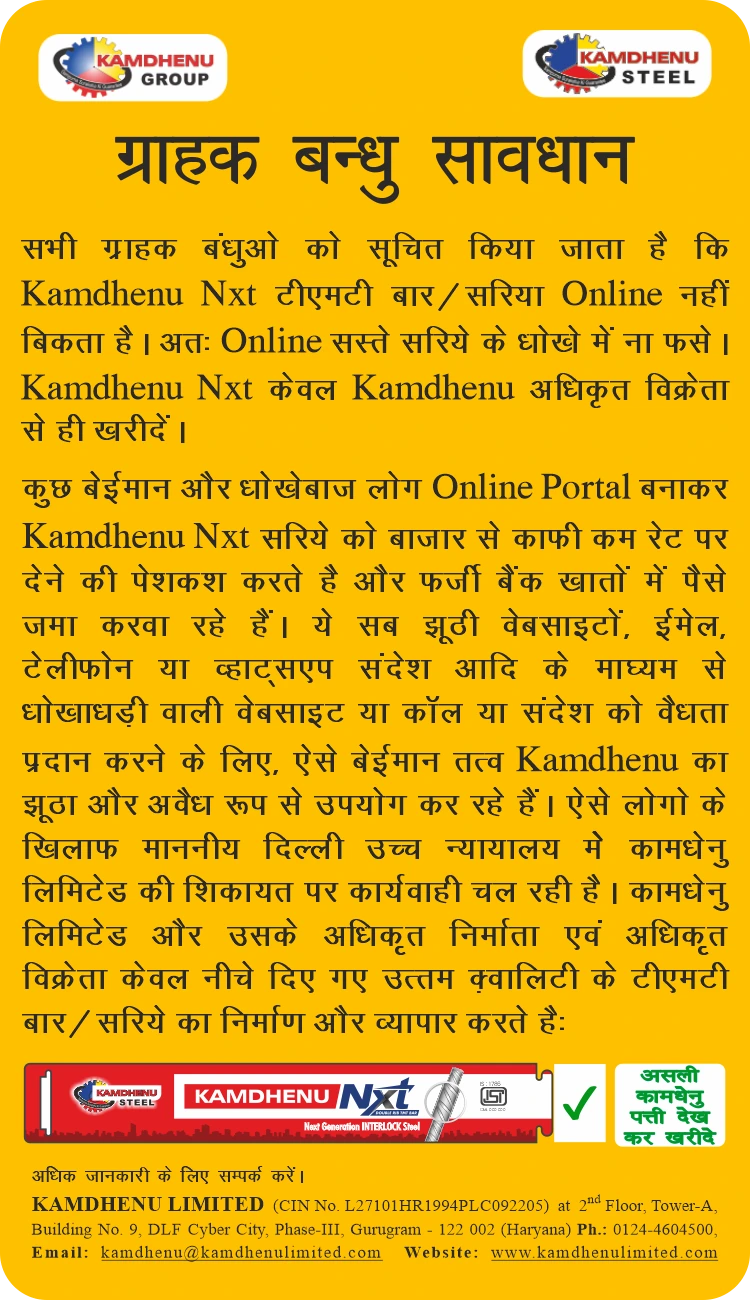
Buyers should purchase through authorised channels and preserve invoices, bundle tags and test reports.
How to Buy Premium TMT Bars in India
Buyers evaluating premium TMT bars India products should purchase through an authorised manufacturer network, distributor or dealer.
The purchase order should state:
- Manufacturer
- Exact grade
- Bar diameter
- Required quantity
- Applicable standard
- BIS requirements
- Test-certificate requirements
- Delivery location
- Weight basis
- Inspection process
- Replacement conditions
Avoid unmarked loose bars where traceability is required.
The invoice, bundle tags and test certificate should identify the same product and grade.
Site Controls After Selecting High Strength Steel
Separate Every Grade
Store different grades in clearly marked areas. Fe 500, Fe 500D, Fe 550 and Fe 550D should not be mixed.
Use Visible Identification
Use tags and approved colour coding to distinguish grades and diameters.
Train Bar Benders
Fabricators should understand the selected material and the approved bending procedures.
Check Mandrel Diameters
Use the specified mandrel size when bending bars. Tight, improper bends may damage reinforcement.
Avoid Flame Heating
Open-flame heating can alter material properties and should not be used unless a controlled method is approved.
Match Certificates to Deliveries
Heat or batch numbers on test certificates should match the bundle tags and delivery records.
Inspect Fixing Before Concrete Placement
Check:
- Bar spacing
- Laps
- Anchorage
- Concrete cover
- Confinement reinforcement
- Supports and chairs
- Cleanliness
- Grade placement
Even the best high strength TMT bars cannot perform correctly if the reinforcement moves during concreting.
Common Mistakes to Avoid
Common errors when considering a structural steel upgrade include:
- Assuming the highest grade is always best
- Replacing the specified grade without approval
- Upgrading without structural recalculation
- Ignoring crack-width and deflection limits
- Treating Fe 550 and Fe 550D as identical
- Focusing on strength while ignoring ductility
- Expecting steel to compensate for weak concrete
- Failing to revise bar bending schedules
- Ignoring development-length changes
- Mixing grades at the site
- Buying unmarked or untraceable material
- Accepting generic test certificates
- Ignoring local supply continuity
- Using open-flame heating for fabrication
- Comparing only the price per tonne
- Accepting specialised claims without reviewing test methods
Avoiding these mistakes ensures that the proposed upgrade remains an engineering improvement rather than an additional project risk.
Why Choose a Reliable High-Strength TMT Manufacturer?
A reliable manufacturer should control:
- Raw material chemistry
- Rolling temperature
- Water pressure
- Quenching
- Self-tempering
- Rib formation
- Diameter
- Nominal mass
- Mechanical testing
- Batch traceability
Buyers evaluating premium TMT bars India should look for:
- IS compliance
- BIS certification
- Clearly declared grades
- Batch-linked certificates
- Consistent bar markings
- Standard nominal weight
- Mechanical test results
- Chemical test results
- Authorised distribution
- Technical documentation
- Complaint and replacement support
Higher-strength reinforcement should be supported by stronger documentation, not merely stronger promotional claims.
Storage and Handling Tips
Keep Bars Above the Ground
Store reinforcement on sleepers or raised supports so that it does not contact soil, mud or standing water.
Protect Bundle Identification
Keep bundle tags attached until the steel has been inspected and segregated.
Prevent Grade Mixing
Different grades and diameters should remain in separate labelled stacks.
Avoid Aggressive Contaminants
Keep the steel away from salts, acids, fertilisers, oil and chemicals.
Use Proper Lifting Methods
Use appropriate slings and lifting equipment rather than dragging bars.
Clean Steel Before Casting
Remove mud, oil and loose scale before concrete placement.
Preserve Traceability
Retain invoices, delivery challans, test certificates and inspection records.
Frequently Asked Questions
What are high strength TMT bars?
High strength TMT bars are reinforcement bars with higher specified yield-strength levels than standard grades commonly used in general RCC construction. Fe 550 and Fe 550D are common examples.
Should every high-rise use Fe 550?
No. Grade selection depends on structural loading, ductility, serviceability, reinforcement congestion and design calculations.
Is Fe 550D better for earthquakes?
Fe 550D offers enhanced ductility compared with standard Fe 550. However, seismic safety depends on the complete structural design, detailing, concrete and workmanship.
Is high ductility steel stronger?
High ductility steel is not defined only by higher strength. Its key advantage is the ability to undergo greater deformation before fracture.
Can high-strength steel reduce reinforcement quantity?
It may reduce the required steel area in certain strength-controlled calculations. The actual result depends on minimum reinforcement, crack control, deflection and detailing.
Can Fe 550 replace Fe 500D?
Not without written approval and structural recalculation. The grades have different strength and ductility properties.
Does a structural steel upgrade improve durability?
A structural steel upgrade may improve selected material properties, but durability also depends on concrete quality, cover, curing, drainage and exposure protection.
Can high-strength bars solve reinforcement congestion?
They may reduce congestion where the design permits a lower steel area. Bar-spacing and minimum reinforcement requirements still apply.
Are specialised TMT bars suitable for high-strength concrete?
They may be suitable when compatibility is demonstrated through engineering analysis, standards and verified test data.
How should premium TMT bars in India be compared?
Compare premium TMT bars India products on grade, ductility, chemistry, nominal weight, bond, certification, traceability, test results, availability and delivered cost.
What documents should buyers request?
Request BIS details, applicable standard compliance, bundle tags, heat-linked test certificates, chemical results, mechanical results and authorised dealer invoices.
Is the most expensive TMT bar always the best?
No. The best product is the one that matches the approved design and provides verified properties, availability and traceability.
Conclusion
Upgrade to high strength TMT bars only when a verified structural design demonstrates a clear benefit.
High loads, reinforcement congestion, long spans and specialised concrete systems may justify the change. In seismic applications, high ductility steel can be as important as higher yield strength.
A successful structural steel upgrade requires more than purchasing a higher grade. The project must review the design, serviceability, laps, anchorage, fabrication, availability, testing and site controls.
Kamdhenu Nxt and PAS 10000 provide options for professional evaluation. However, the final selection should follow current technical documentation, applicable codes and written consultant approval.
The strongest decision is an engineered decision, not simply the highest number printed on a bundle tag.