 June 15 2026
How to Choose the Right Structural Steel Section for Your Project
Choosing a steel section is a design decision.
It affects strength. It affects fabrication. It affects cost. It also affects safety.
Many buyers order steel by habit. They ask for angles, channels or beams without checking load direction, span or connection details. This can create problems during fabrication and erection.
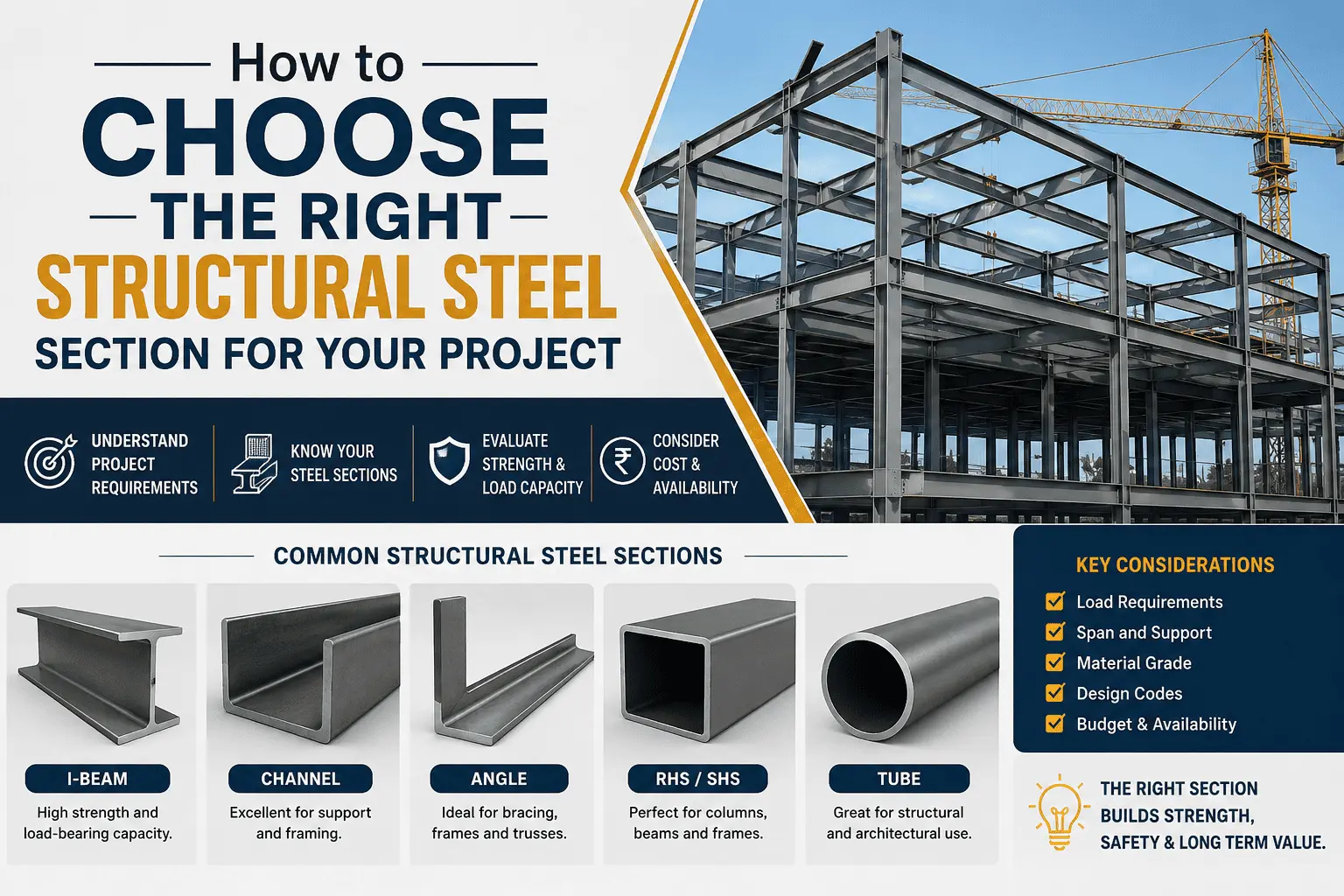
This structural steel section guide explains how to choose the right section for your project. It covers equal leg angles, channel section steel and beam sections India commonly uses.
Start with the Application
The right steel section depends on the work it has to do.
Do not begin with price. Begin with function.
Ask these questions:
- Will the member carry compression?
- Will it act as a beam?
- Will it work as bracing?
- Will it carry equipment load?
- Will it be welded or bolted?
- Is the member exposed to weather?
- Is straightness important?
- What does the drawing specify?
Once these questions are clear, section selection becomes easier.
Understanding Equal Leg Angles
Equal leg angles are L-shaped steel sections with both legs of the same length.
They are simple, strong and easy to fabricate. They are often used in trusses, towers, braces and frames.
Use equal leg angles when:
- Load is moderate
- Bracing is needed
- Connection is simple
- Fabrication speed matters
- The member works in a frame or support system
They are also easy to handle at site. This makes them popular in smaller fabrication jobs.
Understanding Channel Section Steel
Channel section steel has a C-shaped profile.
It has one web and two flanges. This shape makes it useful for framing, edge members and supports.
Use channel section steel for:
- Purlins
- Side rails
- Stair stringers
- Equipment bases
- Racks
- Frame edges
- Light beams
- Industrial supports
Channels are useful because one face can sit against a wall, plate or support. They are also easy to bolt and weld.
Understanding Beam Sections
Beam sections India commonly uses include I-beams and H-beams.
These sections are designed to resist bending. They are useful when load and span are higher.
Use beams for:
- Long-span roof members
- Mezzanine floors
- Crane supports
- Industrial platforms
- Bridge components
- Heavy framing
- Shed columns and rafters
Beam selection should always come from structural design. Span, load, deflection and connection details must be checked.
Quick Section Selection Table
| Need | Better Section Choice | Reason |
|---|---|---|
| Bracing | Equal leg angles | Easy to connect and fabricate |
| Edge frame | Channel section steel | Good support and flat connection face |
| Heavy bending | Beam section | Better resistance to bending |
| Light support | Angles or channels | Economical and easy to handle |
| Equipment base | Channels or beams | Better support area |
This table gives a starting point. It does not replace engineering design.
Check the Standard
For structural steel, standard compliance matters.
IS 2062 covers hot rolled medium and high tensile structural steel. The BIS product manual for IS 2062 supports consistency in certification practice.
Kamdhenu Structural Steel is positioned as conforming to IS 2062. It includes angles, channels, beams and flats. Kamdhenu also highlights high strength, high ductility, weldability, bendability and straightness.
These properties matter in fabrication. A section that is difficult to weld or bend can slow the project.
Match Section with Fabrication Method
Fabrication method affects selection.
A section that looks good on paper may be difficult to connect on site. Before finalising, talk to the engineer and fabricator.
Check:
- Weld access
- Bolt spacing
- Plate connection
- End cutting
- Fit-up tolerance
- Handling and lifting
- Paint or coating need
- Site erection sequence
Good section selection reduces site rework.
Consider Cost Correctly
Steel cost is not only rate per kilogram.
A cheaper section may need more labour. It may need extra plates or stiffeners. It may increase welding time. It may also cause wastage if it does not match the design.
A good comparison should include:
- Material cost
- Fabrication time
- Erection time
- Wastage
- Connection cost
- Coating cost
- Maintenance
The lowest basic rate is not always the lowest project cost.
Where Kamdhenu Structural Steel Fits
Kamdhenu Structural Steel offers angles, channels, beams and flats for construction and fabrication. The product is positioned around strength, ductility and reliability.
It is suitable for:
- Industrial sheds
- Fabricated frames
- Platforms
- Trusses
- Support structures
- Warehouses
- Commercial buildings
- Infrastructure support work
For buyers, this gives a reliable section family for different structural needs.
Buyer Checklist
Before placing an order, confirm:
- Section type
- Size and length
- Grade
- IS 2062 compliance
- Weight per metre
- Straightness
- Surface quality
- Test certificate
- Quantity tolerance
- Delivery schedule
Keep the purchase aligned with drawings. Do not allow unauthorised substitutions.
Final Takeaway
The right steel section depends on load, span, connection and use.
Equal leg angles work well for bracing and light frames. Channel section steel is useful for supports and purlins. Beam sections India uses are best for heavier load-bearing work.
Use this structural steel section guide as a practical starting point. Then confirm final selection with the structural engineer.
Kamdhenu Structural Steel gives builders a dependable range of angles, channels, beams and flats conforming to IS 2062.
Do Not Substitute Sections Without Approval
Substitution is common on sites. It is also risky.
A contractor may suggest replacing a channel with two angles. A fabricator may suggest a smaller beam because it is available. Such changes can affect strength, deflection and connection behaviour.
Every substitution should be approved by the engineer. The section modulus, weight, grade and connection details must be checked.
Availability is important. But safety is more important.
Quick FAQs
Can fabricators choose sections on site?
They can suggest options, but the structural engineer must approve final selection.
What is the first thing to check?
Check the drawing. Then check load, span, connection and section size before ordering.
Procurement Note
The purchase order should mention section size, grade, length and standard. It should also mention whether test certificates are required. Vague orders often lead to wrong supply and delayed fabrication.
Read More: Structural Steel in Construction: Angles, Channels & Beams Guide