 March 09 2026
Beam-Column Joints to Cantilevers: Where Your TMT iron rod Choice Decides RCC Performance
Most RCC failures do not start in the middle of a slab.
They start at stress concentration zones.
They start at joints.
They start at the edges.
They start where detailing is tight, and forces reverse.
That is why “rate per kg” is not the full story.
The right TMT iron rod helps you build predictable behaviour.
And predictable behaviour is what engineers and clients pay for.
Today, the risk environment is also sharper.
In India’s updated seismic zonation work, reports highlight that 61% of the country falls under moderate to high earthquake hazard zones.
That makes ductility and bonding conversations more serious.
Especially for multi-storey frames.
This is also a corrosion country.
A CSIR-NML statement reported India loses 2–3% of GDP every year due to corrosion.
That number should bother anyone building long-life structures.
So let’s talk application.
Not generic buying tips.
And let’s keep it focused on one product.
Kamdhenu Nxt TMT iron rod.
Why Kamdhenu Nxt is positioned for “high-stress zones”
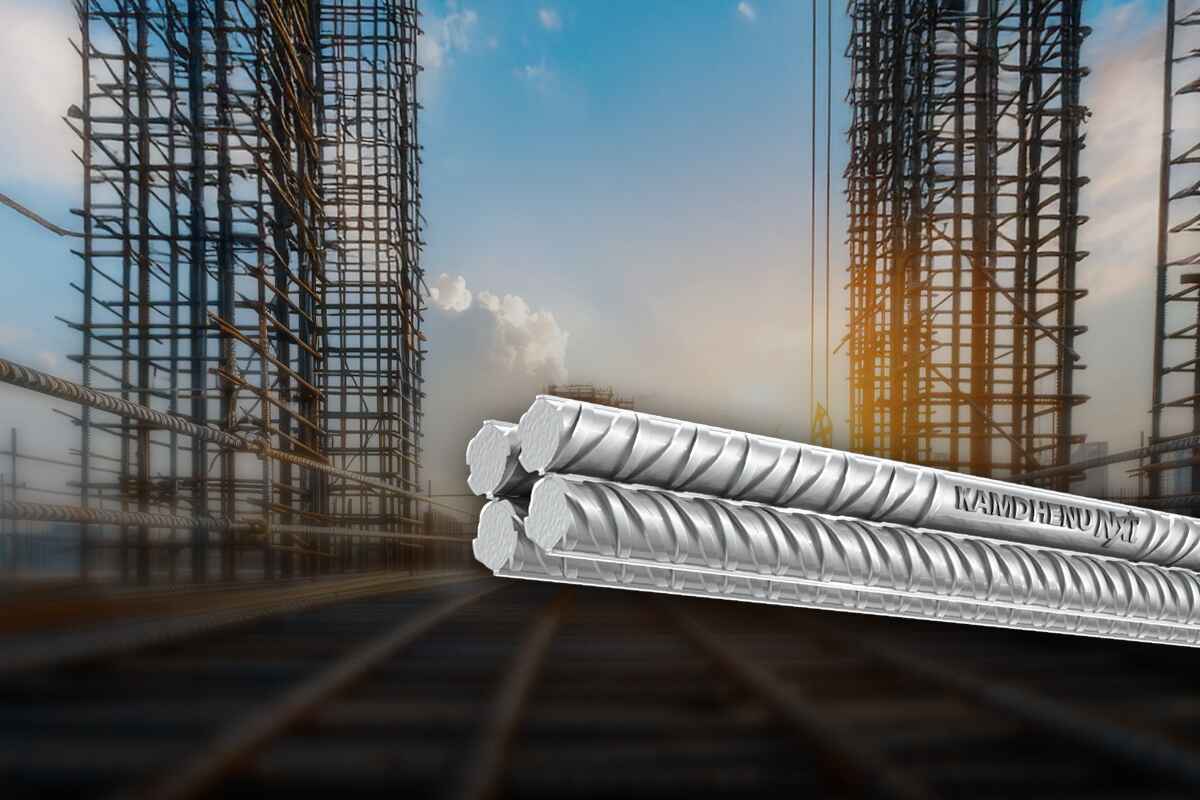
Kamdhenu Nxt is described as next-generation interlock steel.
It uses a double-rib design.
That design is meant to improve interlock with concrete.
And bonding is where many RCC problems begin.
Kamdhenu also positions Kamdhenu Nxt around:
- Superior bonding with concrete.
- Earthquake resistance is a stated benefit.
- Corrosion resistance is a stated benefit.
These claims are not “nice to have.”
They map to real pain points in joints, cantilevers, and exposure zones.
Application Zone 1: Beam-Column Joints (the most punished location)
In framed RCC, the beam-column joint is a force transfer hub.
Bending moment reversals happen here.
Shear demand spikes here.
Congestion is common here.
What goes wrong in joints?
- Poor compaction.
- Bar slippage.
- Crack widening.
- Bad anchorage behaviour.
This is where bond matters.
The double-rib interlock concept is aimed at a stronger grip with concrete.
That directly speaks to joint performance needs.
Practical contractor lens:
If you are building G+3, G+10, or commercial frames, treat joints as premium zones.
Use consistent, traceable steel.
Avoid mixed lots.
Application Zone 2: Cantilevers (balconies, chajjas, canopies)
Cantilevers punish steel in a simple way.
Top bars carry tension.
Cracks want to open at the fixed end.
Water ingress follows cracks.
This is where three things matter.
- Strength
- Ductility
- Corrosion resistance
Kamdhenu Nxt is positioned as corrosion-resistant.
That matters because cantilevers see wetting cycles.
And wetting cycles accelerate corrosion.
Site habit that helps:
- Control cover.
- Control slope and waterproofing.
- Start by selecting a reliable TMT iron rod for this exposure-prone zone.
Application Zone 3: Slab edges, openings, and re-entrant corners
Openings create stress concentrations.
Re-entrant corners crack first.
Slab edges see shrinkage and restraint.
You cannot “cement” your way out of bad reinforcement performance.
You need a stable bond and predictable elongation behaviour.
That is why grade choice matters.
Grade selection by application
Kamdhenu Nxt is available in common grades like:
- Fe-500
- Fe-550
- Fe-500D
- Fe-550D
So you can match grade to design intent.
Ductility grades exist for a reason.
They are built around measurable elongation targets.
In IS 1786 Amendment No. 3, minimum elongation includes:
- Fe500D: 16.0%
- Fe550D: 14.5%
This matters for frames and dynamic loads.
It matters for seismic zones.
It matters for detailing tolerance.
Simple application mapping (always follow design drawings):
- Frames in seismic or vibration-prone zones: Prefer ductile grades when specified (Fe500D / Fe550D).
- Heavier members or higher design demand: Fe550 is often chosen when the structural engineer specifies it.
- Standard residential RCC: Fe500 is common, but do not downgrade from drawings.
If you want “Best Iron Rod Company” logic, this is it.
A best supplier supports grade discipline.
Not on-the-spot substitutions.
Kamdhenu Nxt Fe 550 (example)
Commercial buyers need specs.
Kamdhenu Nxt publishes key mechanical properties for Fe 550:
- Minimum yield stress: 565 N/mm²
- Minimum tensile strength: 610 N/mm²
- Minimum elongation: 14%
- TS/YS ratio: ≥ 1.08
These are meeting-room numbers.
They help in consultant discussions.
They also help with institutional procurement files.
Kamdhenu also states Kamdhenu Nxt offers 4% less weight per meter than standard bars.
That claim is commercially relevant.
Because it affects total tonnage planning and value comparison.
Exposure application: coastal and chloride-prone construction
India has a very large coastline footprint.
A Government of India PIB release states India’s coastline has been re-assessed from 7,516.6 km to 11,098.81 km using updated GIS methodology.
That is not trivia.
It signals how many projects sit in saline exposure zones.
In these zones, corrosion control becomes a project outcome.
Not a maintenance afterthought.
Kamdhenu Nxt is positioned with corrosion resistance benefits.
And corrosion is not a “small cost.”
Again, the CSIR-NML statement points to a 2–3% GDP annual loss due to corrosion.
So if you are building coastal housing, warehouses, or hospitality projects, your TMT iron rod should be a planned choice.
Not a last-minute purchase.
Keep procurement tight
1) Where Kamdhenu Nxt makes practical sense (application shortlist)
Use Kamdhenu Nxt confidently in zones like:
- Beam-column joints in multi-storey frames.
- Cantilevers and slab edges exposed to weather.
- Staircases and landings where cracking complaints are common.
- Basements and plinth beams in waterlogging-prone sites.
- Coastal projects where corrosion risk is a design reality.
2) What to ask your supplier (commercial checklist)
Keep it short.
Keep it documented.
- Confirm grade availability (Fe500 / Fe550 / D grades).
- Confirm sizes needed (Kamdhenu Nxt lists 8 mm to 32 mm).
- Ask for test documentation and lot discipline.
- Ensure supply consistency across the project timeline.
- Avoid mixing brands within one structural system.
This is how “Best Iron Rod Company” thinking looks in practice.
It is a procurement discipline.
Not slogans.
Genuineness checks
Kamdhenu warns that duplicate TMT bars exist in the market.
So your site must have a fast verification method.
Kamdhenu states two clear identifiers for Kamdhenu Nxt:
- Stamp on every meter of the bar
- Red Kamdhenu strip on every bundle
Do this at unloading.
Not later.
Later is when problems become expensive.
Close: a commercial decision that supports engineering intent
If your project has joints, cantilevers, slab edges, and exposure zones, you need reinforcement you can stand behind.
Kamdhenu Nxt gives you application-aligned features like double-rib interlock, published mechanical properties, and clear genuineness markers.
That is what buyers mean when they search for TMT iron rod and Best Iron Rod Company.
They want fewer surprises.
They want predictable RCC behaviour.
They want documented confidence.
Next step (CTA):
For project inquiries, specifications, and procurement support, use Kamdhenu’s official contact page and route your request through the TMT inquiry channel.