 September 07 2026
Structural Steel Channel: Types, Applications, Benefits & Selection Guide
Understanding the section before selecting it
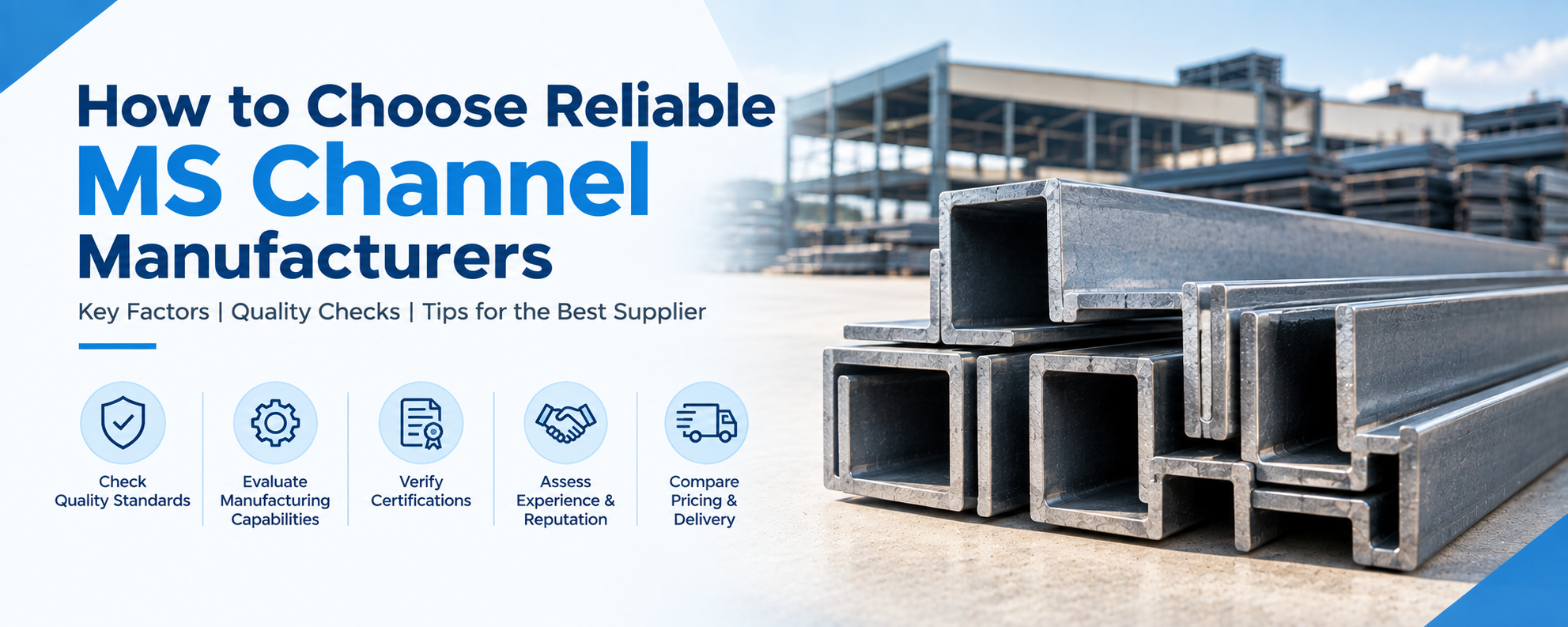
A Structural Steel Channel is a rolled steel section with one web and two flanges. Seen from the end, it has a clear C-shaped or U-shaped profile. The geometry looks simple, but the section is useful in a wide range of construction and fabrication work.
A Structural Steel Channel is commonly used where a member needs a flat web connection and flanges for stiffness. It can be cut, drilled, welded, and bolted with standard fabrication methods. This makes it practical for sheds, racks, platforms, equipment bases, and secondary framing.
Kamdhenu Structural Steel includes channels, angles, beams, and flats. The range is positioned for strength, ductility, straightness, and fabrication suitability, with structural products conforming to IS 2062. For a buyer, that is important because a channel should be selected by grade and section, not by appearance alone.
Main types of channel sections
- Parallel flange channels have flanges that remain almost parallel. They are convenient for plates, cleats, and bolted connections.
- A steel C channel may also be cold formed from sheet or strip for lighter framing duties. It should not automatically be substituted for a hot-rolled structural channel.
- Built-up channels can be fabricated for special loads, but the design and weld details must be engineered.
The right Structural Steel Channel depends on what the member has to carry. A purlin, stair stringer and equipment base may all use channel-shaped steel, but their loading is very different.
Where channels are used in construction
This channel section is useful in both primary and secondary construction. It is often selected where one open side helps with fixing, access, or connection.
Typical applications include purlins, side rails, stair stringers, mezzanine edge members, equipment skids, rack frames, vehicle bodies, platform supports and fabricated frames. An MS channel is also common in gates, utility structures and repair work because fabricators know how to cut and weld it efficiently.
For industrial projects, channels can support cable trays, pipes or small machinery when designed for the load. For buildings, they may act as secondary framing or edge members. The same structural steel sections can also appear in bridges, warehouses, and workshop structures.
Why the channel shape works
A channel places material away from the centre line of the web. This improves bending performance compared with a flat strip of similar mass. The web mainly resists shear, while the flanges contribute strongly to bending resistance.
The open shape also makes a Structural Steel Channel easy to connect to plates and other members. But the same open geometry means it does not behave like a closed box section in torsion. If twisting is important, the engineer may prefer a hollow section, paired channels, or another built-up member.
This is why a structural channel should never be selected only by depth. Section properties, unsupported length, load direction and connection restraint all matter.
Standards, grade and dimensional checks
For Indian projects, hot-rolled structural steel is commonly specified to IS 2062. Section dimensions are normally referred to recognised dimensional standards and manufacturer data. Kamdhenu states that its structural products conform to IS 2062 and supplies channel sections as part of its structural steel range.
Before accepting a Structural Steel Channel, check:
- Grade and applicable standard;
- Section designation and mass per metre;
- Web depth and flange width;
- Web and flange thickness;
- Straightness and twist;
- Surface condition;
- Test certificate and batch traceability;
- Required length and cutting tolerance.
Hot-rolled channel versus cold-formed C channel
The words steel C channel is often used loosely. Buyers should confirm whether the requirement is for a hot-rolled structural section or a cold-formed light-gauge member.
Hot-rolled channels are commonly used for heavier fabrication and structural work. Cold-formed C sections are efficient for purlins; wall girts and light framing when designed as part of a system. Their thickness, local buckling behaviour and connection details differ.
A Structural Steel Channel should therefore be ordered using a complete specification. Simply writing “C channel” on a purchase order leaf too much room for interpretation.
Benefits for fabricators and contractors
A good Structural Steel Channel offers several practical advantages.
- Flat surfaces make marking and drilling straightforward.
- The open side gives access to bolts, nuts, and welding.
- Standardised sizes simplify drawings and cutting lists.
- Steel is easy to repair, strengthen, or modify when engineering approval is available.
- A structural channel can be painted, galvanised or otherwise protected to suit exposure conditions.
How to choose the right channel
Start with the structural drawing. The drawing should define the required Structural Steel Channel size, grade, and connection details. If that information is missing, do not replace engineering design with a supplier's recommendation.
Then consider load direction. A channel is much stronger about one principal axis than the other. Check bending, shear, deflection, buckling and torsion. Connection points should also be reviewed because a load applied away from the shear centre can cause twisting.
For outdoor work, define the corrosion protection system. An MS channel left wet or exposed without suitable protection will rust. Paint quality, galvanising or another coating should match the environment.
Buying mistakes to avoid
The most common mistake is comparing only price per kilogram. A low price can be offset by poor straightness, inconsistent dimensions, rework or missing documentation.
Do not accept a Structural Steel Channel only because the nominal depth matches. Check out the complete section. Do not mix grades without approval. Do not change channel size at site because another section is easier to source. Do not drill or cut critical members without checking the fabrication drawing.
Kamdhenu structural steel for channel applications
Kamdhenu Structural Steel is supplied in channels, angles, beams and flats for construction and industrial use. Published information highlights IS 2062 conformity along with strength, ductility, bendability, and weldability.
Those properties matter in channel fabrication. A Structural Steel Channel must take load, but it must also be workable in the shop. Predictable dimensions and material behaviour help fabricators make cleaner connections and reduce avoidable rework.
Final selection checklist
Before ordering a Structural Steel Channel, confirm the application, design load, section designation, grade, standard, length, coating and test documentation. Check whether the channel is hot rolled or cold formed. Check whether the design needs one channel, paired channels, or another section altogether.
A channel is a familiar product, but familiarity should not lead to casual selection. The correct steel channel is the one that matches the drawing, fabrication method, and service environment. When those three points are aligned, the member becomes easier to fabricate, easier to erect, and more dependable in service.
Practical specification notes
- A Structural Steel Channel should always be checked against the final structural drawing before cutting begins.
- For repeat fabrication, a Structural Steel Channel with consistent dimensions can save significant workshop time.
- When corrosion exposure is high, the Structural Steel Channel coating system should be specified before dispatching.
- A Structural Steel Channel purchase order should state the section designation rather than a local trade nickname.
- Using the correct Structural Steel Channel helps control fit-up, weight, and erection accuracy.