 September 11 2026
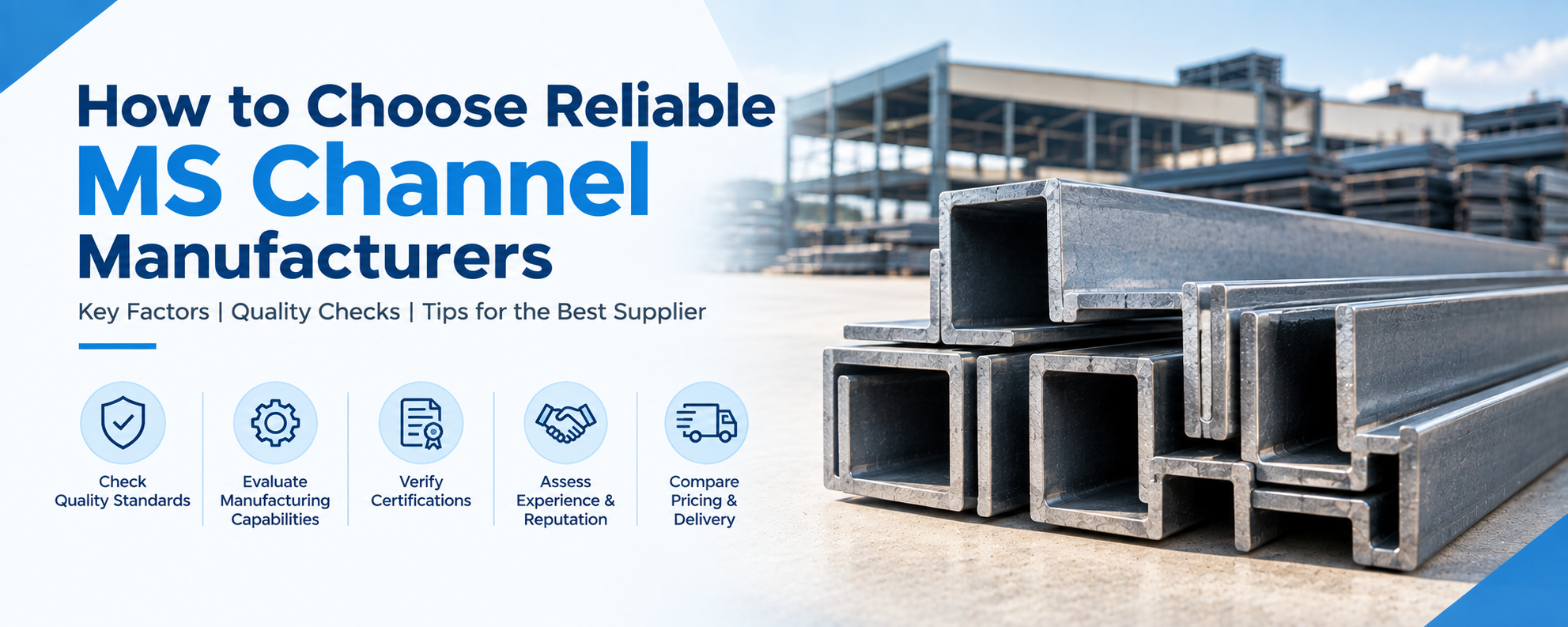
How to Choose Reliable MS Channel Manufacturers: Quality, Standards & Key Factors
Why the manufacturer matters
Buying an MS channel is not only a price exercise. The section becomes part of a frame, platform, shed, equipment base, or industrial support. If dimensions vary, fabrication slows down. If grade documentation is unclear, the project carries unnecessary risk.
This is why choosing MS Channel Manufacturers requires more than comparing quotations. A serious buyer should check the steel grade, section dimensions, rolling quality, test documentation, supply consistency, and after-sales response.
Kamdhenu Structural Steel includes channels within its structural steel portfolio and states conformity to IS 2062. That gives buyers a useful reference point: the product should be defined by a recognised standard and measurable properties, not by trade name alone.
Start with the applicable standard
Reliable MS Channel Manufacturers should be able to state the material grade and the dimensional basis of the section. For hot-rolled structural steel in India, IS 2062 is commonly used for material requirements. Channel dimensions should follow the specified section series and recognised dimensional standards.
Ask the supplier to write the standard and grade on the quotation. Do not accept phrases such as “standard material” without detail.
A complete channel specification normally includes section designation, grade, length, mass per metre, tolerances, surface condition and testing requirement. Good MS channel suppliers will ask for this information before confirming the order.
Check consistency, not only one sample
One straight and clean sample does not prove that the full lot is consistent. MS Channel Manufacturers should control web depth, flange width, thickness, straightness and twist across production.
In a fabrication shop, small dimensional variation becomes expensive. Holes stop lining up. Fixtures need adjustment. Paired channels do not sit properly. Weld gaps become inconsistent.
For repeat projects, ask mild steel channel manufacturers how they control dimensions from batch to batch. A reliable source should be able to explain inspection routines and provide relevant test documentation.
Material test certificates matter
A material test certificate, or MTC, connects the supplied steel to measured chemical and mechanical properties. It is especially important for structural work.
MS Channel Manufacturers supplying project-grade material should be able to provide documentation appropriate to the order. The certificate should match the specified grade and lot identification. Procurement teams should verify that the paperwork refers to the actual material received.
Do not treat an MTC as a formality. It is part of traceability. If steel channel manufacturers cannot connect the delivered bundle to the documents, the value of the certificate is reduced.
Evaluate fabrication performance
Good channels should behave predictably in the workshop. Weldability, bendability where relevant, straightness, and surface conditions all affect productivity.
Ask fabricators what they see during cutting and fit-up. Do pieces sit flat in jigs? Are flanges consistent? Is there an excessive twist? Does the material create unusual problems during welding?
Reliable MS Channel Manufacturers understand that product quality continues after dispatching. A channel that is technically within grade but difficult to fabricate can still create project cost.
Look at the complete product range
That does not mean range alone decides quality. But established MS channel suppliers with multiple structural sections may provide better coordination for bundled project orders.
Ask whether the supplier can maintain consistent grades across the order and whether dispatches can be planned according to the fabrication sequence.
Compare quotations correctly
A low rate per tonne is not enough. Compare the complete commercial offer.
- section designation and theoretical mass;
- Grade and standard;
- Length tolerance;
- Quantity tolerance;
- Taxes and freight;
- Test certificates;
- Packing and unloading conditions;
- Delivery schedule;
- Replacement policy for damaged or off-spec material.
MS Channel Manufacturers should make these points clear. Hidden differences between quotations can be larger than the headline rate difference.
Check supply capacity and lead time
Large projects need dependable dispatch. Ask MS Channel Manufacturers about rolling schedules, stock availability and normal lead times. If your project needs several sizes, confirm whether all sizes can be supplied together or in planned lots.
For infrastructure and industrial work, delays in structural steel can stop fabrication. Good steel channel manufacturers should not promise unrealistic dates simply to win an order.
A practical supplier will explain stock position, production timing and transport constraints before finalising the commitment.
Review storage and handling
Quality can be lost after production. Channels stored in standing water or dragged carelessly may arrive with rust, bent flanges or damaged edges.
Ask MS channel suppliers how material is stacked, bundled and protected during transport. For long sections, the loading method matters. Supports should prevent permanent bending. Bundles should be secured without crushing flange edges.
When material reaches the site, inspect it before signing the receipt. Photograph transit damage and isolate questionable pieces.
Corrosion protection requirements
Hot-rolled MS channels are normally supplied as bare steel unless another finish is specified. The project must define painting, galvanising or another corrosion protection system based on exposure.
Good MS Channel Manufacturers should not make vague claims such as “rust proof” for ordinary bare mild steel. Instead, they should state the supplied surface condition clearly so the buyer can plan preparation and coating.
Outdoor, coastal and chemically aggressive sites need more attention than dry indoor fabrication.
Questions to ask before placing an order
Before selecting among MS Channel Manufacturers, ask:
- Which grade and standard will be supplied?
- What channel sizes are available now?
- What dimensional tolerances are controlled?
- Is an MTC supplied with the lot?
- Can the heat or batch be traced?
- What are the normal length options?
- What is the dispatch lead time?
- How is material packed for transport?
- What happens if a section is visibly off-spec?
The quality of the answers often tells you as much as the quotation.
Kamdhenu as a structural steel reference
Kamdhenu Structural Steel is positioned around high strength, ductility, weldability and dimensional reliability, with channels supplied as part of an IS 2062 structural steel range.
For buyers evaluating mild steel channel manufacturers, this is the kind of information worth looking for: defined standards, identifiable products, and published technical positioning.
Even when buying from any other source, the same discipline should apply. The supplier should be able to explain what is being delivered and how it is checked.
Final takeaway
Reliable MS Channel Manufacturers help protect fabrication quality, project schedules and structural documentation. The best supplier is not automatically the one with the lowest rate.
Check grade, standard, dimensions, MTCs, straightness, supply capacity, and transport discipline. Compare MS channel suppliers with total delivered value. Ask for clear documentation before the steel reaches the workshop.
A well-specified channel from a dependable source is easier to fabricate, easier to trace, and easier to approve. That is the standard procurement teams should expect from professional MS Channel Manufacturers.
Practical specification notes
- MS Channel Manufacturers should be evaluated on repeatability across lots, not one carefully selected sample.
- Good MS Channel Manufacturers make grade, dimensions and test documentation easy to verify.
- For time-sensitive projects, MS Channel Manufacturers should provide realistic rolling and dispatch schedules.
- Experienced MS Channel Manufacturers understand that transport damage can undo good factory quality.
- Professional MS Channel Manufacturers should respond clearly when a buyer reports on dimensional or surface issues.