 November 21 2026
How TMT Bars and Concrete Work Together To Improve Structural Strength
Press down on the middle of a plain concrete beam and watch what happens. It doesn’t bend politely. It cracks along the bottom, often with very little warning. Now place a reinforcing bar in the right spot and the whole story changes.
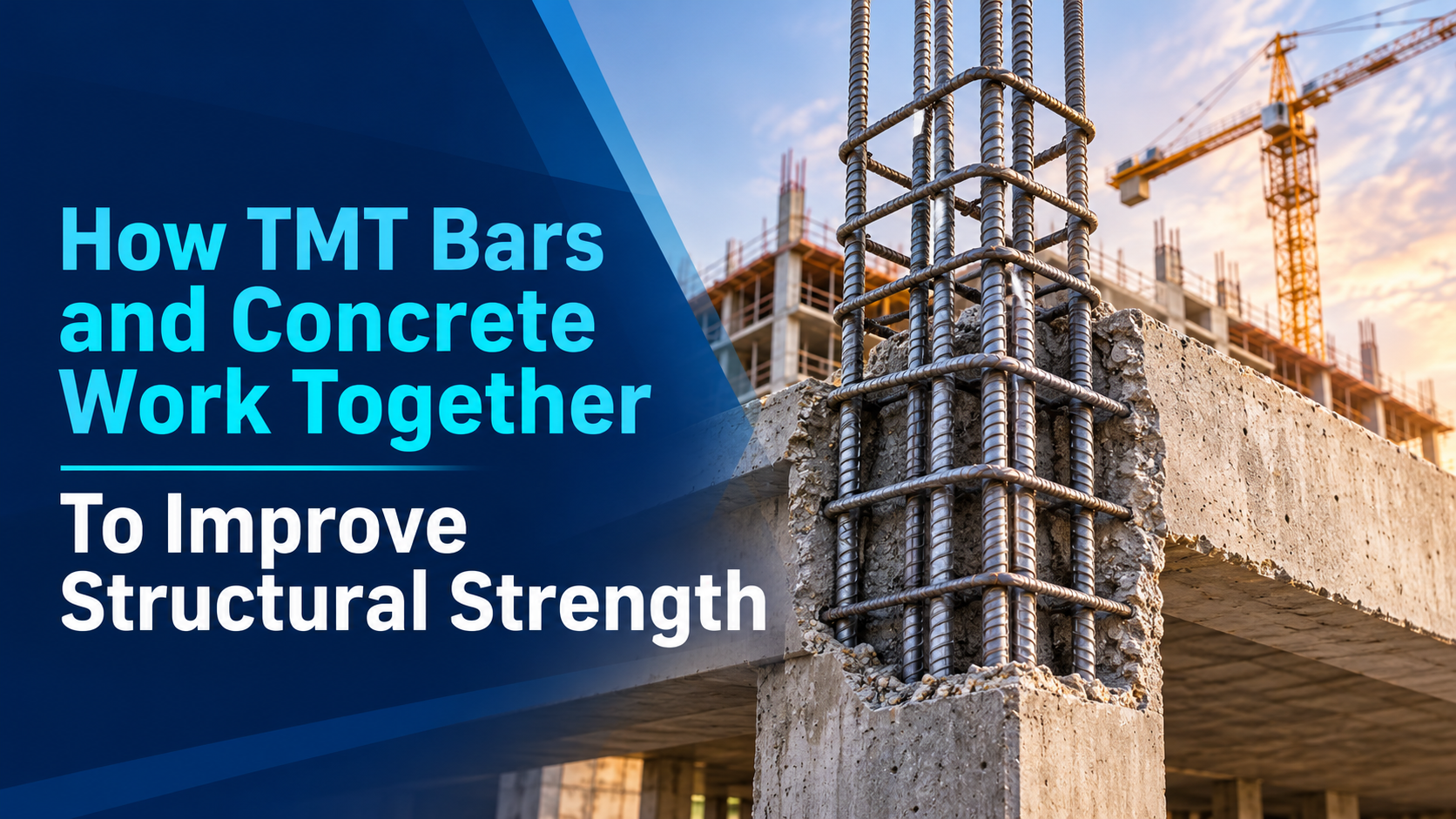
Concrete resists compression while TMT bars carry tension, and the ribs on the bar grip the concrete so both deform together as one material under load. That’s the short version. At Kamdhenu, we’d like to give you the long one, because knowing why these two work together helps you build better and buy better.
Concrete Is Strong, But Only One Way
Concrete loves being squeezed. Columns, footings, and the top of a beam all use that strength. But bend a beam, and its underside goes into tension, which is exactly where plain concrete is weak. So engineers put steel where the pulling happens. The steel takes the tension, the concrete takes the compression, and each covers the other’s weak spot.
Three Reasons the Partnership Works
It isn’t luck. Three things line up, and if one fails, the whole arrangement suffers:
|
Mechanism |
What happens |
What can go wrong |
|
Grip (bond) |
Ribs lock into hardened concrete so the bar can’t slip |
Oily, muddy, or loosely rusted bars; too little embedment |
|
Matching expansion |
Both expand and contract at similar rates, close to 12 × 10⁻⁶ per °C |
Very little, which is why steel suits concrete so well |
|
Chemical protection |
Alkaline concrete (pH above 12) shields the steel from rusting |
Carbonation, chlorides, thin cover, or cracks |
They Grip Each Other
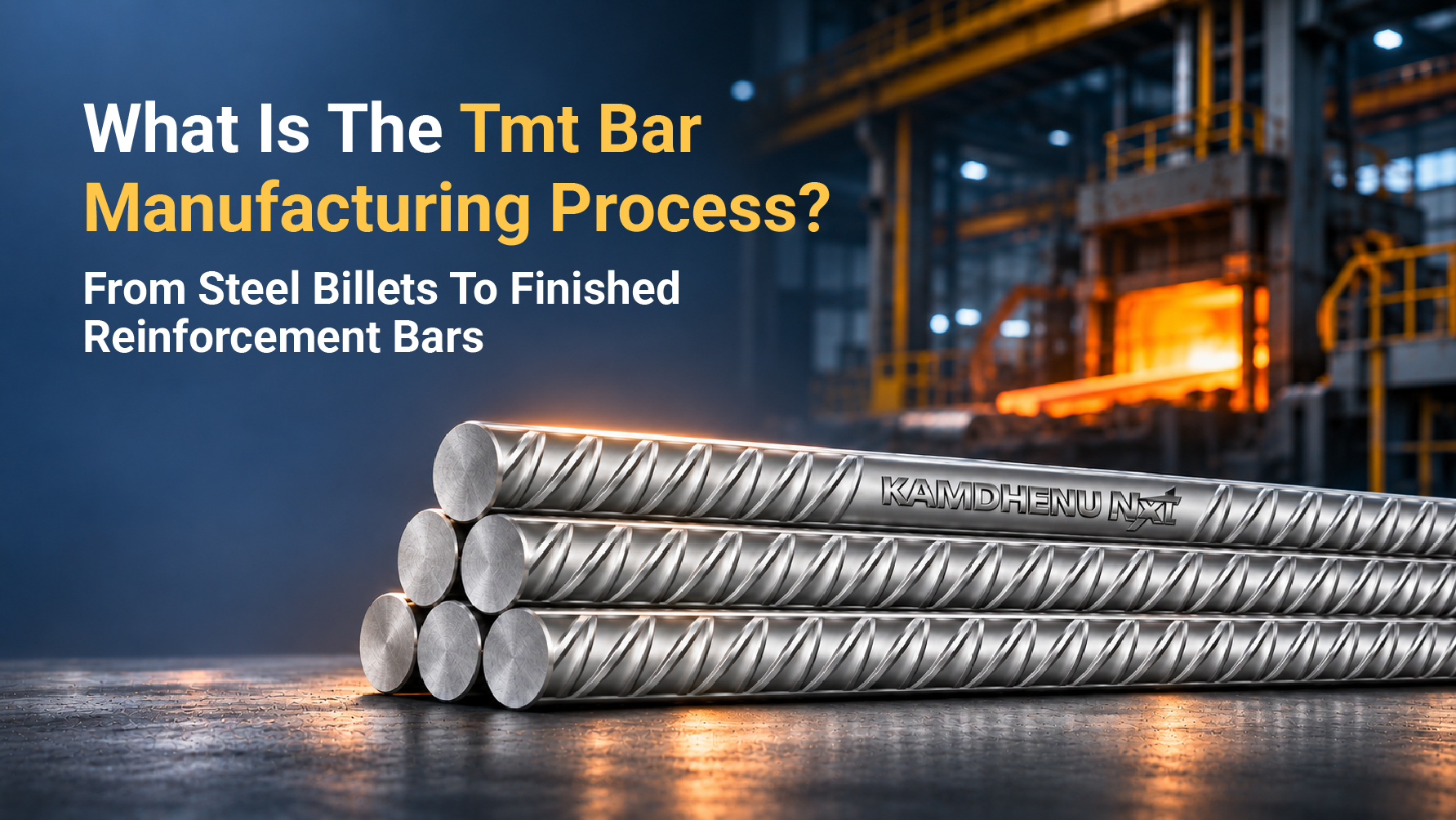
Smooth bars slip. Ribbed bars don’t. The ribs act like small keys that lock into the hardened concrete, so the two materials stretch and shorten together. Those ribs are rolled in during production, and the way these bars are made decides how reliably they grip. Our Kamdhenu Nxt bars follow a double-rib design built for superior interlock with concrete.
They Move Together in the Heat
A slab in the afternoon sun and the bar inside it warm up together. Because steel and concrete expand at nearly the same rate, temperature swings don’t pry them apart. If one expanded much faster than the other, repeated heating and cooling would slowly work the bar loose.
Concrete Shields the Steel
Fresh concrete is highly alkaline, and that chemistry forms a thin protective film on the steel. Trouble starts when carbonation or chlorides reach the bar, usually through thin cover or cracks. That’s why cover depth sits on every structural drawing. It isn’t a detail. It’s the bar’s armour.
Why TMT Suits the Job
TMT bars for construction do more than carry load. Thermo-mechanical treatment gives the bar a tough outer surface and a softer core, bringing strength and flexibility together. The flexibility matters. Ductile steel stretches before it fails, so a structure can show distress rather than give way suddenly. Our Nxt page notes that TMT bars can offer up to 20% more strength than conventional steel.
Our Kamdhenu Nxt TMT steel bars come in Fe-500, Fe-550, Fe-500D and Fe-550D grades, in sizes from 8 mm to 32 mm, so designers can match the grade and size to each structural element. Surface matters too. Our page describes the bars as designed to be free from surface defects, and a clean surface is what lets TMT rebars grip properly.
|
Kamdhenu Nxt feature |
What our page says |
|
Double-rib design |
Superior interlock with concrete |
|
TMT technology |
Tough outer surface, soft core |
|
Earthquake resistance |
Strength combined with flexibility |
|
Corrosion resistance |
Highlighted as a key feature |
|
Thermal resistance |
Designed to offer higher thermal resistance |
What Site Teams Should Get Right
A great bar can still be let down by a rushed pour. A few habits protect the partnership:
- Keep bars clean. Loose rust, oil, and mud weaken the grip.
- Maintain the concrete cover shown in the drawings.
- Follow the lap and anchorage details, so force passes smoothly from one bar to the next.
- Leave enough spacing for concrete to flow around every bar.
- Match grade and size to the drawing, and change nothing without the engineer’s approval.
- Check identification marks on delivery: the Kamdhenu Nxt stamp on every metre, a red Kamdhenu strip tag on every bundle, and the QR code on the tag.
Conclusion
Concrete and steel aren’t rivals. They’re a team, and the team only works when the grip is strong, the cover is right, and the bar itself is sound. Every reinforcing bar you place is a small promise about how the structure will behave years from now. Good steel reinforcement bars, combined with careful site practice, are how that promise gets kept.
Planning a project? Talk to us at Kamdhenu, and we’ll help you choose the right Kamdhenu Nxt grade for it.
FAQs
Q. Why is concrete reinforced with steel bars?
Concrete resists compression well but is weak in tension. Steel bars are placed where pulling forces occur, so the steel carries the tension while the concrete carries the compression, making the structure stronger together.
Q. Why do TMT bars have ribs?
The ribs lock into hardened concrete through mechanical interlock, which stops the bar from slipping under load, so both materials deform together. Kamdhenu Nxt uses a double-rib design built for superior interlock with concrete.
Q. Why don’t steel and concrete crack apart when temperatures change?
Both expand and contract at very similar rates, close to 12 × 10⁻⁶ per °C, so temperature swings create little internal stress. That keeps the bond between the bar and the concrete intact.
Q. How does concrete protect TMT bars from rusting?
Concrete is highly alkaline, which forms a thin protective film on the steel. Adequate cover keeps it in place, while carbonation, chlorides, thin cover, or cracks can weaken protection and let the bar start corroding.
Q. What should site teams check to get the best from TMT bars?
Keep bars clean of loose rust, oil, and mud, maintain the specified cover, follow lap and anchorage details, leave proper spacing for concrete flow, and match grade and size to the drawings.
Also Read:-
TMT Bars For High-Rise Buildings: Strength, Ductility and Key Selection Factors
Steel Door Frames: Types, Benefits, Applications & Installation Considerations
More Useful Links:-
Color Coated Roofing Sheets | MS Pipe Manufacturers in India | MS Binding Wire Manufacturer