 June 15 2026
High-Strength vs Standard TMT Bars: When Should You Upgrade Your Steel Grade?
Not every project needs the same steel grade.
A small house, a high-rise, a bridge and an industrial structure do not carry the same loads. They do not have the same span. They do not face the same risk.
This is why the choice between standard and high strength TMT bars matters.
The right grade supports structural integrity. The wrong grade can create design, cost and execution problems.
This blog explains when a steel grade upgrade makes sense. It also explains Fe 550D benefits and how buyers should think about premium TMT bar India options.
What Are Standard TMT Bars?
Standard TMT bars usually refer to grades used in regular RCC work.
Fe 500 is a common grade for homes and general buildings. It gives a good balance of strength, ductility and availability. For many residential projects, Fe 500 is enough when specified by the structural engineer.
Standard bars are used in:
- Footings
- Columns
- Beams
- Slabs
- Stairs
- Lintels
- Regular RCC frames
They are practical, widely understood and suitable for many projects.
What Are High Strength TMT Bars?
High strength TMT bars offer higher yield strength than standard grades.
Fe 550 and Fe 550D are common examples. They can carry higher stress before yielding. This can be useful in structures with larger spans, heavier loads or greater design demands.
The D in Fe 550D means higher ductility. This matters in seismic zones and in members where deformation capacity is important.
High strength does not mean the site team can use less steel on its own. Only the engineer can optimise design based on the grade.
Why Upgrading Steel Grade Can Help
Upgrading may help when design demands are higher.
A higher grade can support load-bearing efficiency. It can also help in congested reinforcement zones when designed correctly. Ductile high strength steel can support better performance under stress.
Upgrade may be considered for:
- High-rise buildings
- Long-span beams
- Heavy commercial buildings
- Industrial floors
- Seismic zone projects
- Critical columns and transfer beams
- Infrastructure projects
The decision must be based on drawings and calculations.
Fe 550D Benefits
Fe 550D is a high strength and high ductility grade.
It offers the strength advantage of Fe 550 with improved elongation and ductility. This makes it more useful for demanding structures than Fe 550 in many cases.
Key Fe 550D benefits include:
- Higher yield strength
- Better ductility than non-D grades
- Improved energy absorption potential
- Suitability for seismic design intent
- Better support for structural integrity
- Potential steel optimisation when designed correctly
For projects in seismic areas, D grade bars are often a better option when specified.
Standard vs High Strength TMT Bars
| Factor | Standard TMT Bars | High Strength TMT Bars |
|---|---|---|
| Common Grades | Fe 500, Fe 500D | Fe 550, Fe 550D |
| Strength | Suitable for general RCC | Higher load performance |
| Ductility | Good in D grades | Better in Fe 550D |
| Best Use | Homes and regular buildings | High-rise, heavy and demanding structures |
| Cost | Usually lower | Usually higher |
| Selection Basis | Structural drawing | Structural drawing and load need |
A higher grade should not be chosen only because it sounds stronger. It must match design intent.
Role of BIS Standards
In India, TMT bars for concrete reinforcement are covered under IS 1786:2008. BIS certification checks help ensure consistency in key properties.
Kamdhenu states that its TMT bars are supplied against IS 1786:2008 in grades such as Fe 500, Fe 550, Fe 500D and Fe 550D.
Buyers should ask for BIS certified steel. They should also check test certificates, bundle labels and bar markings.
Kamdhenu Options for Steel Grade Upgrade
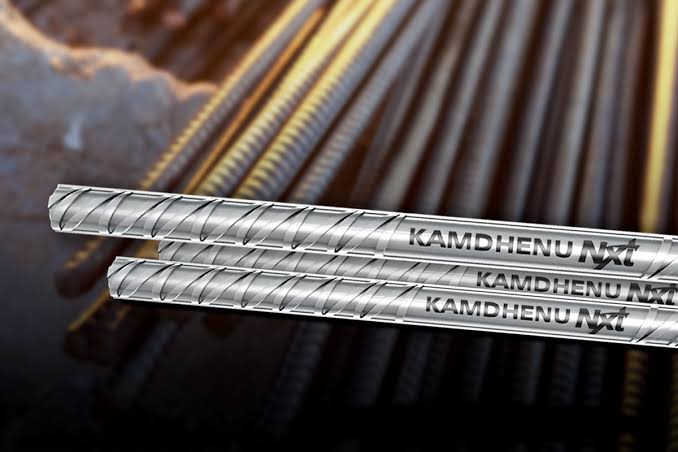
Kamdhenu Nxt TMT bars are available in Fe 500, Fe 550, Fe 500D and Fe 550D. The product is positioned as next generation interlock steel with a double-rib design for better concrete bonding.
For more demanding projects, Kamdhenu PAS 10000 is positioned as a high-performance power alloy steel product for 10000 PSI concrete structures. Kamdhenu also highlights 28% higher load-bearing capacity and 200% higher bond strength for PAS 10000.
This gives buyers multiple options. Regular projects can select Kamdhenu Nxt grades. Premium and critical projects can evaluate PAS 10000 with engineer approval.
When Not to Upgrade
High strength steel is not needed everywhere.
Do not upgrade when:
- The drawing clearly specifies a standard grade
- The project is small and load demand is normal
- The site team wants to reduce bar quantity without redesign
- The structural consultant has not approved the change
- Bending requirements may not suit the selected grade
Wrong substitution can harm safety and approval compliance.
Buying Checklist
Before buying high strength TMT bars, check:
- Engineer's specified grade
- BIS certification
- Test certificate
- Diameter and quantity
- Ductility requirement
- Bar marking
- Bundle identification
- Supplier authenticity
- Bendability needs
- Storage condition
Steel purchase should be documented. This helps during quality audits and later project reviews.
Final Takeaway
High strength TMT bars are useful when the structure demands higher performance.
Fe 500 suits many regular projects. Fe 550 and Fe 550D suit heavier and more demanding designs. Fe 550D benefits become important where strength and ductility are both required.
For premium TMT bar India options, Kamdhenu offers grade choices through Kamdhenu Nxt and high-performance steel through Kamdhenu PAS 10000.
Choose steel by design. Not by guesswork.
A Practical Example
A single-storey house and a commercial tower do not need the same reinforcement strategy.
The house may use Fe 500 or Fe 500D as per design. The tower may need higher grade bars in selected members. A heavy industrial structure may need a different approach again.
This is why steel grade should not be decided at the shop counter. It must come from drawings and structural calculations.
The best purchase is not the strongest bar in the market. The best purchase is the correct bar for the project.
Quick FAQs
Can high strength steel reduce total steel quantity?
It may help in some designs. But only a qualified engineer can make that decision.
Should homeowners ask for Fe 550D?
They can ask the engineer if it suits the project. They should not change the grade without approval.
Procurement Note
Do not mix standard and high strength bars at site unless the drawings clearly permit it. Store bundles separately and mark them clearly to avoid placement errors.