 March 18 2026
Branded TMT Bars for Commercial Builds
Commercial sites move fast. Steel arrives in phases. Teams change. So does accountability.
That is why branded TMT bars matter more on commercial projects than on small homes. Not because a brand is a logo—but because branded supply is easier to verify, trace, and repeat.
This is also about safety. India is a seismic country. About 59% of India’s landmass is vulnerable to earthquakes. In that environment, reinforcement quality cannot be a guess.
Rebar is also a large national category. Bars and rods accounted for 42% of India’s finished steel consumption in FY24, about 59 million tonnes. At this scale, counterfeits and substitutions exist—and both sites and procurement teams see it.
So the real question is simple: How do you reduce the substitution window?
This blog provides a practical protocol for buyers, engineers, and contractors. It uses Kamdhenu Nxt as a reference where required.
What Branded TMT Bars Should Mean on Site
A branded bar should deliver four essentials:
- Standard alignment
- Measurable properties
- Traceability
- Easy field identification
In India, high-strength deformed bars are governed by IS 1786. BIS also publishes a product manual covering certification and inspection practices, including:
- Nominal size
- Mass
- Tensile properties
- Bend and rebend tests
This is your baseline. A brand should make it easier to meet this baseline consistently.
The Real Risk Is Not Quality—It Is Mix-Ups
Consider a common commercial scenario:
- A project procures Fe 550 for columns
- A local urgent purchase is made for slabs
- Bars are stored in a common yard
- Tags tear or go missing
On pour day, no one can verify what went where. Even if the steel quality is fine, documentation fails—and disputes begin.
The solution is not complexity. It is a simple, repeatable system.
The 3 Gate Protocol for Branded TMT Bars
Gate 1: Purchase Gate (Before Bulk PO Release)
Keep the checklist short and strict:
- Ask for IS 1786 compliance references
- Request heat-wise test certificates
- Freeze grade and diameter schedule with structural consultant
- Confirm sizes and dispatch phasing
Now add product-specific verification.
For Kamdhenu Nxt (Fe 550), listed specifications include:
- Yield stress: ≥ 565 N/mm²
- Tensile strength: ≥ 610 N/mm²
- Elongation: ≥ 14%
- TS/YS ratio: ≥ 1.08
Chemical limits include:
- Carbon ≤ 0.25%
- S + P ≤ 0.095%
These values enable like-to-like comparison and help consultants validate design assumptions.
Also ask about process control. Kamdhenu Nxt describes:
- Billet sampling
- Billet manufacturing through CCM
- Thermo mechanical treatment (controlled water cooling)
- Rolling checks within tolerances
- Testing as per IS 1786
- Dispatch after test certificate validation
This gives visibility into quality checkpoints.
Gate 2: Unloading Gate (At Site Delivery)
This is where substitution is stopped. Perform checks every time.
For Kamdhenu Nxt, verify:
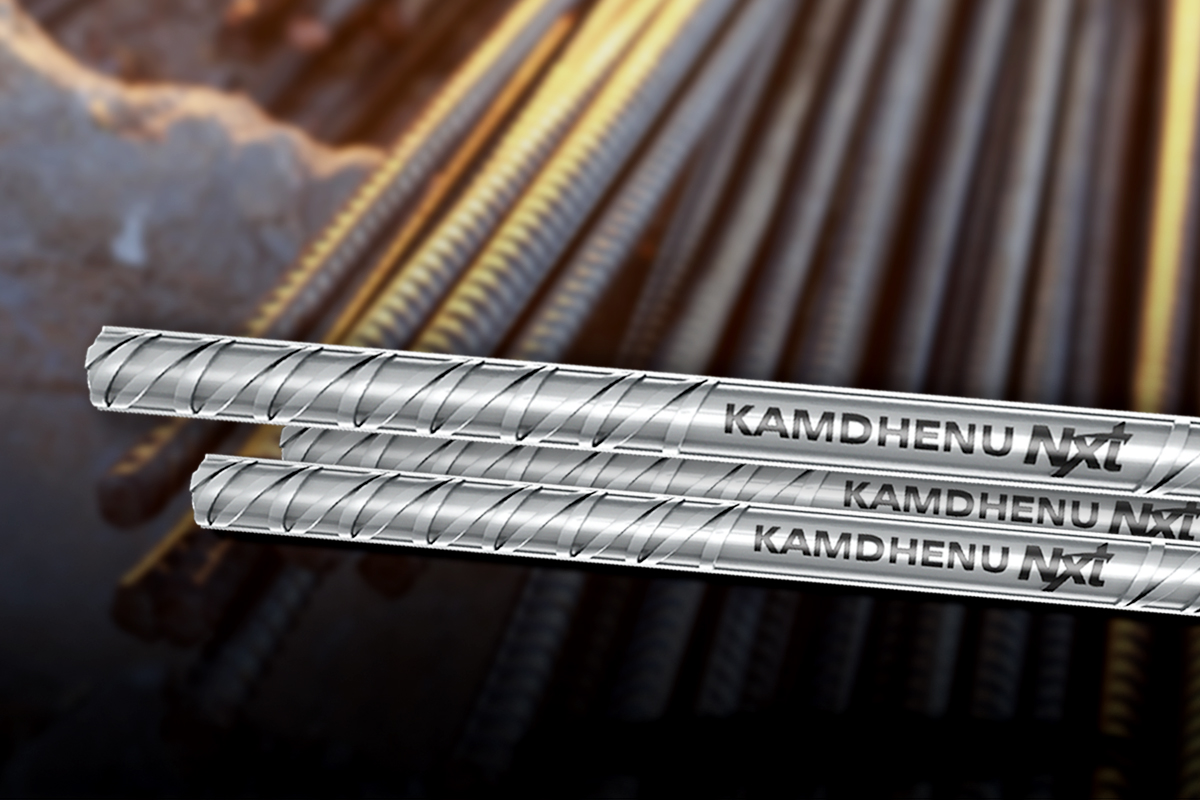
- Stamp on every meter of the bar
- Red Kamdhenu strip on every bundle
- QR code on bundle tag
These checks should be completed before unloading approval.
Add quick physical checks:
- Measure diameter using a vernier
- Perform a bend test (if QA permits)
- Check for rust, pitting, or oil contamination
These are rapid risk filters—not replacements for lab tests.
Gate 3: Pre-Pour Gate (Before Casting)
This stage focuses on handling discipline:
- Store bars on sleepers
- Separate diameters clearly
- Keep tags visible
- Avoid mixing leftover steel without re-tagging
For large pours, add one rule:
Do not accept unrecorded late-night deliveries. This is a major entry point for substitutions.
Why Branded Bars Reduce Total Cost
Commercial projects cannot afford rework or delays.
Kamdhenu Nxt highlights:
- Potentially higher strength (up to 20% more vs conventional steel)
- Approximately 4% less weight per meter
These should be treated as project assumptions—not guarantees. Structural consultants must validate quantities, and procurement must verify delivered material.
However, consistent branded supply improves predictability—and predictability reduces cost.
Where Kamdhenu Nxt Fits Best
Suitable for high-impact structural zones:
- Infrastructure projects
- High-rise buildings
- Modern architectural structures
- Earthquake-prone zones
Critical members include:
- Columns
- Shear walls
- Transfer zones
- Heavily loaded slabs
- Structural joints
These areas demand maximum traceability and consistency.
Quick Buyer Checklist for Branded TMT Bars
What to Insist On
- IS 1786 compliant documentation
- Heat-wise test certificates
- On-bar and bundle-level identification
What to Avoid
- Loose bundles without readable tags
- Mixed diameters in one stack
- Unrecorded urgent purchases
What to Record
- Delivery date
- Truck number
- Bundle count
- QR/tag photos
Simple Next Steps
Start with the 3 Gate Protocol. Then shortlist one supply route and keep it consistent.
For Kamdhenu Nxt, use the product page to compare specifications and identification markers.
For bulk enquiries, use the “Request a Quote” option or the official contact section.
That is the most practical way to buy. It protects quality, safeguards schedules, and keeps accountability clear as projects scale.