March 16 2026
Best Quality TMT Bars Suppliers for Bulk Projects
Rebar is not a small purchase anymore. It is a planning item. It is also a risk item.
In FY24, bars and rods accounted for 42% of India’s finished steel consumption, about 59 million tonnes. Demand is expected to rise as India’s urban floor area is projected to more than double by 2040, reaching 35 billion square metres.
So procurement teams have to be sharper. They need suppliers who can deliver quality at scale. They also need proof.
This matters even more because India is seismically active. A government reply in Parliament notes that about 59% of India’s landmass is prone to earthquakes of different intensities. Zone V alone covers about 11% of the country’s area.
That is why contractors search for the best quality TMT bars suppliers. They want strength. They also want ductility, bond, and traceability.
This blog shares a practical commercial checklist. It is written for bulk buyers. It is also written for site engineers who sign off on steel.
Step 1: Start With the Standard, Not the Sales Pitch
In India, reinforcement steel is governed by IS 1786. BIS also publishes a product manual for certification and inspection practice under IS 1786.
What to Ask from Any Supplier
- BIS licence details for the manufacturing unit
- Heat-wise test certificate for your lot
- Clear mention of grade and size group
Why this matters: IS 1786 is built around performance requirements. It covers mechanical tests, bend and rebend tests, and surface characteristics.
If a supplier cannot share documentation early, move on. That is not a “later” issue. That is a procurement risk.
Step 2: Use a Simple Supplier Scorecard
Here is a scorecard that many commercial teams use. Keep it on one page.
Quality and Compliance
- BIS and IS 1786 proof
- Batch test certificate with heat numbers
- In-house lab or recognized third-party testing
Site Performance
- Bond and rib consistency
- Bend and rebend behaviour
- Dimensional accuracy and weight consistency
Supply Reliability
- Availability across locations
- Dispatch discipline
- Replacement policy for damaged stock
Commercial Clarity
- Rate validity window
- Credit terms
- Delivery terms and unloading scope
This is how you separate real best quality TMT bars suppliers from traders.
Step 3: Check What “Bond Strength” Looks Like on a Real Site
Concrete cracks in tension. Steel carries that tension. The link between them is a bond.
If the bond is weak, the steel can slip. Crack widths can increase. Deflection control becomes harder.
Kamdhenu NXT is positioned as “Next Generation Interlock Steel.” It highlights a double rib design for superior interlock with concrete. It is a practical feature for structural members where anchorage and crack control matter.
So when your team compares best quality TMT bars suppliers, do not skip ribs. Ask for rib pattern consistency. Inspect it before unloading.
Step 4: Ask for Mechanical Numbers, Then Match Them to Your Design Need
Commercial work is not only about a higher grade. It is about predictable behaviour.
Kamdhenu NXT lists technical specifications for Fe 550:
- Yield stress minimum 565 N/mm²
- Tensile strength minimum 610 N/mm²
- Elongation minimum 14%
- TS to YS ratio ≥ 1.08
It also lists chemical limits like carbon ≤ 0.25% and combined S+P ≤ 0.095%.
Use these numbers correctly. Match grade selection to the structural design. Do not let procurement override design intent.
Step 5: Verify Process Controls, Not Just the Result
Two lots can look identical. But they can perform differently.
Kamdhenu NXT describes its manufacturing flow in clear steps:
- Billet sampling
- Billet making through CCM
- Thermo mechanical treatment with controlled water cooling
- Rolling checks within tolerances
- Testing as per IS 1786
This is what maturity looks like—defined checkpoints, defined testing, and defined dispatch controls.
That is a key trait of best quality TMT bars suppliers.
Step 6: Run Three On-Site Checks That Catch Most Problems
Kamdhenu’s own site guidance on identifying genuine TMT bars recommends systematic checks, including marking verification, BIS compliance, and bend testing.
Use This Quick Routine
Marking Check
Look for consistent rolled marks. Reject blurry or irregular marks.
Bend Test Check
A genuine bar bends smoothly without surface cracks.
Weight and Diameter Check
Measure the diameter with a vernier. Weigh random bars and compare with standard charts.
For Kamdhenu NXT, specific identifiers include:
- Stamp on every meter
- Red strip on every bundle
- QR code on the bundle tag
These are practical checks that help prevent material substitution.
Step 7: Supply Reach Matters in Commercial Projects
Commercial projects do not buy once. They buy in phases.
Kamdhenu’s partner network includes:
- 10,000+ dealers
- 500+ distributors
- Large production footprint
This matters for multi-site projects and changing project logistics.
A Clean Buying Flow You Can Copy
- Freeze grade and diameter schedule with your structural consultant
- Shortlist 2 to 3 best quality TMT bars suppliers
- Collect BIS details and heat-wise sample certificates
- Run a small trial lot
- Do on-site checks at unloading
- Lock rate and delivery plan
- Scale to monthly bulk procurement
Conclusion
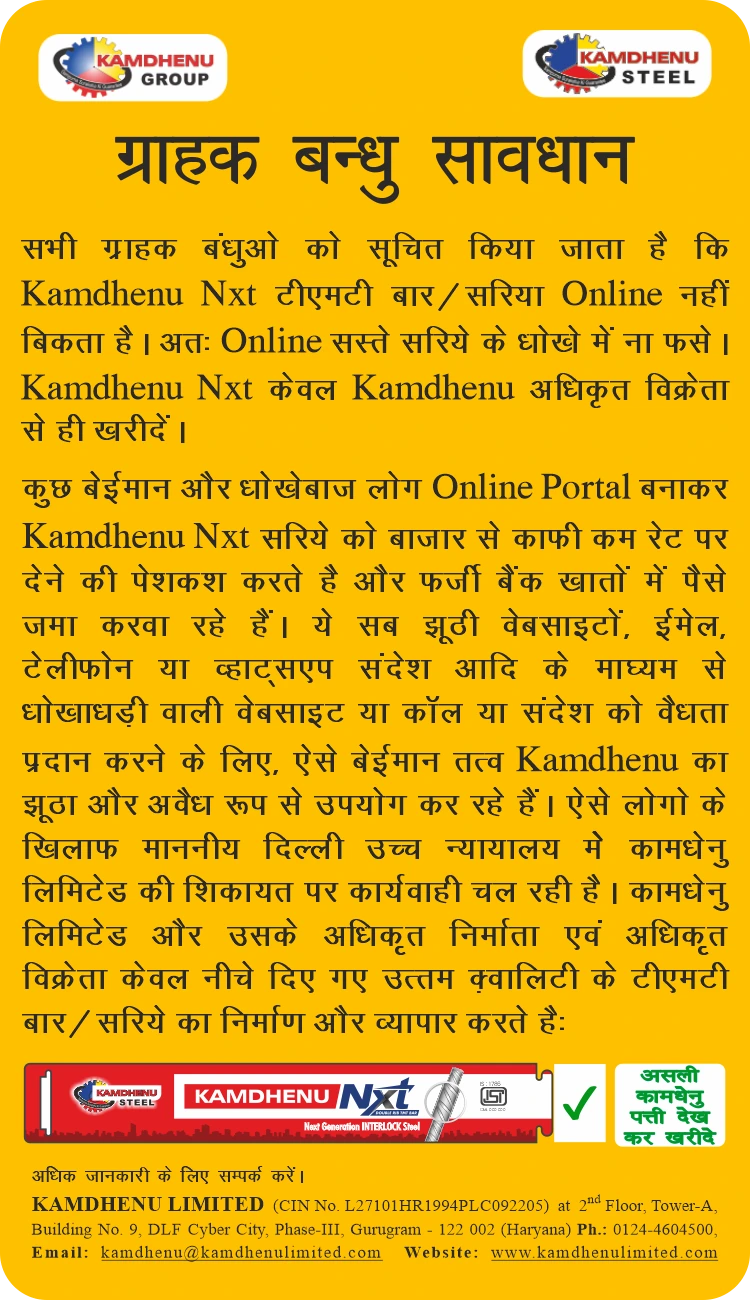
If your project needs Kamdhenu NXT TMT bars, keep procurement clean. Use authorized channels. Keep documentation aligned to IS 1786.
For bulk enquiries, use the official contact form and select your state and district.
That is how you buy with confidence. And that is how serious projects shortlist the right supplier.