 July 12 2026
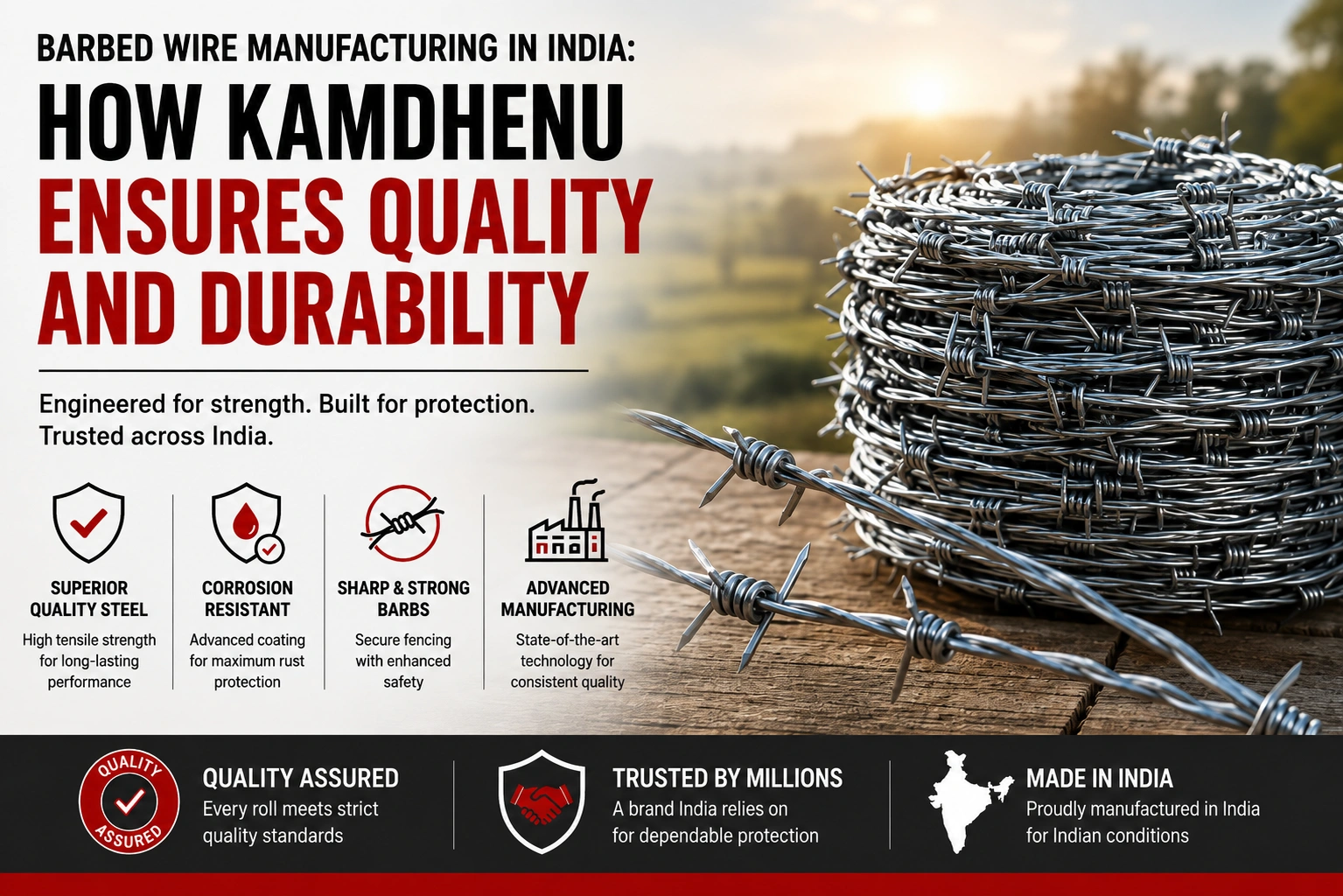
Barbed Wire Manufacturing in India: How Kamdhenu Ensures Quality and Durability
Barbed Wire – Manufacturing, Quality & Selection Guide
Barbed wire may appear to be a simple fencing product. Two steel line wires are twisted together, sharp barbs are fixed at regular intervals, and the finished material is wound into rolls for installation. However, small manufacturing errors can affect its safety, strength, durability and overall value.
Reliable barbed wire manufacturers control every stage of production. They inspect the steel wire rod, maintain wire diameter, control galvanising, regulate barb spacing, verify roll weight and protect the finished material during storage and transport.
Across India, barbed wire is used for agricultural land, industrial plots, warehouses, construction sites and large open boundaries. It offers an economical way to secure long perimeters, but its performance depends on consistency across the entire roll.
This guide explains how barbed wire is manufactured, which quality checks matter, why galvanising determines durability and what buyers should examine before selecting a manufacturer.
What Is Barbed Wire?
Barbed wire is a perimeter fencing material made by twisting two steel line wires together and fixing short, sharp wire points at regular intervals. The twisted line wires provide the main strength, while the barbs create a visible and physical deterrent.
It is commonly used as boundary fencing wire for:
- Agricultural farms and livestock areas
- Industrial properties
- Warehouses and storage yards
- Vacant plots
- Construction sites
- Government and institutional land
- Large commercial boundaries
Compared with solid boundary walls, barbed wire is generally faster and more economical to install across large distances. It also allows clear visibility of the surrounding area. However, its effectiveness depends on wire quality, coating, post strength, barb formation and installation workmanship.
How Barbed Wire Is Manufactured in India
The quality of the finished product depends on several connected manufacturing stages. Responsible barbed wire manufacturers maintain control from raw material selection to final packing.
1 Selecting the Steel Wire Rod
Manufacturing begins with steel wire rod of suitable chemistry, strength and surface condition. The rod should draw smoothly without excessive cracking or frequent breakage.
Surface scale, contamination and irregularities must be controlled before further processing. Poor-quality raw material can produce uneven diameter, weak sections and repeated breaks during wire drawing or barb formation.
Good barbed wire manufacturers record incoming material batches and inspect them before production. The objective is not only to achieve strength. The wire must also retain enough workability for drawing, twisting and forming secure barbs.
India has a large domestic steel supply base. The Ministry of Steel reported crude steel production of 168.4 million tonnes between April 2025 and March 2026, while finished steel production reached 160.9 million tonnes during the same period. While production scale supports material availability, consistent quality still depends on disciplined manufacturing controls.
2 Wire Drawing
During wire drawing, the steel rod is pulled through a series of dies. Each die gradually reduces the wire diameter until the required size is achieved.
Wire diameter directly affects strength, roll weight, material content and price. If the diameter varies significantly across the roll, the fence may tension unevenly and perform inconsistently.
Modern manufacturing lines monitor drawing speed, lubrication and die condition. Finished wire is measured using suitable gauges or micrometres.
Buyers should ask for the nominal diameter in millimetres rather than relying only on traditional gauge descriptions. Diameter provides a clearer and more measurable basis for comparing products from different barbed wire manufacturers.
3 Cleaning and Galvanising
Steel begins to rust when it is exposed to moisture and oxygen. Galvanising protects the surface by applying a zinc coating.
Before galvanising, the steel wire must be cleaned properly so that the zinc layer can bond with the surface. The wire then passes through the selected galvanising process.
A continuous and properly adhered zinc coating supports longer service life in exposed environments. This is especially important for galvanized barbed wire India, where site conditions can range from dry inland heat to coastal humidity, industrial exposure and heavy monsoon rainfall.
Coating quality should not be judged only by appearance. A bright or shiny wire may still have a light, uneven or poorly bonded zinc layer. Manufacturers should check:
- Zinc coating mass
- Coating adhesion
- Surface continuity
- Exposed steel areas
- Flaking or scaling
The coating should be evaluated according to the applicable product specification and internal quality plan.
4 Stranding the Line Wires
Two line wires are fed into a barbing machine and twisted together. This twist holds the wire construction in place and helps secure the barbs.
The machine must maintain consistent feed and tension. Irregular movement can create loops, loose sections or changes in twist pitch.
The line wires carry the primary tensile load in the finished fence. They should remain continuous and free from harmful splices, cracks or major surface defects.
IS 278:2009 covers two-strand galvanised steel barbed wire in different constructions and sizes. It also includes requirements related to galvanising and freedom from defects.
5 Forming and Fixing the Barbs
Short wire pieces are wrapped around the twisted line wires to form sharp points. Barb length, shape, sharpness and spacing should remain reasonably consistent throughout the roll.
Loose barbs can rotate, slide or detach during handling and installation. Blunt or poorly formed points reduce the deterrent effect of the fence.
Machine settings require regular monitoring because worn tooling may produce weak or uneven barb points. Operators must also ensure that barb formation does not damage the zinc coating on the main line wire more than necessary.
Good-quality barbed wire should unwind without excessive tangling. It must remain manageable during installation while still forming a clear physical and visual barrier.
6 Winding, Weighing and Packing
Once production is complete, the finished barbed wire is wound into compact reels. Each roll should be secure, manageable and correctly identified.
The manufacturer checks the net weight and, where applicable, verifies approximate roll length. Good packing prevents the roll from opening during transportation and protects workers handling the material.
Packing also reduces abrasion that could damage the zinc coating. Labels should ideally include:
- Product name
- Nominal diameter or gauge
- Net roll weight
- Batch details
- Manufacturer information
- Applicable specification, where relevant
Proper identification improves traceability and makes it easier to address quality concerns or repeat-order requirements.
Quality Checks That Matter
A responsible manufacturer should not depend only on visual inspection. A suitable quality plan for barbed wire may include:
- Wire diameter measurements at multiple points
- Tensile strength and elongation checks, where specified
- Zinc coating mass and adhesion tests
- Barb spacing measurements
- Barb sharpness and formation inspection
- Roll weight and approximate length verification
- Surface checks for scaling, flaking and exposed steel
- Unwinding tests to identify tangling or weak joints
- Label and batch traceability review
These checks help protect both the manufacturer and the buyer. They also support consistency across repeat orders and large project quantities.
Why Galvanising Quality Determines Durability
The service life of barbed wire depends heavily on the zinc coating and the conditions in which the fence is installed.
Salt-laden coastal air, fertilisers, industrial chemicals, standing water and prolonged humidity can accelerate corrosion. Scratches and impact damage may also expose the underlying steel and create local rust points.
A durable boundary fencing wire system should therefore include:
- A suitable zinc coating
- Correctly spaced and properly founded posts
- Careful material handling
- Compatible fasteners and ties
- Proper wire tension
- Regular inspection and maintenance
Fence wires should not remain in direct contact with soil or standing water. Vegetation that holds moisture against the wire should be removed.
For severe environments, buyers should ask whether heavier galvanising or an alternative protective coating is available. Not every silver-coloured wire provides the same level of corrosion resistance.
Benefits of High-Quality Barbed Wire
Well-manufactured barbed wire offers several practical advantages when it is correctly selected and installed.
Consistent Perimeter Security
Uniform diameter, strong line wires and properly formed barbs create a dependable deterrent across the entire fence.
Longer Service Life
A continuous and well-adhered zinc layer helps delay corrosion, especially in outdoor and high-rainfall environments.
Lower Material Wastage
Wire that unwinds smoothly and does not break frequently is easier for contractors to install.
Better Cost Efficiency
Consistent roll weight, diameter and coating help buyers evaluate the actual value of the product rather than comparing only the price per roll.
Easier Installation
Correct winding, secure barbs and manageable reel construction reduce tangling and unnecessary handling difficulties.
Improved Traceability
Batch records, product labels and testing information support complaint handling and repeat-order consistency.
Factors Affecting Barbed Wire Quality and Price
The price and performance of barbed wire may vary based on:
- Steel wire diameter
- Raw material quality
- Tensile properties
- Zinc coating level
- Barb spacing
- Net roll weight
- Approximate roll length
- Packing quality
- Order quantity
- Freight and delivery location
Buyers should not compare quotations based only on the price per roll. Two rolls may have different weights, diameters, coatings or lengths.
A fair comparison requires the same nominal diameter, coating specification, roll weight and delivered location.
How to Identify a Responsible Barbed Wire Manufacturer
Buyers should shortlist barbed wire manufacturers that provide clear technical and commercial information.
| Buyer question | Why it matters |
|---|---|
| What is the nominal wire diameter? | Confirms the material content and strength basis |
| What coating is used? | Indicates the expected level of corrosion protection |
| Which standard is followed? | Creates a measurable acceptance basis |
| What is the net roll weight? | Prevents misleading price comparisons |
| Is batch testing recorded? | Supports traceability and complaint handling |
| How is the roll packed? | Reduces transport damage and handling risks |
| Can samples be provided? | Allows buyers to inspect the product before ordering |
Reliable barbed wire manufacturers should be able to explain their product specification without relying only on brand claims or visual appearance.
How Kamdhenu Approaches Barbed Wire Quality
Kamdhenu's Wirebond brochure states that its barbed wire is manufactured using modern technology and quality raw material. It also states that the product is tested before market release and manufactured under ISO 9001:2015 quality systems.
The brochure identifies Kamdhenu barbed wire as Iowa type and highlights standard gauge, size and finish.
Project buyers should still obtain the latest product specifications, availability and technical confirmation from an authorised Kamdhenu channel partner before placing an order.
Installation Tips for Long-Lasting Barbed Wire Fencing
Manufacturing quality can be protected or wasted during installation. Even high-quality boundary fencing wire may fail early if the posts are weak or the wire is handled carelessly.
Use Strong Posts
Posts must be capable of carrying the tension applied to the wire. Corner, gate and end posts need stronger foundations and proper bracing.
Maintain Even Tension
Each strand should be tensioned evenly. Over-tensioning can pull posts out of alignment, while low tension may cause sagging.
Protect the Zinc Coating
Do not drag rolls over stones, concrete or rough ground. Scratches can expose the steel and create early corrosion points.
Use Compatible Fasteners
Avoid using untreated steel ties that may rust before the main wire. Fasteners should provide a similar level of corrosion protection.
Keep the Wire Above Ground
The wire should not rest directly on soil or remain exposed to standing water. Ground contact can accelerate corrosion.
Use Proper Tools
Workers should use gloves and suitable unwinding and tensioning equipment. Improvised handling increases the risk of injury, tangling and coating damage.
Common Mistakes to Avoid
Common mistakes when buying or installing barbed wire include:
- Selecting material only on the lowest price
- Comparing rolls with different diameters or weights
- Ignoring the zinc coating specification
- Assuming all bright wire is heavily galvanised
- Buying from suppliers who cannot provide traceability
- Dragging rolls across rough surfaces
- Using weak or poorly founded posts
- Applying uneven or excessive tension
- Allowing vegetation to remain against the fence
- Ignoring damaged coating or loose wire sections
Avoiding these mistakes can significantly improve fence performance and service life.
Maintenance Tips
A barbed wire fence should be inspected regularly, particularly after monsoon, strong winds or construction activity near the boundary.
Maintenance should include:
- Checking for loose or sagging strands
- Inspecting posts, braces and gate connections
- Removing vegetation and debris
- Repairing scratches and exposed metal
- Replacing damaged fasteners and ties
- Tightening loose sections before sagging becomes severe
- Checking for localised corrosion near the ground
Prompt repairs prevent small defects from spreading across the fence.
Frequently Asked Questions
What makes high-quality barbed wire durable?
Durability depends on consistent wire diameter, suitable tensile strength, secure barb formation, proper galvanising, careful packing and correct installation.
Why is galvanising important for barbed wire?
Galvanising places a protective zinc layer over steel. This delays rust and helps the wire withstand rainfall, humidity and outdoor exposure.
How can buyers compare different barbed wire products?
Compare nominal diameter, zinc coating, barb spacing, roll weight, approximate length, specification, packing and delivered cost. Do not compare only the price per roll.
Which standard applies to galvanised barbed wire in India?
IS 278:2009 covers two-strand galvanised steel barbed wire in different constructions and sizes, including requirements related to galvanising and freedom from defects.
Can barbed wire be used in coastal areas?
Yes, but coastal environments can accelerate corrosion. Buyers should consider heavier galvanising or another suitable protective coating and conduct more frequent inspections.
Why does roll weight matter?
Roll weight helps confirm material quantity and enables fairer price comparisons. A cheaper roll may contain less wire or use a smaller diameter.
What information should a manufacturer provide?
A manufacturer should provide nominal diameter, coating information, roll weight, applicable specification, batch identification, packing details and testing information where relevant.
Can poor installation damage good-quality barbed wire?
Yes. Weak posts, excessive tension, rough handling and incompatible fasteners can shorten the life of otherwise well-manufactured wire.
Conclusion
Good fencing begins inside the factory. Reliable barbed wire manufacturers control raw material quality, wire diameter, galvanising, twisting, barb formation, roll weight, packing and traceability.
Kamdhenu's published product information highlights modern production methods, standard gauge and quality testing. Buyers should combine this manufacturing discipline with proper product selection, installation and maintenance.
The result is a boundary fencing wire system that remains secure, manageable and economical for a longer period.