 June 19 2026
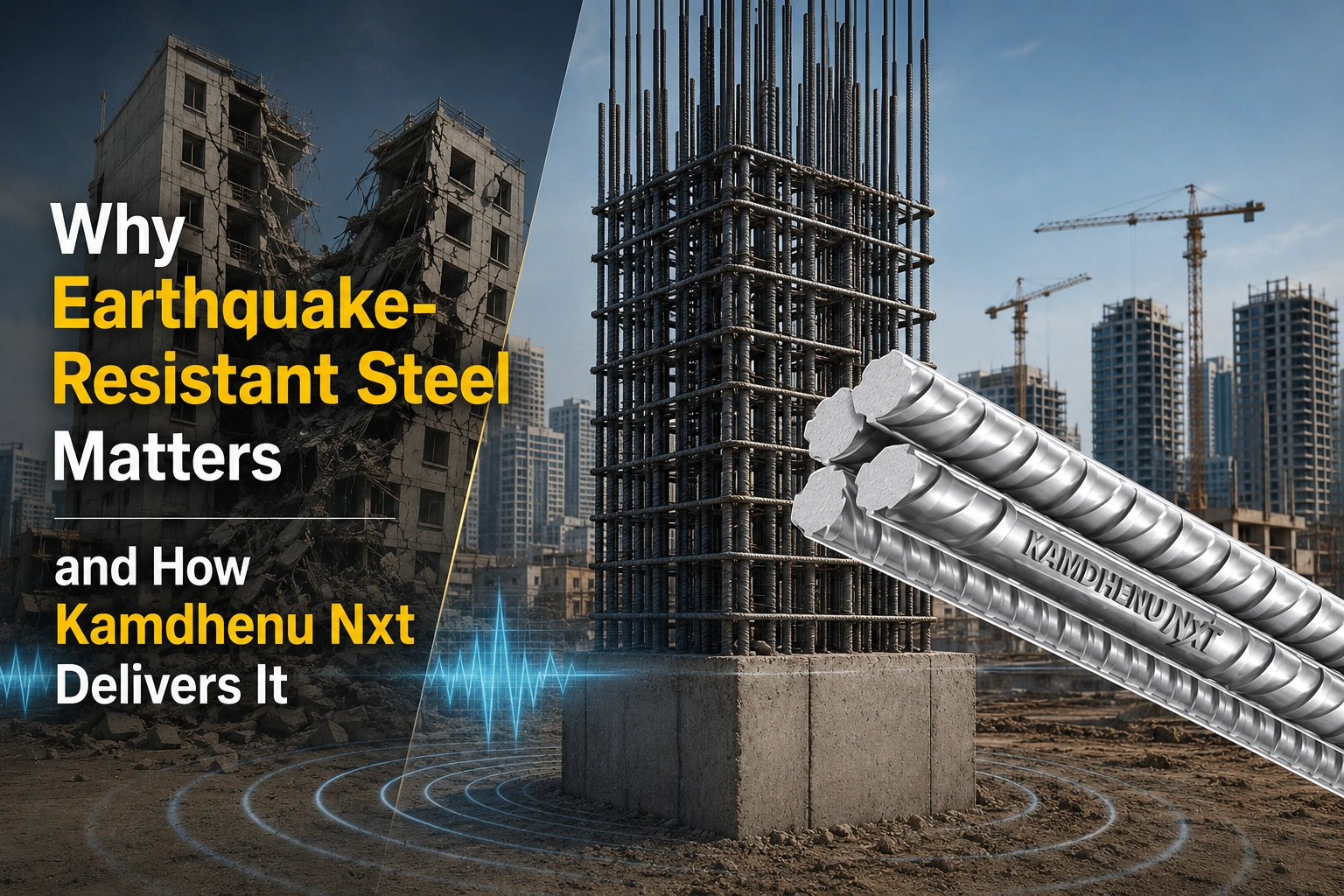
Why Earthquake-Resistant Steel Matters and How Kamdhenu Nxt Delivers It
Earthquakes do not give warning.
They test the structure suddenly. They test every joint. They test every column. They test every beam. This is why material selection matters in seismic zone construction.
A safe building needs good design, proper detailing, correct concrete and reliable steel. Among these, reinforcement steel plays a major role.
Earthquake resistant TMT bars are designed to support strength and ductility. Ductility means the ability to stretch and deform before failure. This is important during seismic movement.
Kamdhenu Nxt TMT bars are positioned as earthquake resistant steel with a unique double-rib design for superior bonding and structural strength.
Why Steel Matters During an Earthquake
During an earthquake, a building moves laterally.
This creates stress in beams, columns and joints. The structure must absorb this movement without sudden collapse. This is where high ductility steel becomes important.
A brittle bar can fail suddenly. A ductile bar can bend and stretch more before failure. This gives the structure better energy absorption.
Good seismic performance depends on:
- Structural design
- Ductile detailing
- Correct bar grade
- Proper anchorage
- Good concrete quality
- Skilled workmanship
- Reliable material testing
Steel alone cannot make a building earthquake-proof. But good steel supports the engineer's design intent.
India and Seismic Design
India has several earthquake-prone regions. The Himalayan belt, parts of the North-East, Kutch, Andaman and Nicobar, and other areas need careful seismic design.
IS 1893 is the Indian standard used for criteria for earthquake resistant design of structures. It includes provisions for seismic design and zonation.
This is why seismic zone construction should not be treated like regular construction. The material and detailing must match the risk.
For RCC buildings, ductile reinforcement is a practical part of this approach.
What Makes TMT Bars Suitable for Seismic Work?
A good TMT bar for seismic work should provide strength and ductility.
Strength helps carry load. Ductility helps the bar deform without sudden breaking. Bonding helps concrete and steel act together.
Important properties include:
- Adequate yield strength
- Higher elongation
- Good bendability
- Consistent rib pattern
- Good concrete bond
- Controlled chemistry
- Standard compliance
The D in Fe 500D or Fe 550D stands for higher ductility. These grades are often preferred for safer structural behaviour when specified by engineers.
How Kamdhenu Nxt Supports Safer Construction
Kamdhenu Nxt is described as next generation interlock steel. Its unique double-rib design supports better bonding with concrete. The product is positioned for earthquake resistance and superior structural strength.
Kamdhenu Nxt TMT bars are available in Fe 500, Fe 550, Fe 500D and Fe 550D grades. These grades are supplied against IS 1786:2008 for chemical composition, mechanical properties and dimensional tolerances.
The bars are made through thermo-mechanical treatment. Kamdhenu explains that the process includes quenching, tempering and cooling. This gives the bar strength, ductility and toughness.
This combination matters for safe building materials.
Double-Rib Bonding and Earthquake Resistance
Bonding is critical in RCC.
When the structure shakes, load transfer between concrete and steel becomes important. If steel slips inside concrete, the member loses performance. A better rib pattern improves grip.
Kamdhenu Nxt uses a double-rib design. This improves mechanical interlocking with concrete.
Better interlocking can help in:
- Beam-column joints
- Anchorage zones
- Slabs and beams
- Footings and columns
- High-stress RCC members
- Earthquake-resistant design details
This feature supports the structure. It does not replace engineering design. But it gives the designer and builder a stronger reinforcement option.
Comparison: Regular Steel vs High Ductility Steel
| Factor | Regular Reinforcement | High Ductility Steel |
|---|---|---|
| Strength | May meet basic load needs | Meets strength with better elongation |
| Behaviour under stress | Can be less forgiving | Deforms more before failure |
| Seismic suitability | Depends on grade and design | Better suited where ductility is specified |
| Detailing need | Still important | Still essential |
| Safety focus | Basic reinforcement | Improved energy absorption support |
This is why D grades should be considered where structural drawings call for them.
What Builders Should Check
For earthquake-prone areas, material checks must be stricter.
Before buying earthquake resistant TMT bars, check:
- Grade specified in drawing
- D grade requirement
- IS 1786 compliance
- Test certificate
- Bar diameter and weight
- Bendability
- Brand marking
- Bundle identification
- Supplier reliability
- Site storage
Do not mix grades without approval. Do not allow unmarked bars in critical RCC members.
Common Mistakes to Avoid
Many site problems begin with small shortcuts.
Avoid these mistakes:
- Using lower grade than specified
- Ignoring ductility in seismic areas
- Cutting anchorage length at site
- Poor tying of reinforcement
- Wrong lap length
- Inadequate cover blocks
- Rusted or doubtful steel
- Missing test certificates
A safe building is built by discipline, not by chance.
Why Kamdhenu Nxt Is a Reliable Choice
Kamdhenu Nxt offers a clear product proposition for safer RCC work.
It has double-rib bonding. It has multiple grade options. It follows IS 1786:2008 for key properties. It is backed by brand traceability through metre stamping and bundle identification.
For builders, this helps reduce risk. For homeowners, it improves confidence. For engineers, it supports design execution.
Final Takeaway
Earthquake safety starts with design. But it does not end there.
The right steel grade, correct detailing and reliable material quality are essential. High ductility steel is important where seismic performance matters.
Kamdhenu Nxt TMT bars support earthquake-resistant construction through double-rib bonding, TMT processing, grade options and traceability.
For seismic zone construction, choose safe building materials. Choose steel that supports strength, bonding and ductility.
Material Is Only One Part of Seismic Safety
No steel bar can correct poor design.
Earthquake safety also needs correct column sizes, beam-column detailing, lap location, stirrup spacing, cover and concrete quality. The structural engineer must design the building for the correct seismic zone.
Contractors must then execute the drawing without shortcuts. Laps should not be shifted casually. Stirrups should not be reduced. Cover blocks should not be ignored.
Earthquake resistant TMT bars support this system. They do not replace it.
Quick FAQs
Can steel make a building earthquake-proof?
No material can make a building fully earthquake-proof. But ductile steel can support safer structural behaviour when used with correct design.
Which grade is better for seismic zones?
D grades such as Fe 500D or Fe 550D are often preferred when specified by the engineer because they offer higher ductility.
Procurement Note
In seismic areas, do not separate material purchase from engineering review. The grade, lap length, anchorage and detailing should be checked as one system before concreting starts.
Read more: How Earthquake-Resistant Steel is Shaping the Future of Indian Home Construction?