Why square pipes are widely used
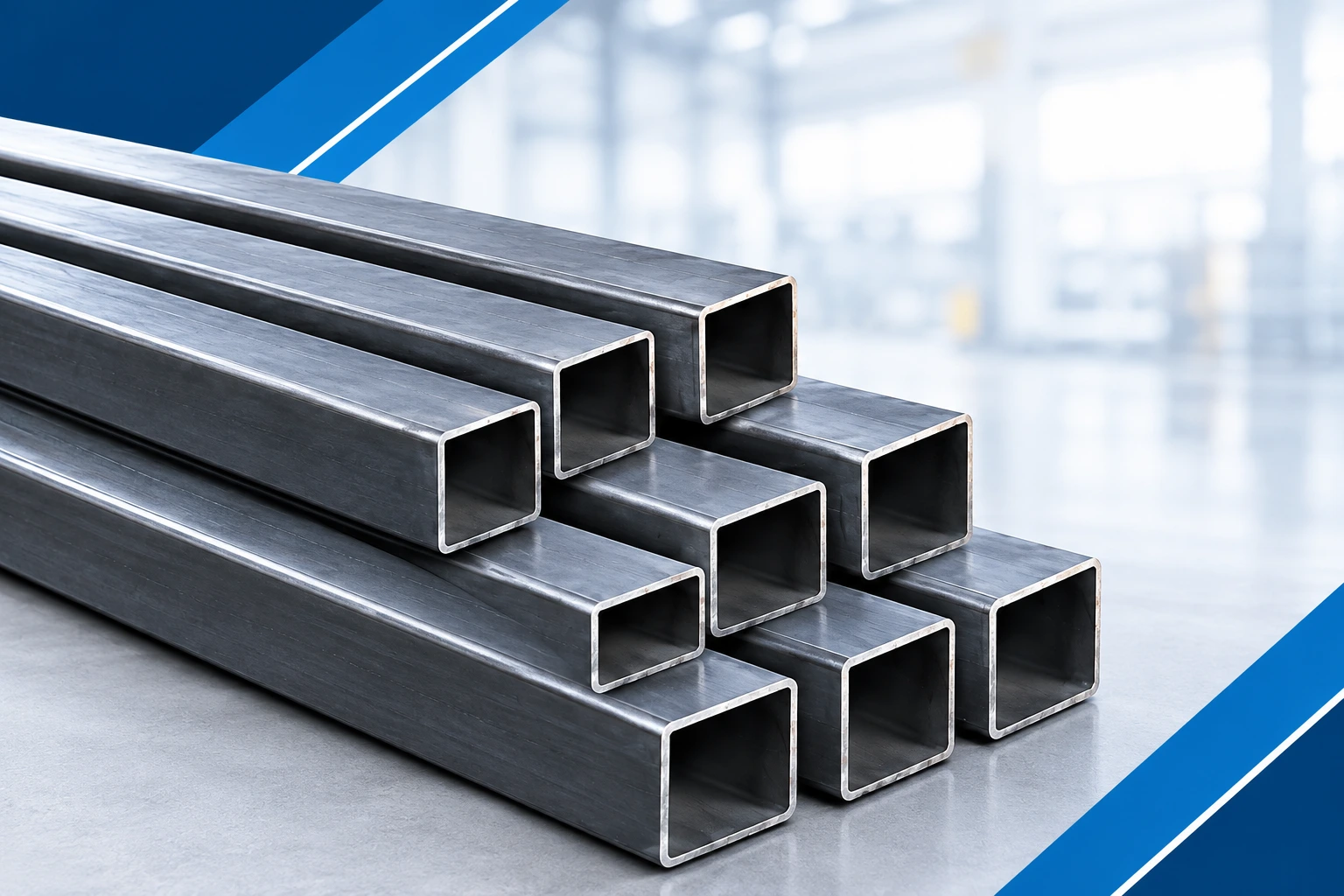
An MS Square Pipe combines four flat faces with a hollow centre. That gives fabricators a section that is easy to measure, clamp, cut, and align. It is used in gates, frames, railings, racks, canopies, furniture, light structures, and industrial fabrication.
The popularity of MS Square Pipe comes from this balance. It is lighter than a solid square bar of the same outer size, yet the closed shape provides useful bending and torsional stiffness. Flat faces also make it easier to attach plates, brackets, and cladding.
Kamdhenu Pipes are offered in circular, square, and rectangular hollow sections. Published product information highlights dimensional accuracy, fabrication ease, tensile strength, and dependable structural performance.
What is an MS square pipe?
An MS Square Pipe is a mild-steel hollow section with four equal sides. It is generally produced from steel strips or coil that is formed into shape and welded along the length.
The term square steel pipe is commonly used in the market, although structural buyers may also call it a square hollow section or SHS. The product should still be specified by outside dimension, wall thickness, length, grade, and applicable standards.
A square MS pipe should not be confused with a solid square bar. The hollow section has different weight and structural behaviour.
Common sizes and thicknesses
MS Square Pipe is available in many market sizes. The correct size depends on the application and the manufacturer's range. Kamdhenu's published hollow-section information lists square sections up to 91.5 x 91.5 mm, with a broader published thickness range of 2 mm to 5.4 mm for its hollow-section range.
These figures are product-specific, not universal market limits. Buyers should confirm actual availability before finalising drawings or cutting lists.
When comparing two sizes, look at both outside dimension and thickness. A 50 x 50 mm mild steel square pipe with a 2 mm wall is very different from a 50 x 50 mm pipe with a 4 mm wall.
Standards and specifications
For structural square and rectangular hollow sections in India, IS 4923 is an important reference. It covers material and dimensional requirements for hollow steel sections used structurally.
A professional MS Square Pipe specification should include:
- Outside size;
- Wall thickness;
- Length;
- Grade or material standard;
- Dimensional tolerance;
- Weld condition;
- Surface finish;
- Test certificate requirement;
- Coating, if any.
Do not place an order using only a local size description. A complete specification prevents confusion between a decorative tube and a structural MS hollow section.
Main construction applications
An MS Square Pipe works well in applications that benefit from flat surfaces and equal geometry.
Typical uses include gates, grills, balcony railings, stair frames, canopies, pergolas, roof trusses, equipment supports, storage racks, display structures, machine guards, signage and façade sub-frames.
The same square hollow section may also be used in structural frames when designed for the load. Engineers must check bending, compression, local buckling, connection capacity, and unsupported length.
A decorative frame and a load-bearing column should never be chosen by the same rule of thumb.
Benefits during fabrication
Flat faces are the main workshop advantage. An MS Square Pipe sits well in jigs and is easy to align at 90-degree corners. Mitre cuts are straightforward. Plates can be welded or bolted without curved saddles.
Because all four sides are equal, orientation mistakes are less common than with rectangular hollow sections. This helps with repetitive fabrication.
Other benefits include a clean appearance, high strength-to-weight ratio, useful torsional stiffness and convenient attachment of panels or infill materials.
For modular frames, these features can reduce fabrication time even when the raw material rate is not the lowest option.
Square pipe versus RHS and CHS
A square MS pipe is only one type of hollow section.
Rectangular hollow sections provide more depth in one direction, which can improve bending efficiency when orientation is known. Circular hollow sections have the same geometry in every direction and work well in columns, braces, and visible tubular structures.
An MS Square Pipe gives a middle ground. It has flat faces like RHS, but equal dimensions make orientation simple. That is why it is common in frames and architectural fabrication.
Section choice should still come from design rather than convenience alone.
Wall thickness and load capacity
Thickness changes mass, stiffness, weld behaviour and local strength. Two pipes with the same outer size may have very different performance.
A thicker MS Square Pipe generally carries more material and gives greater section capacity, but it also costs more and may require different welding heat input. A thin square steel pipe may be ideal for a light partition frame but unsuitable for heavily loaded support.
The structural engineer should select the section based on calculated loads. Procurement should then buy exactly that specification.
Corrosion protection
Mild steel needs protection when exposed to moisture. An MS Square Pipe used outdoors may be painted, galvanised or protected by another suitable coating system.
Closed sections need careful detailing. Open ends can allow water to enter. Sealed ends can trap moisture if the fabrication is poor. Drain holes, caps, and weld sealing should be planned as part of the design.
Surface preparation also matters. Paint applied over oil, loose scale or active rust will not perform well.
What to check before buying
Before accepting an MS Square Pipe lot, check the dimensions and straightness. Inspect the weld seam where visible. Look for dents, excessive twists, and damaged edges.
Ask for the applicable standard and test documentation when the product is used structurally. Confirm the available length and cutting tolerance. For large orders, check whether the supplier can maintain the same wall thickness and section quality across lots.
A reliable mild steel square pipe should be predictable in the fabrication shop, not just look clean at delivery.
Kamdhenu Pipes for square hollow applications
Kamdhenu Pipes are positioned for construction, infrastructure, and structural frameworks. The range includes square, rectangular, and circular hollow sections with emphasis on dimensional accuracy and fabrication ease.
For a buyer considering an MS Square Pipe, published size and thickness of information can be used as a starting point. Final availability should still be confirmed with the dealer or supplier before the drawing is released for production.
Final takeaway
An MS Square Pipe is practical because it combines a closed structural shape with four easy-to-work flat faces. It suits frames, gates, railings, racks, canopies, and many engineered applications.
Choose the section by outside size, thickness, grade and load. Check the standard. Plan for corrosion protection. Do not substitute for another wall thickness because the outside dimension is the same.
A correctly specified MS Square Pipe gives fabricators better alignment, cleaner connections and dependable performance. That is what turns a common square steel pipe into a useful construction component.