 March 21 2026
How to Evaluate MS Channel Manufacturers for Fast, Clean Steel Erection
Commercial projects move on deadlines.
Steel is often the first critical path item.
If steel erection slows down, everything slows down.
This is where a Structural Steel Channel becomes more than a line item.
It becomes a scheduled decision.
India’s construction and industrial build cycle is still expanding.
Finished steel consumption in 2023–24 was 136.29 million tonnes, as per a PIB release using Joint Plant Committee data.
At the same time, warehousing and industrial space continues to see healthy demand.
Colliers reported 25.6 million sq ft of industrial and warehousing gross leasing in 2024 across the top five cities.
Knight Frank reporting also points to 56.4 million sq ft of warehousing transactions across eight primary markets in 2024, up 12% year on year.
This growth has a direct effect.
More sheds.
More platforms.
More mezzanines.
More service frames.
And a lot more channels.
So buyers keep searching for MS Channel Manufacturers who can supply consistent sections.
They want fast fit-up.
They want fewer site corrections.
They want predictable quality.
Why channels create or kill site speed
A channel looks simple.
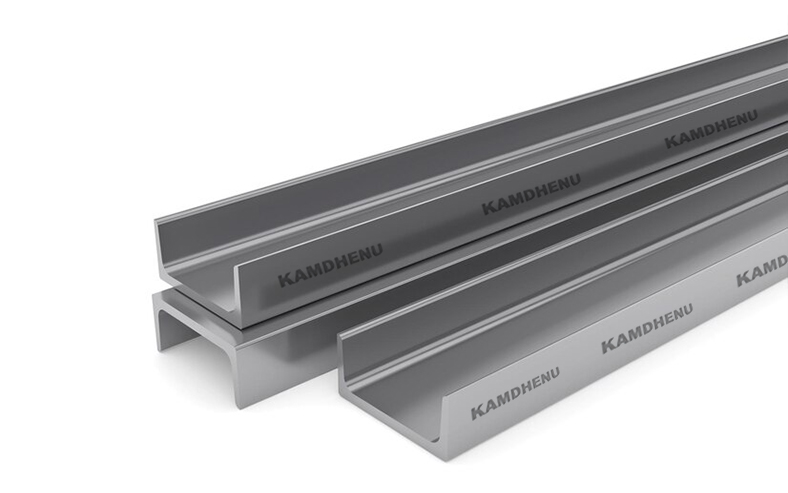
But a Structural Steel Channel is used in places where alignment matters.
Common use cases:
- Purlin lines and secondary framing in sheds
- Mezzanine beams and edge members
- Equipment platforms and walkways
- Rack support frames and utility frames
- Door and dock framing in warehouses
In most of these, holes are drilled or punched.
Brackets are welded.
Angles meet channels at tight tolerances.
If the channel is twisted or out of straight, the whole bay starts fighting you.
Kamdhenu’s structural steel page describes channels as “U/C channels built for straight, stable runs” and highlights easier bolting on flanges and alignment across the web.
That is the correct lens.
Straightness equals speed.
Start with the standard, not the brochure
In India, structural sections are commonly specified under IS 2062.
IS 2062 explicitly covers hot rolled steel for structural work, including shapes and sections like channels and beams.
BIS also publishes a product manual for IS 2062 as a reference for certification practice.
So the first filter for MS Channel Manufacturers is simple.
Ask how they align supply to IS 2062.
Then ask how they document it.
The “fit-up factor” checklist procurement teams should use
This is the part many buyers skip.
And this is where rework begins.
Use this checklist before you release a bulk PO.
1) Dimensional accuracy and straightness
Ask for stated tolerances.
Then verify on receipt.
Do not accept “it is standard.”
Kamdhenu’s structural steel brochure highlights “superior bendability, weldability and straightness” as a practical advantage for fabrication.
That is the kind of claim you should demand from any supplier, with evidence.
2) Grade and mechanical properties
A Structural Steel Channel is not only about yield strength.
Ductility matters for fabrication and service loads.
Kamdhenu Structural Steel lists minimum yield stress 250 N/mm², minimum tensile strength 420 N/mm², and minimum elongation 24% in its technical specifications.
Those numbers indicate the baseline behaviour expected for common structural grades.
3) Chemistry control for weldability
Welding problems usually show up late.
They show up as cracking, porosity, and poor bead quality.
Kamdhenu Structural Steel lists chemical limits such as carbon max 0.22% and sulphur and phosphorus max 0.045% each.
Their brochure also states structural products are produced in E250 (Fe 410W) grade as per IS 2062:2011, and mentions restricting carbon and manganese below specification to support ductility and weldability.
You should ask any supplier to share a similar chemistry discipline.
4) Mass and section weight discipline
Underweight sections create design risk.
They also create a mismatch in connections.
Kamdhenu’s brochure states supply “with section weight and dimension lower than nominal,” and mentions section weight lower than nominal up to 3%, shown under dimensional tolerances as per IS 2062:2011.
Do not treat this casually.
Ask what “nominal” and “tolerance” mean for the specific section series you are buying.
Then match it to your design assumptions.
5) Surface condition and corrosion plan
Rust is not only a storage issue.
It affects paint adhesion later.
It also affects welding cleanliness.
Ask how bundles are stored and transported.
Ask how they prevent water traps in stacking.
On receipt, reject deep pitting.
6) Supply reliability and replacement policy
Commercial projects are bought in phases.
So you need repeatable lots.
Ask these questions:
- What is the lead time by section size?
- Can you maintain the same section series in repeat orders?
- What is the replacement process if the material is bent in transit?
- What documents come with every dispatch?
A practical receiving inspection for structural channels
Do this at the gate.
Not after unloading.
- Measure flange width and web depth on random pieces.
- Check straightness by sighting along the length.
- Check twist by placing the channel on a flat surface.
- Confirm heat or batch traceability on tags, if provided.
- Photograph tags and bundle condition for records.
This takes 15 minutes.
It can save days later.
What to ask MS Channel Manufacturers in your RFQ
Use these bullets in your RFQ email.
Keep it crisp.
- Confirm compliance with IS 2062 and the grade offered.
- Share typical tolerances for depth, flange width, and straightness.
- Share the chemical and mechanical test reports format.
- Confirm section series and availability in standard lengths.
- Confirm packing method and bundling protection.
- Confirm the dispatch documentation list and escalation contact.
- Confirm replacement timelines for transit damage.
If a vendor answers clearly, they are usually easier to work with.
Where Kamdhenu Structural Steel channels fit
If your project needs consistent channels with documented properties, Kamdhenu’s structural steel range explicitly includes channels, along with angles, beams, and flats, and states conformity to IS 2062 standards.
The same page positions the product for industrial structures, residential and commercial buildings, and high-stress applications.
If you want to evaluate, do it like a buyer.
Start with the technical specifications on the product page.
Then compare it to your design needs.
Then ask for supply documentation and tolerances.
Closing: choose channels like you choose time
A Structural Steel Channel is a small section with a big impact.
It decides fit-up.
Fit-up decides speed.
Speed decides margin.
Shortlist MS Channel Manufacturers who can prove three things.
Standards alignment.
Dimensional discipline.
And phase-wise supply reliability.
That is how commercial projects stay clean.
And that is how you avoid rework that nobody budgets for.