 July 14 2026
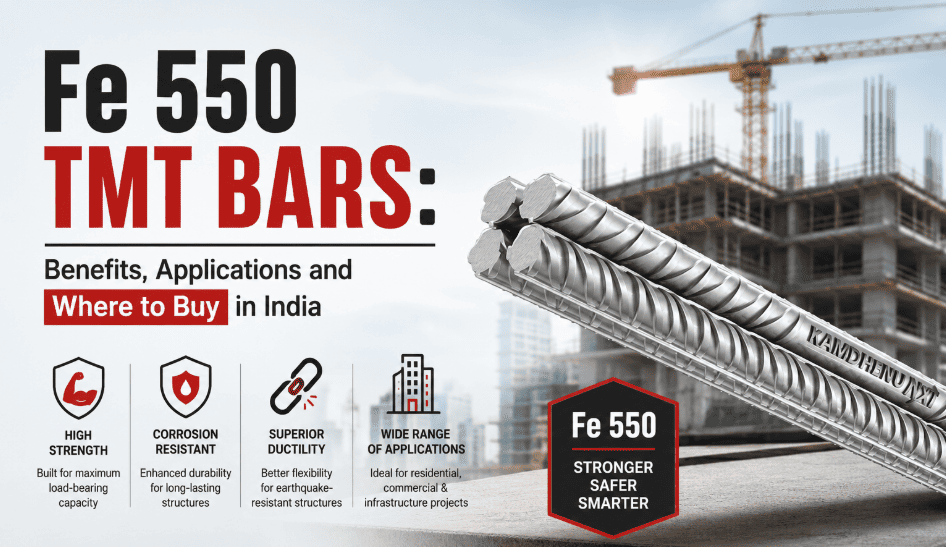
Fe 550 TMT Bars: Benefits, Applications and Where to Buy in India
Reinforcement steel plays a permanent role in the safety and performance of an RCC structure. Once the concrete has been placed, the bars become difficult to inspect, repair or replace. Selecting the correct reinforcement grade is therefore an engineering decision rather than a purchase based only on price or availability.
Fe 550 TMT bars are high-strength deformed reinforcement bars with a specified minimum yield or proof stress of 550 N/mm² under IS 1786:2008. They provide a higher strength level than Fe 500 and may support more efficient reinforcement design in suitable structures.
However, the number 550 is a strength classification, not a general quality ranking. It does not mean that Fe 550 is automatically better for every building. Concrete grade, structural loads, crack control, ductility, member dimensions and reinforcement detailing must all be considered.
This guide explains the benefits, applications, quality checks, commercial considerations and sourcing requirements for Fe 550 TMT bars in India. It also provides a practical Fe 550 vs Fe 500 comparison and explains when Fe 550D TMT may be more appropriate.
What Are Fe 550 TMT Bars?
Fe 550 TMT bars are thermo-mechanically treated steel reinforcement bars with a minimum specified yield or proof stress of 550 N/mm².
The “Fe” refers to iron, while “550” identifies the strength class. These bars have raised ribs on their surface to improve mechanical interlock with concrete.
They are commonly considered for:
- High-rise residential and commercial buildings
- Long-span structural members
- Bridges and flyovers
- Metro and infrastructure projects
- Heavy industrial foundations
- Power projects
- Large civil structures
- Congested RCC members
- Strength-optimised reinforcement designs
The structural engineer must decide whether the grade is suitable. Procurement teams should not replace another specified grade with Fe 550 TMT bars merely because they appear stronger or are available at a favourable price.
How the TMT Process Supports Performance
TMT bars are produced through a controlled sequence of hot rolling, rapid cooling, self-tempering and atmospheric cooling.
Hot Rolling
Steel billets are heated and passed through rolling stands until the required bar diameter and rib pattern are formed.
The bars leave the final rolling stand at a high temperature.
Rapid Surface Cooling
The hot bars pass through a controlled water-cooling system. The outer surface cools and hardens rapidly, while the inner core remains hotter.
Water pressure, bar temperature and cooling time must be controlled. Variation at this stage can affect the final mechanical properties.
Self-Tempering
Heat from the core moves towards the cooled outer region and tempers the hardened surface.
This creates a balance between strength and ductility.
Atmospheric Cooling
The bars then cool naturally. The inner core retains comparatively greater ductility, while the outer region provides strength.
The process allows quality Fe 550 TMT bars to combine a high yield-strength level with controlled deformation characteristics. However, the final result depends on plant discipline, steel chemistry and production consistency.
A label stating Fe 550 is meaningful only when it is supported by compliance, test results and batch traceability.
Understanding the Fe 550 Strength Grade
Under IS 1786:2008, Fe 550 has a specified minimum yield or proof stress of 550 N/mm².
This means the bar can carry a higher stress before yielding than Fe 500 at the material level. In suitable designs, the higher strength may allow the structural engineer to reduce the required steel area in certain strength-controlled calculations.
However, reinforcement design is not governed by yield strength alone. It may also be controlled by:
- Minimum reinforcement requirements
- Maximum reinforcement limits
- Crack-width control
- Deflection
- Bar spacing
- Development length
- Anchorage
- Lap requirements
- Seismic detailing
- Concrete placement needs
- Fire and durability considerations
The expected steel saving may not appear where these factors govern the design.
What Is Fe 550D TMT?
Fe 550D TMT belongs to the same 550 N/mm² minimum strength class as standard Fe 550, but it must meet enhanced ductility and elongation requirements.
The letter “D” identifies the ductility category. Higher ductility helps reinforcement undergo greater deformation before fracture.
This can be important in structures subjected to:
- Seismic forces
- Dynamic loading
- Repeated load reversal
- Impact
- Greater deformation demand
- Ductile structural detailing
Standard Fe 550 and Fe 550D TMT should not be treated as the same product. The exact grade must be shown on the bundle tag, bar marking and test certificate.
A project specifying Fe 550D TMT should not receive ordinary Fe 550 as a substitute without written engineering approval.
Main Benefits of Fe 550 TMT Bars
Higher Yield Strength
The primary benefit of Fe 550 TMT bars is their higher minimum yield or proof stress compared with Fe 500.
This can support members carrying heavier loads or designs where reinforcement efficiency is important.
Potential Reduction in Reinforcement Quantity
In certain strength-controlled designs, the higher grade may allow a lower steel area.
The actual reduction must be calculated by the structural engineer. It should not be assumed by the contractor, dealer or purchase team.
Reduced Reinforcement Congestion
Columns, beams, transfer members and foundations can become congested with reinforcement.
Where design provisions permit, high grade steel bars may help rationalise the steel quantity and create more space for concrete placement. Better spacing can support compaction, but minimum spacing and detailing requirements must still be followed.
Suitability for Demanding Structures
High grade steel bars are frequently considered for high-rise buildings, bridges, industrial facilities, infrastructure and heavy foundations where structural loads are significant.
Improved Strength-to-Weight Potential
A properly engineered higher-strength reinforcement system may improve the strength achieved for a given quantity of steel.
This benefit depends on the complete structural design rather than the grade label alone.
Reliable Bond With Concrete
The deformed surface of Fe 550 TMT bars improves mechanical interlock with concrete.
Bond performance also depends on rib geometry, concrete strength, compaction, cover, anchorage and development length.
Better Material Traceability
Branded and certified products are generally supplied with bar markings, bundle tags, test certificates and batch details.
These records support inspection, acceptance and complaint resolution.
Fe 550 vs Fe 500 Comparison
A useful Fe 550 vs Fe 500 comparison must consider strength, ductility, detailing and project requirements rather than only the grade number.
| Parameter | Fe 500 | Fe 550 |
|---|---|---|
| Minimum yield or proof stress | 500 N/mm² | 550 N/mm² |
| Common application | General RCC and building construction | Higher-load and optimised designs |
| Steel area | Standard design basis | May be lower in some strength-controlled cases |
| Standard-grade ductility | Subject to Fe 500 requirements | Subject to Fe 550 requirements |
| D-grade option | Fe 500D | Fe 550D TMT |
| Reinforcement congestion | May require a higher steel area | May support rationalisation in suitable designs |
| Selection basis | Engineer’s specification | Engineer’s specification |
| Substitution | Requires design approval | Requires design approval |
A proper Fe 550 vs Fe 500 comparison should also account for local fabrication capability, availability, crack control and established project practices.
Fe 500 may remain preferable where general RCC work, simpler detailing or a project’s approved design supports it. Fe 550 may be selected where higher loading or reinforcement optimisation offers a measurable benefit.
Neither grade should be considered universally superior.
Fe 550 vs Fe 550D TMT
Both Fe 550 and Fe 550D TMT share the same minimum strength class. The main difference is the enhanced ductility requirement of the D-grade.
| Factor | Fe 550 | Fe 550D TMT |
|---|---|---|
| Minimum strength class | 550 N/mm² | 550 N/mm² |
| Ductility category | Standard | Enhanced |
| Elongation requirement | Standard-grade requirement | Higher minimum requirement |
| Typical consideration | High-strength applications | High-strength applications requiring greater ductility |
| Seismic relevance | Depends on design | May be more suitable where enhanced ductility is specified |
| Interchangeability | Cannot replace Fe 550D without approval | Must match the exact structural specification |
The engineer should review the complete stress-strain behaviour and not only the yield-strength value.
Factors to Consider Before Buying Fe 550 TMT Bars
Structural Specification
The structural drawing should clearly state the required grade and diameter.
Never replace Fe 500, Fe 500D or Fe 550D TMT with Fe 550 solely to reduce quantity or use available stock.
IS 1786 Compliance
Buyers should confirm that the product complies with IS 1786 requirements applicable to high-strength deformed steel bars and wires for concrete reinforcement.
BIS Standard Mark
Check the BIS Standard Mark and licence details where applicable.
For significant purchases, licence information should be verified through official BIS resources.
Yield and Tensile Strength
The test certificate should report yield or proof stress and ultimate tensile strength.
These values must satisfy the declared grade.
Elongation
Elongation indicates the extent to which the bar can deform before fracture.
This is especially important when evaluating Fe 550D TMT for seismic or dynamic structures.
Chemical Composition
The chemical composition influences strength, ductility and weldability.
The test certificate may include:
- Carbon
- Sulphur
- Phosphorus
- Manganese
- Carbon equivalent
Controlled chemistry supports predictable fabrication and welding behaviour where welding is permitted.
Bar Diameter and Nominal Mass
Bars should comply with the specified diameter, theoretical mass and permitted tolerances.
Underweight bars may reduce the steel area installed in the structure. Excessively overweight bars may increase cost and congestion.
Rib Pattern
The ribs should be reasonably clear and consistent. Rib geometry supports mechanical bond with concrete.
Kamdhenu describes Kamdhenu Nxt as next-generation interlock steel with a double-rib pattern intended to improve concrete bonding.
Bend and Rebend Performance
Quality bars should satisfy the relevant bend and rebend requirements.
Bars that crack during correct bending may indicate problems with chemistry, processing or material quality.
Traceability
The supplied product should be traceable through:
- Bar embossing
- Bundle tags
- Heat or batch numbers
- Test certificates
- Dealer invoices
- Delivery documents
Unmarked loose material should be avoided where project quality control requires traceability.
Applications of Fe 550 TMT Bars
High-Rise Buildings
Fe 550 TMT bars may be specified in high-rise residential and commercial buildings where structural loads and reinforcement quantities are substantial.
Their use should be coordinated with ductility, wind and seismic design requirements.
Long-Span Beams and Transfer Structures
Long-span beams and transfer members can experience heavy bending forces and reinforcement congestion.
Higher-strength reinforcement may support an optimised design, subject to serviceability and detailing checks.
Bridges and Flyovers
Bridges, flyovers and metro structures may use high grade steel bars when required by the project design and specification.
Such projects often demand strict traceability, testing and independent quality assurance.
Industrial Plants
Heavy industrial facilities may contain machinery foundations, process structures and members carrying significant dynamic or static loads.
The reinforcement grade must be selected as part of the complete structural and durability design.
Heavy Equipment Foundations
Foundations supporting turbines, presses and other heavy machinery can contain dense reinforcement.
In suitable designs, Fe 550 TMT bars may help manage the steel area while maintaining the required strength.
Power and Infrastructure Projects
Power plants, metro systems and major infrastructure projects may specify higher-strength reinforcement for selected components.
Water-Retaining Structures
High grade steel bars may be used in large water-retaining or civil structures where approved by the structural design.
However, crack-width control often plays a major role in these structures and may limit the expected reduction in steel quantity.
Congested RCC Elements
Columns, pile caps, transfer zones and heavily reinforced joints may benefit from optimisation where higher-strength steel reduces congestion.
The final spacing must still allow proper concrete placement and compaction.
When Fe 550 May Not Be the Right Choice
Fe 550 TMT bars should not be selected only because they have a higher numerical grade.
They may not provide a meaningful advantage when:
- Minimum reinforcement controls the design
- Crack-width requirements govern
- Deflection controls the member
- Ductile detailing is the primary concern
- Bar spacing cannot be reduced further
- Local fabricators cannot reliably identify grades
- Site storage may mix different reinforcement grades
- The approved design uses Fe 500 or Fe 500D
- Supply continuity is uncertain
- The anticipated saving is commercially insignificant
In these circumstances, Fe 500D or another engineer-approved grade may provide a better balance of strength, ductility, availability and site control.
Quality Checks Before Purchase
Buyers should request the following information before approving Fe 550 TMT bars:
- IS 1786 compliance
- BIS Standard Mark and licence details
- Exact grade embossed or tagged
- Heat- or batch-linked test certificate
- Yield or proof stress results
- Ultimate tensile strength
- Elongation results
- Chemical composition
- Carbon equivalent
- Bend or rebend test results
- Nominal mass
- Dimensional tolerances
- Available diameters
- Product identification guidance
- Authorised dealer confirmation
For major projects, independent testing should be conducted according to the approved quality plan.
How to Inspect Fe 550 TMT Bars on Delivery
Check the Bar Marking
The manufacturer and grade markings should be visible along the bar.
Inspect Bundle Tags
Bundle tags should show:
- Manufacturer
- Grade
- Diameter
- Bundle weight
- Heat or batch number
Match Test Certificates
The heat or batch number on the certificate should correspond with the material supplied.
A generic photocopy without matching identification has limited value.
Examine the Surface
Bars should be inspected for:
- Loose scale
- Deep rust
- Pitting
- Oil
- Mud
- Chemical contamination
- Visible cracks
- Damaged ribs
Light surface rust may require assessment, but heavy scaling and pitting are concerns.
Check Diameter, Length and Weight
Random measurements and weight checks can help confirm that the supply matches the purchase order and permitted tolerances.
Confirm the Exact Grade
Ordinary Fe 550 and Fe 550D TMT should be stored and identified separately.
Misidentification can defeat the structural design.
Fe 550 TMT Bar Price in India
Steel prices vary with raw material costs, energy, transport, regional demand and order quantity.
Fe 550 TMT bars are commonly quoted by weight, usually per tonne. However, the base rate alone does not represent the complete delivered cost.
A commercial comparison should include:
| Cost item | What to confirm |
|---|---|
| Base steel rate | Grade-specific rate per tonne |
| GST | Included or charged separately |
| Freight | Delivery cost to the project site |
| Loading and unloading | Included or additional |
| Weight basis | Theoretical or actual weight billing |
| Diameter mix | Availability and rate differences |
| Testing | Included or arranged separately |
| Credit terms | Payment period and conditions |
| Quote validity | Period for which the rate remains valid |
| Wastage | Cutting and fabrication allowance |
India’s finished steel consumption reached 163.7 million tonnes in 2025–26, according to Ministry of Steel data cited in the source article. Price movement can therefore be significant, making procurement planning useful for long-duration projects.
Project teams should establish purchasing windows and escalation terms instead of depending on the lowest daily quotation.
How to Compare Fe 550 Commercial Quotations
Before comparing rates, confirm that every supplier is quoting the same:
- Grade
- Diameter
- IS specification
- BIS certification
- Nominal mass
- Bundle size
- Delivery location
- Tax basis
- Freight terms
- Test documentation
- Dealer support
A low quotation may reflect unverified material, limited traceability, underweight supply or excluded delivery charges.
The commercial decision should be made only after technical compliance has been established.
Where to Buy Fe 550 TMT Bars in India
Purchase Fe 550 TMT bars through an authorised manufacturer network, distributor or dealer.
Avoid loose, unmarked bars when project traceability is required. Obtain a proper tax invoice showing:
- Brand
- Exact grade
- Diameter
- Quantity
- Rate
- Dealer details
- Batch information, where available
Kamdhenu provides contact and dealer-enquiry routes for its TMT products. Kamdhenu Nxt is offered in Fe 500, Fe 550, Fe 500D and Fe 550D TMT grades.
The published range generally includes diameters from 8 mm to 25 mm, with 32 mm available against bulk demand. Buyers should confirm the current specification and local stock before ordering.
Why Choose a Reliable TMT Bar Manufacturer?
A reliable manufacturer controls more than the final bar appearance. Quality depends on steel chemistry, rolling, quenching, tempering, rib formation and testing.
A dependable source should provide:
- Clearly declared grades
- IS 1786 compliance
- BIS certification
- Consistent bar markings
- Batch traceability
- Chemical test results
- Mechanical test results
- Standard nominal mass
- Consistent rib geometry
- Authorised distribution
- Replacement and complaint support
High grade steel bars should be supported by measurable properties rather than promotional claims alone.
Kamdhenu Nxt includes Fe 550 in its published range and is described as interlock steel with a double-rib pattern. Buyers should obtain the latest product documentation from an authorised source.
Storage and Handling Tips
- Store Bars Above the Ground – Use sleepers or raised supports to prevent contact with soil, mud and standing water.
- Separate Grades and Diameters – Store Fe 500, Fe 500D, Fe 550 and Fe 550D TMT in clearly labelled areas.
- Keep Bundle Tags Attached – Do not remove identification before the material has been recorded and segregated.
- Protect Bars From Contamination – Avoid contact with salts, acids, fertilisers, oil and aggressive chemicals.
- Use Proper Lifting Equipment – Use suitable slings rather than dragging bars across the ground.
- Clean Before Concreting – Mud, oil and loose scale should be removed before the reinforcement is placed in concrete.
- Follow Approved Drawings – Bends, laps, spacing, development lengths and cover blocks must match the structural drawings.
Good material quality is wasted when reinforcement detailing or concrete workmanship is poor.
Common Mistakes to Avoid
Common mistakes when selecting and using Fe 550 TMT bars include:
- Assuming a higher grade is always better
- Selecting Fe 550 only to reduce purchase quantity
- Replacing Fe 500D without engineering approval
- Confusing Fe 550 with Fe 550D TMT
- Buying unmarked loose bars
- Ignoring BIS certification
- Accepting generic test certificates
- Comparing only the rate per tonne
- Ignoring freight and unloading costs
- Mixing grades during storage
- Failing to check nominal weight
- Accepting bars with loose scale or pitting
- Using incorrect bends or mandrels
- Ignoring crack-control requirements
- Poor concrete placement in congested members
- Losing bundle tags and traceability
Avoiding these errors helps preserve both structural safety and project value.
Frequently Asked Questions
Conclusion
Fe 550 TMT bars provide a higher-strength reinforcement option for demanding and optimised RCC designs. Their benefits may include improved load capacity, more efficient material use and reduced reinforcement congestion in suitable applications.
However, the grade should never be selected based only on its numerical strength or price per tonne. A proper Fe 550 vs Fe 500 comparison must consider ductility, crack control, serviceability and structural detailing. Where greater elongation is required, Fe 550D TMT may offer a more appropriate balance.
Buyers should purchase through authorised sources, verify IS and BIS details, check batch-linked test documents and preserve traceability from delivery to casting.
The right high grade steel bars, combined with correct engineering, storage, fabrication and concrete workmanship, can support a safer, more efficient and more durable structure.