 March 25 2026
Choose a TMT Bar Company in India for Commercial Projects
Rebar decisions are not small now.
They impact approvals.
They impact speed.
They impact safety.
India's rebar demand is also great.
Rebar sits inside "bars and rods."
That category made up 42% of India's finished steel consumption in FY24, around 59 MT.
So, the market is crowded.
So the risk of mix-ups is real.
That is why buyers search for a reliable TMT Bar Company in India.
Commercial sites need more than a rate card.
They need proof.
They need repeatability.
They need clean documentation.
This blog gives a pour-wise plan.
It is built for procurement heads.
It is also built for site engineers.
Step 1: Start with the IS 1786 discipline
In India, TMT bars are governed by IS 1786.
BIS also publishes a product manual for certification practice.
That manual is useful for buyers.
It shows what a serious inspection system looks like.
It lists common checks done in a day.
BIS highlights checks like these:
- Freedom from defects
- Deformation and surface characteristics
- Nominal size
- Effective cross-sectional area and mass
- Proof stress, elongation, tensile strength
- Bend and re-bend test
So your first filter is simple.
Ask your TMT Bar Company in India how they control these.
Then ask how they document them.
Step 2: Make traceability "pour-wise," not "project-wise"
Most projects fail traceability at the yard.
Bars from multiple lots get stacked together.
Tags tear.
Then nobody knows what went into which pour.
Use a pour-wise method instead.
Here is a simple rule.
One lot should feed one pour zone.
At least for critical members.
Examples:
- Core walls in towers
- Transfer slabs
- Column starter zones
- Shear wall boundary elements
This reduces disputes later.
It also makes testing smarter.
You can isolate problems fast.
BIS also includes a sample test certificate format.
It references rolling, mass tolerance and surface defects.
That is the mindset you need on-site.
Not casual stacking.
Step 3: Run a 20-minute "truck gate audit" every time
This is where most risk is stopped.
Do it before the unloading sign-off.
Do not do it after.
Use this checklist.
Truck gate audit checklist
- Check the PO and grade against the invoice.
- Check bundle tags and batch references.
- Take photos of tags and bundles for records.
- Measure the diameter of random bars with a vernier.
- Check ribs visually for consistency.
- Reject bundles with heavy pitting rust.
- Keep accepted bundles in a marked bay.
Now add product-specific identity checks.
This is where branded systems help.
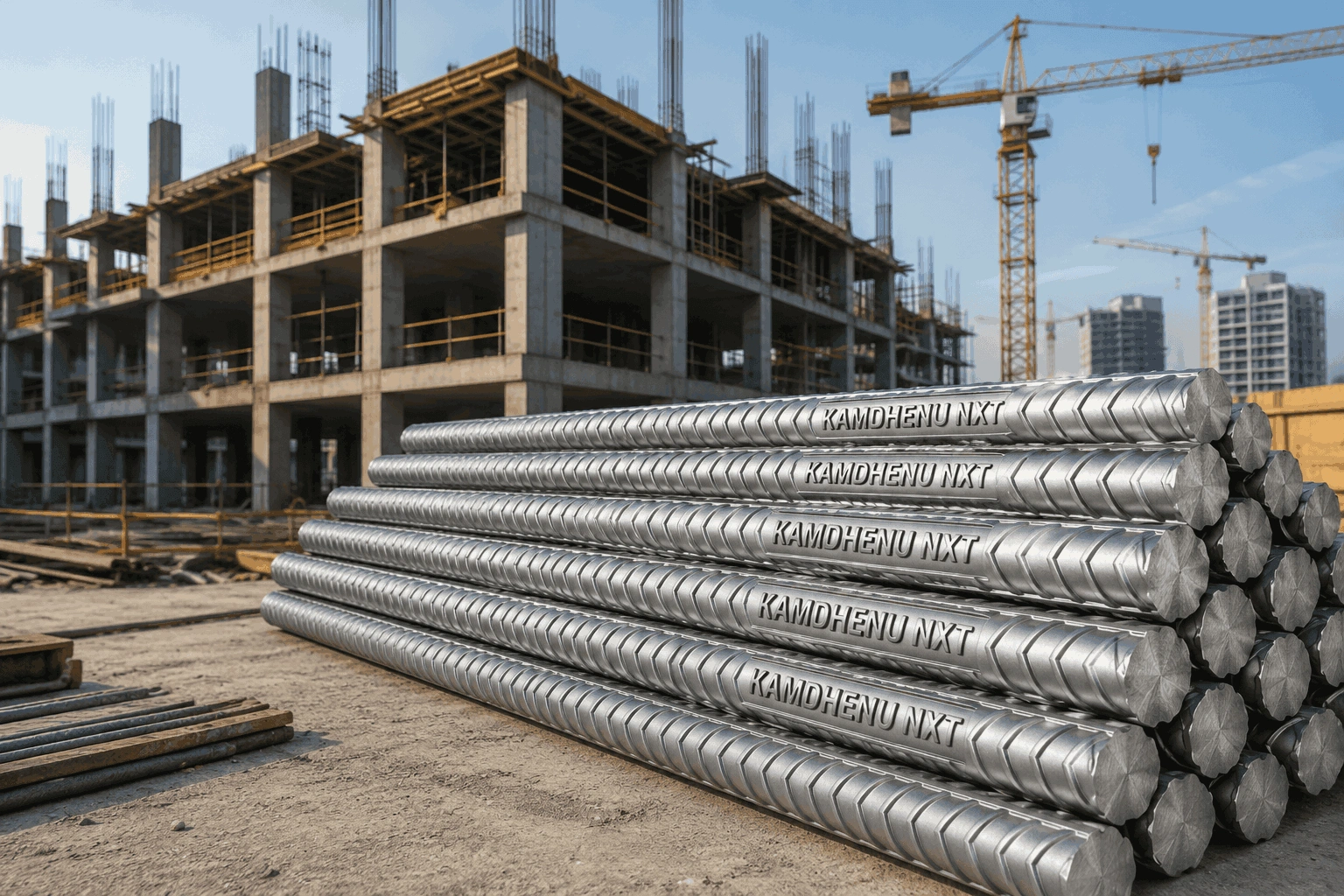
For Kamdhenu Nxt, the product page lists clear identifiers:
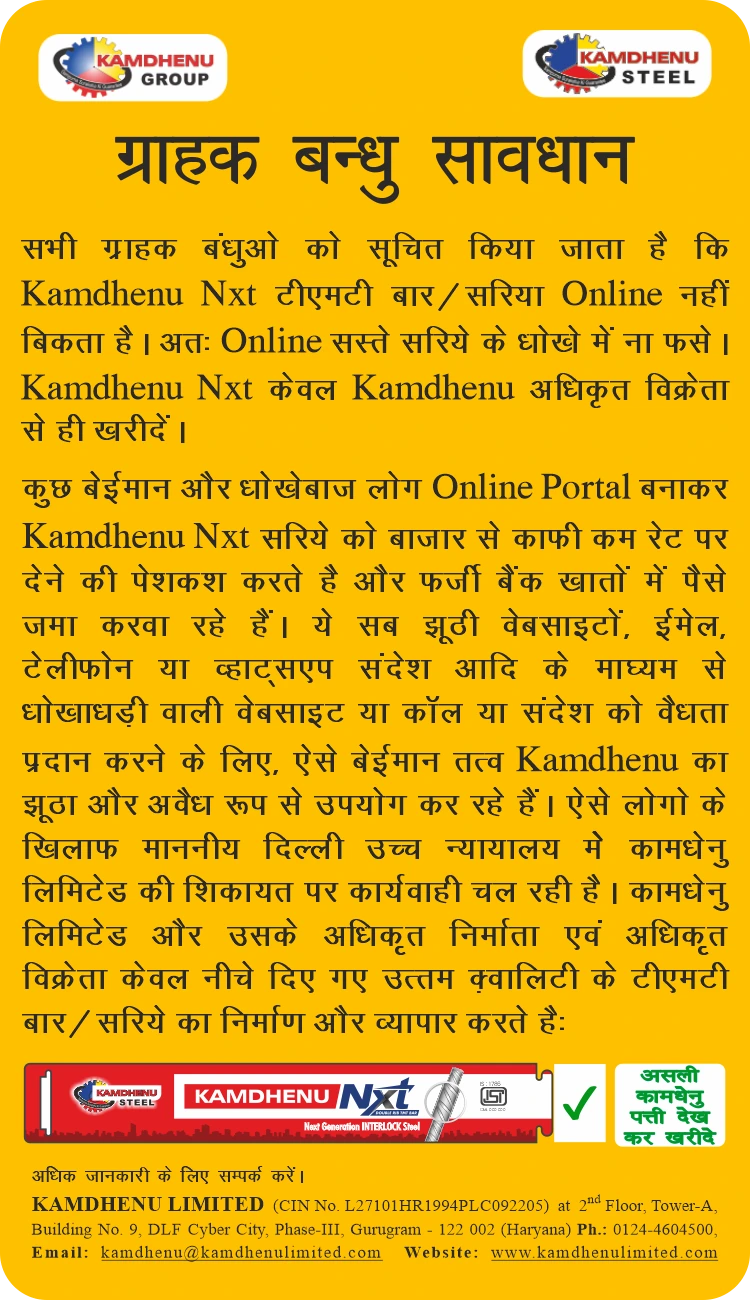
- Stamp on every meter of the bar
- A red strip on every bundle
- A QR code on the bundle strip or tag
This makes substitution harder.
It also makes audits faster.
It supports accountability.
If you are choosing a TMT Bar Company in India, ask for this level of field identity.
It saves time when the site is busy.
Step 4: Understand why rib geometry matters in RCC
Concrete is weak in tension.
Steel carries tension.
Bond transfers stress between the two.
Bond is not abstract.
It shows up as crack control.
It shows up as anchorage behaviour.
It shows up at lap splices.
Kamdhenu Nxt is described as "Next Generation Interlock Steel."
It highlights a double-rib design for superior bonding with concrete.
For commercial work, this matters at:
- Dense beam-column joints
- Wall boundary zones
- Short lap splice areas
- High shear regions with tight stirrups
Bond issues are hard to fix later.
So compare rib consistency during procurement.
Do not treat it as a cosmetic feature.
Step 5: Compare numbers that actually affect design behaviour
Many buyers focus only on yield strength.
That is incomplete.
Commercial structures need strength and ductility.
Kamdhenu Nxt lists Fe 550 values on its page:
- Yield stress minimum 565 N/mm²
- Tensile strength minimum 610 N/mm²
- Elongation minimum 14%
- TS/YS ratio ≥ 1.08
These numbers matter together.
Elongation supports deformation capacity.
TS/YS ratio supports stable yielding behaviour.
This matters in seismic zones.
And India is a seismic country.
PIB notes that about 59% of India is vulnerable to earthquakes.
So reinforcement selection is not only commercial.
It is also a safety decision.
Kamdhenu Nxt also lists chemical limits for Fe 550.
It includes carbon ≤ 0.25% and S+P ≤ 0.095%.
This matters for consistency.
It also matters for fabrication behaviour.
So when you evaluate a TMT Bar Company in India, ask for:
- Grade-wise test values
- Heat-wise test certificates for your lot
- Clear acceptance criteria for deviations
Step 6: Ask the supplier to explain their process checkpoints
Many suppliers describe outcomes.
Few describe controls.
Kamdhenu Nxt lists a step-by-step manufacturing process on the product page.
It mentions:
- Billet sampling from different lots
- Billet making through a continuous casting machine
- Thermo-mechanical treatment with controlled water cooling
- Rolling checks within tolerances
- Testing as laid down in IS 1786 with an in-house lab
- Dispatch only after "tested and OK" and certificate check
This is the level of transparency to look for.
It shows where quality is locked.
It also gives you procurement questions.
Questions to ask based on process checkpoints
- Do you sample billets lot-wise?
- Do you log cooling parameters batch-wise?
- Do you record rolling tolerances per shift?
- Do you test as per IS 1786 sampling logic?
- Do you release dispatch only after the certificate check?
A capable TMT Bar Company in India answers these cleanly.
A weak supplier avoids specifics.
Step 7: Do not ignore supply continuity and reach
Commercial projects are bought in phases.
That is where procurement breaks.
Your supplier should support:
- Multi-location supply
- Repeatable lots
- Faster replacements if damage happens
- Dealer support close to the site
Kamdhenu's Partner Program page cites a network of 10,000+ dealers and 500+ distributors.
It also lists operational claims like 24 to 48 hour delivery and 100+ manufacturing units on the same page.
For a buyer, this helps continuity.
It reduces urgent local buying.
It reduces mixing risk.
This is a practical "commercial" advantage.
It supports a schedule.
Schedule protects margin.
A clean buying flow you can copy
Use this flow for Kamdhenu Nxt.
- Freeze grade and sizes with your structural consultant.
- Ask for IS 1786-aligned documents and lot format.
- Compare specs and identity markers on the Kamdhenu Nxt page.
- Run a trial lot for one pour cycle.
- Implement the truck gate audit and yard segregation.
- Lock delivery phasing with your contractor.
- Scale to bulk supply after the first cycle.
Next Steps
If you are evaluating a TMT Bar Company in India for a commercial project, keep the decision evidence-based.
Use standards.
Use traceability.
Use site checks.
For Kamdhenu Nxt, you can use the "Request a Quote" option on the product page.
You can also reach the team through the Contact Us section of the Kamdhenu website.