 April 15 2026
Binding Wire Buying Guide for RCC Work: How to Choose the best binding wire for Faster Fixing
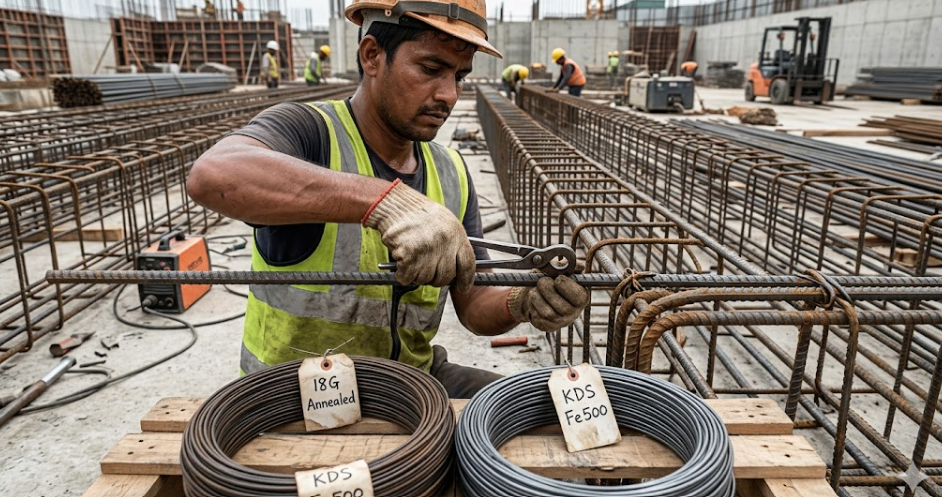
Binding Wire looks like a small purchase. It is not. It controls cage stability, bar spacing, and the speed of rebar fixing. The best binding wire reduces breakage and re-tying. It also keeps cages from shifting during concreting and vibration. That is why contractors now treat binding wire like a productivity tool, not a commodity.

Why Binding Wire selection matters more than people think
India’s RCC demand is large, and rebar work happens on every project. Rebar sits in the bars and rods category, which accounted for 42% (59 MT) of India’s finished steel consumption in FY24.
More rebar work means more tying work. When tying slows, bar fixing becomes the bottleneck. When tying quality is poor, cages move during concreting and cover can get compromised. So, the real question is not “what is the cheapest wire.” The real question is “what wire keeps work moving without failures.”
What standards should a Binding Wire buyer reference
For mild steel wire used in general engineering, IS 280 is a commonly referenced Indian standard. IS 280:2006 covers mild steel wire in a wide diameter range, from 0.125 mm to 12.5 mm, for general engineering purposes. BIS also publishes product manuals that explain grouping and certification style practices for standards like IS 280. This helps commercial buyers because it puts structure around terms like diameter, condition, and finish. It also supports vendor evaluation and documentation checks.
How to define the best binding wire for your site
The best binding wire is the wire that ties fast, stays tight, and does not snap during twisting. It must be ductile enough to form clean knots and hooks. It must also be consistent in diameter so your tying tension stays predictable. Surface finish matters too, because sharp defects cut gloves and slow work. Packing quality matters because tangled coils create waste and frustration.
Binding Wire use cases that change the wire choice
Use case decides the right diameter and condition. Different tasks need different tying strength and flexibility. If you buy one wire for everything, your site will either waste time or waste material.
Common site use cases:
-
Rebar cage tying in slabs, beams, and columns
-
Formwork ties and temporary holding
-
Masonry wall ties and general construction binding
-
Precast yard work where repeatability matters
Kamdhenu Limited lists Kamdhenu WIREBOND as suitable for reinforcement binding, masonry wall ties, and general construction.

Why Kamdhenu WIREBOND is positioned for binding work
Kamdhenu WIREBOND is described as a premium binding wire made with ultra-modern technology and manufactured to ISO 9001:2015 standards. The page highlights uniform diameter, superior surface finish, and high tensile strength as key features for safe and consistent tying. It also states standardized packing in 25 kg and 5 kg bundles with ISO seal, which is useful for handling and inventory planning on site. The FAQ section also states it is manufactured as per IS 280.
Technical table for quick procurement comparison
Use this table in your PO annexure and first-lot checks. Confirm project-specific requirements with the Kamdhenu Limited technical team and your site QA plan.
|
Parameter |
Kamdhenu WIREBOND (as listed) |
|
Standard |
Manufactured as per IS 280 |
|
Wire types |
Annealed, Soft Drawn |
|
Diameters offered |
0.71 mm, 0.90 mm, 1.12 mm |
|
Bundle packing |
5 kg and 25 kg |
|
Tensile strength (max) |
Annealed 500 N/mm², Soft Drawn 550 N/mm² |
|
Chemistry (range or max) |
C 0.10–0.20%, Mn 0.30–0.60%, S max 0.050%, P max 0.050% |
A practical checklist to evaluate Binding Wire on site
Do this once per batch and whenever a new supplier lot arrives. Keep it simple and repeatable. This is how contractors protect productivity.
Site checklist for Binding Wire
-
Check diameter consistency by measuring a few random samples
-
Twist test by hand, check snapping and brittle cracking
-
Look for surface splits, burrs, and sharp defects
-
Check coil winding quality, avoid coils that tangle easily
-
Verify bundle weight and tag integrity for store control
-
Store off the ground and keep coils dry to reduce corrosion
Kamdhenu WIREBOND positions “uniform diameter” and “superior surface finish free from splits and flaws” as benefits that directly align with these checks.

Common mistakes that make “best binding wire” irrelevant
Even good wire can fail when site practices are poor. These mistakes are common and expensive.
-
Using one diameter for every job, leading to over-tying or breakage
-
Storing coils in wet zones, causing rust and weak spots
-
Cutting wire with damaged pliers, creating inconsistent tie ends
-
Over-twisting ties, which reduces ductility and increases snapping
-
Mixing old and new coils without tag control, causing wastage and tracking issues
The fix is boring. Store discipline, tool discipline, and a short acceptance routine.
How to pick a wire diameter for typical RCC tying
Do not overcomplicate it. Use a basic mapping and adjust for cage density.
-
0.71 mm can suit lighter tying work and faster tying in less congested zones
-
0.90 mm is a common middle choice where speed and holding strength both matter
-
1.12 mm is useful when ties need more holding strength for heavier bars or tighter cages
If you are unsure, run a one-hour site trial with two diameters. Track breakage count and re-tie count. The wire with lower re-ties usually wins, even if the rate per kg is slightly higher.
Binding Wire is a small cost, but a big schedule lever
Binding wire cost is small compared to the total RCC cost. But its impact is disproportionate. Re-tying and snapping ties consume labour hours. Loose cages consume supervision time. Cage movement consumes repair time. That is why commercial teams treat binding wire choice as part of their rebar productivity plan, not as a store item.
If you want a related product view, Kamdhenu Limited also maintains pages for reinforcement bars and TMT categories used alongside binding wire procurement planning.
Conclusion
If you want Binding Wire that supports faster tying, lower breakage, and cleaner site control, start with Kamdhenu WIREBOND specifications, available diameters, and bundle formats, then raise an enquiry for availability and nearest supply support.
For commercial enquiries, use the official Kamdhenu Limited Contact Us page and share your project location, expected monthly consumption, and preferred coil size, so the team can guide supply planning for the best binding wire fit.
FAQ (Suitable for FAQ schema)
Q1. What makes a binding wire “best” for RCC work?
Consistent diameter, good ductility for twisting, clean surface finish, and reliable packing that avoids tangling.
Q2. Which standard is referenced for mild steel wire used in binding applications?
IS 280 is a commonly referenced standard for mild steel wire for general engineering purposes.
Q3. What bundle sizes help site handling and inventory control?
Smaller bundles reduce handling strain, and larger bundles support bulk planning. Kamdhenu WIREBOND lists 5 kg and 25 kg bundles.