 April 06 2026
Best TMT Bars Manufacturers In India: The 3-Layer Audit Commercial Teams Use Before Buying
Choosing the best TMT Bars Manufacturers in India is not a branding exercise. It is a risk-control exercise. One wrong lot can delay a pour. One weak document trail can delay consultant approvals. That is why procurement teams evaluate TMT Bars Manufacturers and TMT Bar Suppliers using a repeatable audit, not a one-time price comparison. This article follows the Kamdhenu Limited content rules for tone, links, and structure.

Why stronger checks matter right now
The steel market is large and active. India’s finished steel consumption in 2023–24 was reported at 136.29 MnT by PIB, citing Joint Plant Committee data. Rebar demand is also structurally important. A BMTPC and RMI report notes that bars and rods accounted for 42% (59 MT) of India’s finished steel consumption in FY24.
Add seismic exposure to this. PIB has stated that about 59% of India’s landmass is prone to earthquakes of different intensities. In this context, “lowest rate” is not the full commercial answer. The better answer is “lowest risk per pour.”
The standard baseline every buyer should reference
For reinforcement steel, India uses IS 1786. BIS publishes a product manual for IS 1786 that outlines inspection expectations and common checks like tensile properties, elongation, and bend and rebend tests.
Use this as your baseline when comparing TMT Bars Manufacturers. If a supplier cannot support standard-style documentation discipline, the risk shifts to your site team and your consultant.
Layer 1: Document Audit for TMT Bar Suppliers
This layer happens before you release a bulk PO. It filters out weak TMT Bar Suppliers early. It also keeps your buying decision defensible in internal reviews.
Ask for these three items in the RFQ stage
-
A sample batch-wise test certificate format aligned to IS 1786 practice.
-
A dispatch mapping format that links the certificate to bundle tags and delivery lots.
-
A written replacement and complaint closure process, with timelines and escalation contact.
Red flags that show up in real procurement
-
Certificates that do not mention traceable batch references.
-
Vague statements like “tested as per standard” with no format.
-
No clarity on who signs quality documents and who owns the NCR closure.

Layer 2: Process Audit used by Best TMT Bars Manufacturers in India
Good Best TMT Bars Manufacturers In India not only show outcomes. They show checkpoints. This matters because it predicts lot-to-lot consistency. It also reduces surprises when you buy in phases.
What you want to hear in plain terms is simple. Raw material checks are recorded by lot. Rolling and cooling controls are stable across shifts. Testing happens at defined frequencies. Dispatch is released only after document verification. This is not “extra.” This is what makes a supplier dependable on commercial timelines.
Where Kamdhenu NXT fits when the keyword is TMT Bars
When your discussion is about TMT bars, keep the product specific. Kamdhenu Limited presents Kamdhenu NXT as “Next Generation Interlock Steel,” highlighting a double-rib design intended to improve bonding with concrete. Bond is not a buzzword. It affects anchorage and crack control in RCC members. It also affects how reliably bars perform at laps and joints when detailing is dense.
[IMAGE: Close-up of Kamdhenu NXT rib pattern and rolled marking]
Layer 3: Site Audit at the gate (the non-negotiable layer)
Most substitution risk enters through the gate. So the site audit must happen before the unloading sign-off. This single routine saves more time than any spreadsheet debate about price.
15-minute Gate Checklist
-
Match the PO grade and diameter schedule to the invoice.
-
Check bundle tag condition and readability.
-
Take two photos: full bundle and close-up tag.
-
Measure the diameter with a vernier on random bars from at least 3 bundles.
-
Scan for deep pitting rust, heavy scaling, and visible damage from transit.
-
Record bundle count and approximate weight in a simple receiving register.
Kamdhenu Limited also has a practical site guide on identifying genuine TMT bars, including checks like ISI mark, grade, rib pattern, and a basic bend test. Use it to formalize your site SOP and reduce dependence on individual judgment.
What to verify specifically for Kamdhenu NXT at the site
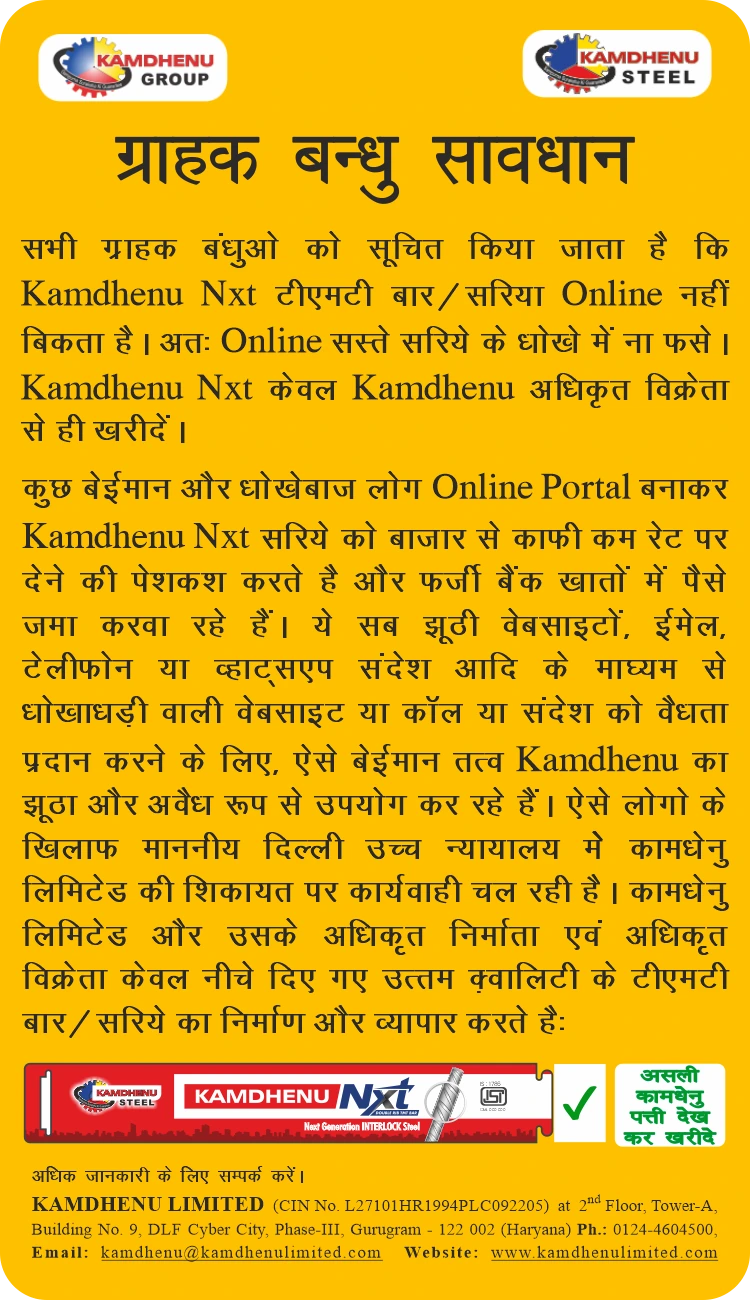
If your project has selected Kamdhenu NXT, verify the identity markers consistently. The goal is simple. Make substitution difficult and detection easy.
A practical identity checklist
-
Confirm the bar and bundle identification method described on the Kamdhenu NXT page.
-
Verify that the test certificate provided maps to the delivered batch or lot reference.
-
Do not merge any unverified material into critical cages until the traceability is resolved.
This is how commercial sites keep profits moving without later disputes.
Specification table for quick comparison
Use this table for PO annexures and first-lot comparisons. Values are taken from Kamdhenu NXT information and should be confirmed with the Kamdhenu Limited technical team during procurement.
|
Parameter (Fe 550 reference) |
Kamdhenu NXT (as listed) |
|
Minimum yield stress |
565 N/mm² |
|
Minimum tensile strength |
610 N/mm² |
|
Minimum elongation |
14% |
|
TS/YS ratio |
≥ 1.08 |
A scorecard to shortlist TMT Bars Manufacturers without debate
A scorecard keeps decisions consistent across projects and teams. It also makes your choice defensible in audits.
Suggested scorecard headings
-
Standards and documentation discipline (IS 1786 alignment).
-
Site-verifiable traceability and markings.
-
Consistency across lots and delivery phases.
-
Replacement speed and NCR closure process.
-
Local availability and supply continuity for phase-wise procurement.
This is how teams shortlist the Best TMT Bars Manufacturers in India without getting trapped in subjective arguments.
Yard controls that protect quality after unloading
Good material can become “bad practice” if the yard is unmanaged. This is common on large sites with multiple contractors.
Keep these three rules, and your rebar yard stays audit-friendly:
-
Keep stacks separated by diameter and by lot.
-
Keep bundles off the ground on sleepers, with a drainage slope.
-
Do not merge leftovers into critical zones without re-tagging and logging.
This reduces cage errors, reduces confusion, and keeps your documentation aligned with reality.
A short note on tying quality (often ignored)
Cage stability affects cover and bar position during vibration. Binding wire failures lead to loose cages and re-tying. Kamdhenu Limited’s WIREBOND page positions the product around uniform diameter and surface finish, intended to support reliable tying. This matters because re-tying is a hidden labor cost, and it increases rework risk at the worst time, right before pouring.
Conclusion
If you are evaluating Best TMT Bars Manufacturers In India, use the 3-layer audit and keep it pour-wise. Start with Kamdhenu NXT specifications and site-verification approach, then run the gate checklist on every truck. For project enquiries and bulk supply planning, contact Kamdhenu Limited through the official Contact Us page and share your grade, diameter schedule, and monthly requirement.
This is the most practical way to shortlist strong TMT Bars Manufacturers and dependable TMT Bar Suppliers without slowing your site.
FAQ (Suitable for FAQ Schema)
Q1. What is the minimum proof I should request from Tmt Bar Suppliers?
Ask for a batch-wise test certificate format and a dispatch-to-batch mapping aligned to IS 1786 practices.
Q2. How do I compare TMT Bars Manufacturers beyond price?
Compare documentation discipline, traceability, lot consistency, and replacement response time.
Q3. Why does site verification matter even with branded steel?
Because mix-ups and substitutions can happen during transit and unloading, not only at the mill.
Q4. What is the simplest anti-substitution step?
A gate checklist with photos, tag logging, and diameter sampling before unloading.